
We may earn a commission if you buy through links on this page. It never changes a score or a ranking. How we make money
The bottom line
A capable open-source analytics engine; budget for self-hosting and validate its fit with your workload.
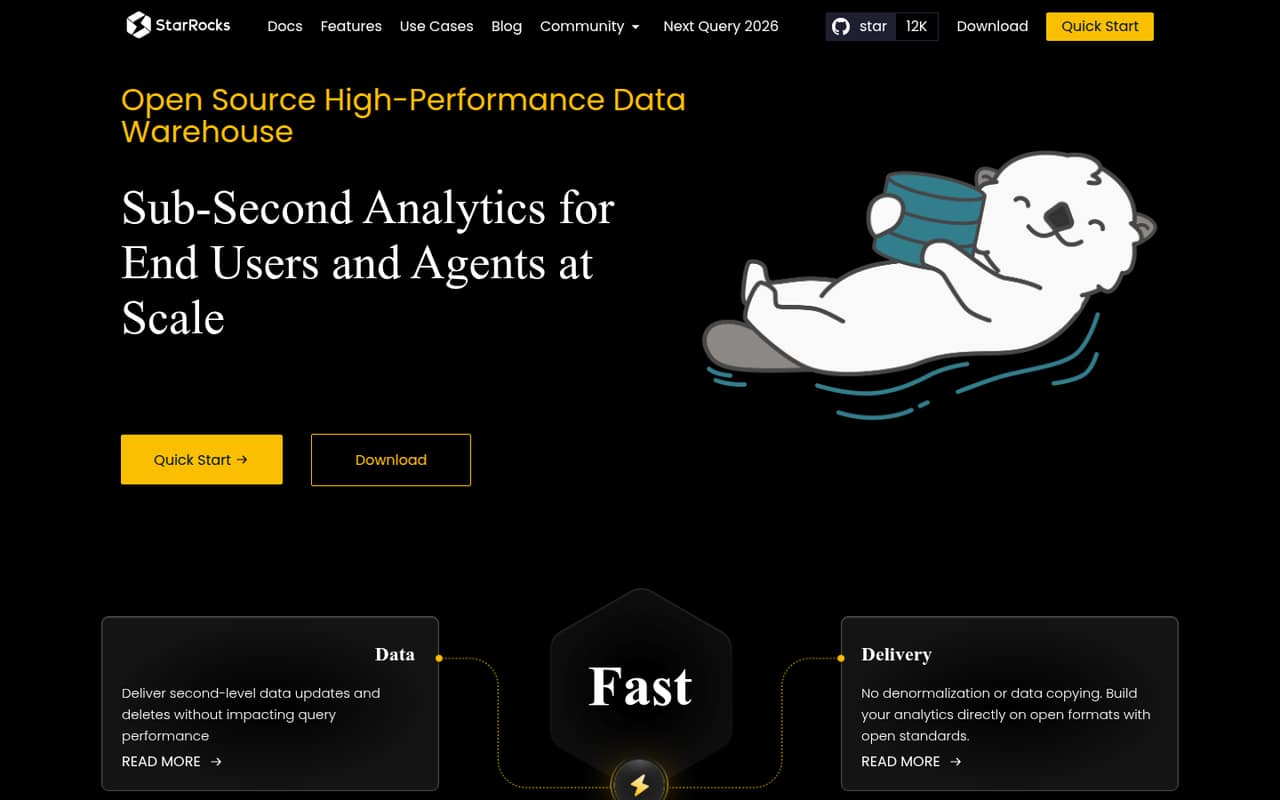
StarRocks is an open-source data warehouse aimed at real-time analytics, lakehouse queries and AI workloads. The vendor highlights fast updates and deletes, sub-second multi-table queries, and analytics on open formats without denormalization or data copying.
The self-hosted option is free to download under Apache License 2.0. That makes it worth evaluating for teams that can operate a database cluster, but the vendor does not publish pricing for managed service or infrastructure costs. Reddit reports are positive in some production cases, while other users flag bugs and operational effort.
Good fit if
- Teams running self-hosted analytics
- Real-time update-heavy workloads
- Lakehouse query deployments
Skip it if
- Teams requiring published managed pricing
- Projects needing named SDK support
- Operators without database on-call capacity
ScoresHow it rates
What works
- Free to download under Apache License 2.0
- Supports second-level updates and deletes
- Targets sub-second complex multi-table queries
- Queries open formats without data copying
- Homepage offers a Slack community
What doesn't
- No published monthly or annual rates
- Homepage does not identify SDKs or languages
- Self-hosting adds deployment and operations work
- Reddit users report bugs in self-deployed setups
- Resource isolation is a reported concern
01What StarRocks is, technically
StarRocks is an open-source data warehouse that teams can download and self-host. It is a database engine for analytical queries, not a hosted API, a client library or a command-line-only tool. In a stack, it sits between data sources and the applications, dashboards or agents that need analytical results.
The vendor positions it for real-time analytics, lakehouse queries and AI workloads. Its homepage highlights second-level updates and deletes, sub-second complex multi-table queries, and direct analytics on open formats without denormalization or copying data. It also describes serving AI agents with low latency and high concurrency, including when SQL is unoptimized.
This makes StarRocks a candidate for teams that want fresh data and interactive query performance in a warehouse layer. The deployment model means teams should account for operating the database themselves unless they choose a separate managed offering. Before adopting it, match its query and update behavior to your workload and verify how it connects to your existing data systems.
02StarRocks API, SDKs and docs
The homepage offers a Quick Start and download, and describes analytics on open formats and open standards. It does not name an API style, programming languages, SDKs, CLI, or specific data-source connectors. Treat StarRocks as a database to integrate into your data stack, then confirm supported client protocols, SDKs and languages in the vendor’s documentation before choosing an application integration.
The stated integration use cases are querying fresh data in real time and querying directly from a lakehouse. The homepage also invites developers to join a Slack community for questions and feedback. That gives teams a community channel, but it is not a substitute for confirming the exact connection method, authentication options and compatibility with their existing tools.
For an evaluation, check the Quick Start against your deployment environment and test the path from source data through ingestion or lakehouse access to the queries your application needs. The vendor’s claims about open standards do not, by themselves, establish support for a particular catalog, protocol or SDK.
03StarRocks pricing for developers
The listed Open Source option is free to download, self-hosted and under Apache License 2.0. The pricing page lists no monthly or annual rate, and the vendor does not publish billing terms for a managed or usage-based plan. There is no published starting price for paid service in the pricing information available here.
For a self-hosted deployment, free software does not mean a free production system: teams still need to plan for the compute, storage and engineering work required to run it. The vendor does not publish a usage-based rate or an overage schedule here, so we cannot calculate a cost per query, seat, node or amount of data. Nor are add-on prices listed.
Before moving beyond an evaluation, ask the vendor for current managed-service pricing, if relevant, and model your own infrastructure and operations costs for a self-hosted cluster. Get the billing unit, included resources, scaling behavior and any support charges in writing. Without those figures, the open-source download is the only price point we can state.
04StarRocks: open source, self-hosting and lock-in
StarRocks is available as a self-hosted open-source download. The listed licence is Apache License 2.0, which permits teams to inspect and run the software under that licence. The download and self-hosting option avoid requiring a hosted service for the database itself.
The homepage promotes querying open formats and open standards without data copying. That can reduce dependence on a proprietary data layout in some architectures, but it does not establish a complete export path for StarRocks-managed data. Confirm supported export formats, backup and restore procedures, and how much application SQL or schema design would need to change if you migrate away.
There is no published migration guide or data-export guarantee in the pricing details. Treat portability as a design and verification task: test a representative extract and query rewrite before committing production workloads. The open-source licence reduces licensing lock-in; it does not remove the operational work of replacing a database.
05StarRocks in production
StarRocks claims sub-second complex queries, second-level updates and deletes, and consistent performance for real-time and lakehouse workloads. Those are vendor claims, not a guarantee for a particular schema, data volume or concurrency profile. The homepage highlights SSB Flat Table and TPCDS benchmark reports; teams should review the methodology and test their own workload before sizing a deployment.
Reddit feedback includes a team that reported moving from ClickHouse to StarRocks because frequent updates were a problem, and said it was satisfied with the results. Other commenters describe the projects as buggy and say self-deployment may require help. One commenter also called out resource isolation as a gap in their experience. These are individual reports, not a reliability record.
Before production, verify high availability, backup and recovery, authentication, encryption, compliance and resource isolation against your requirements. Ask how the deployment scales under concurrent queries and updates, and who handles incidents if you use a managed service. The vendor does not publish service-level or compliance details in the homepage text.
From the threadsWhat users say
Reddit sentiment leans positive among some operators who describe production use and good results. Other commenters flag bugs, self-hosting effort and differences in workload fit, so the feedback is mixed rather than a consensus.
Extremely satisfied with the results
StarRocks handles things differently
Both projects are great. Both are changing rapidly and tbh are quite buggy, so you'll need help if you're self-deploying
Are you already on a data lake(house), where StarRocks can connect directly to your storage?
Questions people ask
What is StarRocks used for?
StarRocks is an open-source data warehouse for real-time analytics, lakehouse queries and AI workloads. The vendor highlights fast updates and deletes, sub-second complex multi-table queries, and analytics on open formats without denormalization or data copying. Evaluate those capabilities against your own schemas, data freshness needs and query concurrency.
Can I self-host StarRocks?
Yes. The listed Open Source option is free to download and self-hosted under Apache License 2.0. Self-hosting means your team is responsible for deployment and operations. Reddit commenters report that self-deployed setups can be buggy and may need help, so plan operational ownership before relying on it in production.
How much does StarRocks cost?
The Open Source option is listed as free to download. The vendor does not publish monthly or annual rates, billing terms, or an overage schedule for a paid or managed option in the pricing information available here. For self-hosting, include your infrastructure and engineering costs when estimating the total cost.
Can StarRocks query lakehouse data directly?
The vendor says StarRocks can query directly from the lakehouse and build analytics on open formats and open standards without denormalization or data copying. Confirm that your specific format, catalog and deployment are supported in the vendor’s documentation before designing around that integration.
Does StarRocks support real-time updates and sub-second queries?
The homepage claims second-level data updates and deletes without impacting query performance, and sub-second latency for complex multi-table queries. These are product claims, not workload-specific guarantees. Test with your own data shape, update rate and concurrency, and review the methodology behind any benchmark before sizing production.