
We may earn a commission if you buy through links on this page. It never changes a score or a ranking. How we make money
The bottom line
A low-friction REST API for public social data, but verify coverage and service terms first.
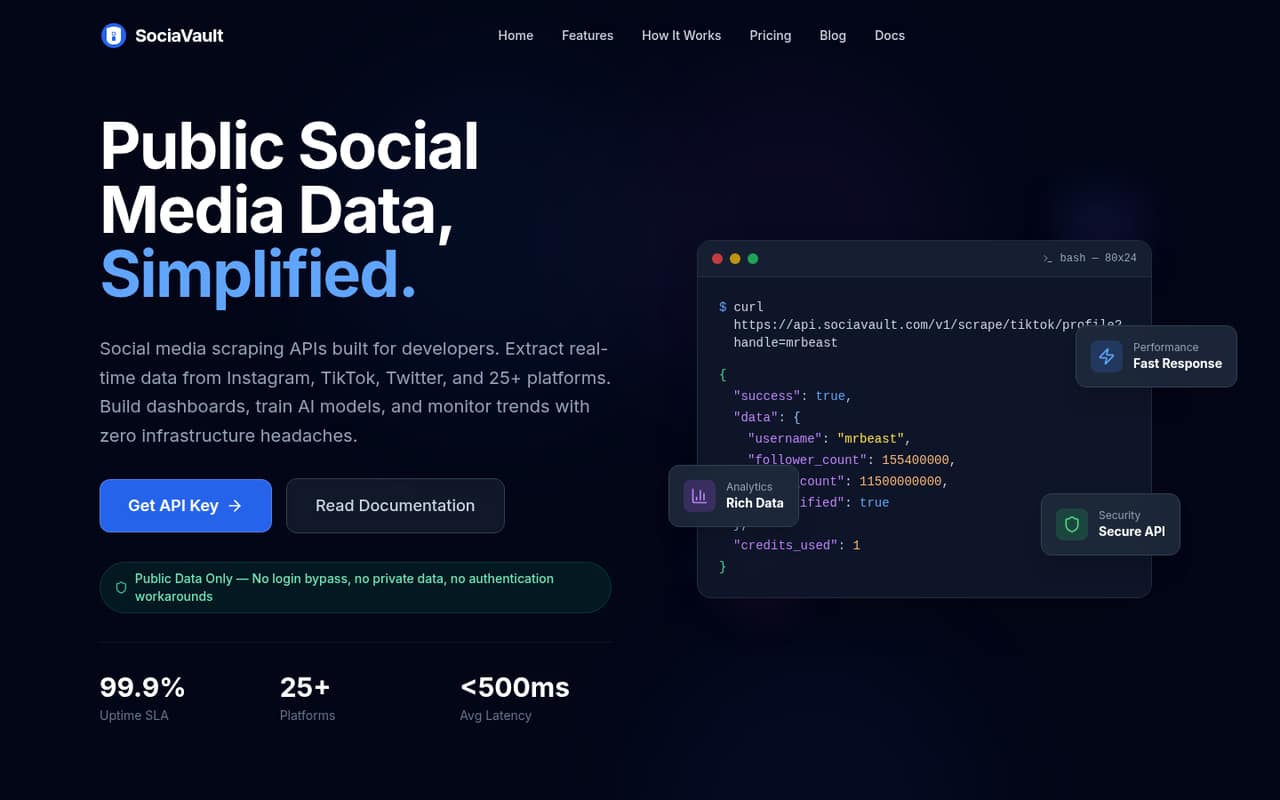
SociaVault is a hosted REST API for retrieving public social media data across 25+ platforms. It uses an API key in the X-API-Key header and returns JSON; the vendor says requests are live and credits do not expire.
The pricing page lists a 50-credit trial and one-time paid packs starting at $29. The simple integration and credit model are useful for prototypes and data pipelines, but SDK support, endpoint-specific costs and production service terms are worth confirming before committing.
Good fit if
- Prototyping social-data pipelines
- Public profile and engagement research
- Teams wanting a hosted REST API
Skip it if
- Private or login-gated data collection
- Teams requiring self-hosted infrastructure
- Projects needing documented SDKs
ScoresHow it rates
What works
- REST API uses a single API-key header
- 50 free credits; no card required
- One-time packs; credits never expire
- Vendor lists 25+ platform integrations
- JSON responses suit dashboards and pipelines
What doesn't
- SDKs and supported languages are not named
- Paid pack prices beyond the starting price are unpublished
- No self-hosted option or open-source license is published
- No rate limits is a vendor claim to verify
- Reddit evidence is limited to an MCP announcement
01What SociaVault is, technically
SociaVault is a hosted REST API, not a library, CLI product or self-hosted server. It sits between your application and public social-platform data: your service sends an HTTP request with an API key, and SociaVault returns JSON. That makes it a data-ingestion dependency for analytics dashboards, competitor monitoring, influencer research, market research and AI or ML pipelines.
The vendor says one API covers 25+ platforms, with data such as profiles, posts, comments and engagement metrics. Its homepage describes responses as live rather than served from a cache. SociaVault also says it does not access private data or bypass logins, so it is not a route to authenticated or login-gated content. The API can reduce the work of building and maintaining platform-specific scrapers, but the integration still depends on the endpoints and data fields available for each platform. Confirm that coverage against your target platforms and use case before making it a core data source.
02SociaVault API, SDKs and docs
The integration surface is a REST API: send an HTTP request, pass your key in the X-API-Key header and handle JSON. The homepage gives a curl example for a TikTok profile endpoint and says the API works with curl, Postman or a language of your choice. It also describes consistent JSON response shapes across endpoints.
The homepage links to documentation, but does not name language-specific SDKs, a CLI, webhooks or framework integrations. Confirm SDK support and endpoint-specific request and response schemas in SociaVault’s docs before choosing a client library; otherwise, plan to call the HTTP API directly. The vendor says one request usually costs one credit, but qualifies that as applying to most endpoints. Check the cost and required parameters for each endpoint you intend to call. A Reddit post also describes an MCP server for querying SociaVault data with natural-language commands, but the post is not an SDK compatibility or support guarantee.
03SociaVault pricing for developers
The pricing page lists a free trial of 50 credits with no card required; SociaVault does not list a recurring free plan. Paid packs are one-time purchases, not monthly or annual subscriptions, and credits never expire. The listed starting price is $29, but prices for the other packs are not published on the vendor's site.
The Starter Pack includes 6,000 credits. Growth includes 20,000 credits and is listed as 18% cheaper per credit than Starter; Pro has 75,000 credits and is 45% cheaper per credit; Enterprise has 200,000 credits and is 58% cheaper per credit. All include full REST API access and all platforms. Pro adds priority support and onboarding; Enterprise lists dedicated support and an SLA, with custom integrations on request. The vendor says most endpoints use one credit per request, so usage drives the bill; confirm endpoint costs before estimating production volume. The vendor advertises no hidden multipliers and no subscription, but does not publish add-ons or overage terms. Ask how requests that fail or return partial data are charged.
04SociaVault: open source, self-hosting and lock-in
SociaVault is offered as a hosted REST API. The vendor does not publish an open-source license or a self-hosted deployment option, so teams should treat it as a hosted dependency unless SociaVault confirms otherwise. The API’s JSON responses can be consumed by your own storage and data systems, but the vendor does not publish a bulk export feature or a data-portability process in the available product details.
Migration away would mean replacing the SociaVault calls with another provider’s API or your own collection pipeline. The HTTP interface and JSON payloads keep the client-side integration relatively conventional, but endpoint paths, schemas and platform coverage may not map directly to another service. To reduce lock-in, store the data your application needs in your own systems and isolate SociaVault calls behind an internal adapter. Before adoption, ask about retention, deletion, export, and whether your collected data remains accessible after credits are exhausted or the account is closed.
05SociaVault in production
SociaVault’s homepage advertises a 99.9% uptime SLA, average latency below 500 ms, unlimited concurrency and no per-minute caps. These are vendor claims, not a substitute for reviewing the SLA, endpoint-specific limits and remedies for downtime. The vendor also says responses are pulled live, which makes upstream platform availability and changes relevant to your request path. Build retries, timeouts, monitoring and a plan for missing or changed fields into the consuming service.
The homepage says access uses an API key and that SociaVault does not bypass logins or access private data. It does not publish detailed security or compliance commitments in the available material. Ask about key rotation, data handling, retention and applicable compliance requirements before sending sensitive workloads. A Reddit post announces an MCP server for querying profiles, posts, videos and engagement metrics; it is not a report of production reliability or user experience. Confirm support response expectations and Enterprise SLA terms directly before making the service a critical dependency.
From the threadsWhat users say
The available Reddit signal is thin: one post announces an MCP server and describes its data access. It offers no independent report on reliability, pricing or support, so sentiment is inconclusive.
SociaVault MCP Server
Instagram, TikTok, Twitter/X, Threads, YouTube, Facebook, and Reddit
directly through natural language commands
profiles, posts, videos, and engagement metrics
Questions people ask
Does SociaVault offer a free plan?
SociaVault lists a 50-credit free trial with no card required, rather than a continuing free plan. The vendor says credits are used for API requests and that most endpoints cost one credit per request. Check the cost of your chosen endpoints before estimating how far the trial will go.
How much does SociaVault cost?
The listed starting price is $29 for a one-time credit pack. The Starter Pack includes 6,000 credits; larger packs include 20,000, 75,000 and 200,000 credits, with lower per-credit prices stated for each. Prices for those larger packs are not published on the vendor's site.
Does SociaVault have rate limits?
The homepage claims there are no per-minute caps or concurrency limits, and says credits are the only limit. Treat that as a vendor claim and confirm endpoint-specific limits and production terms in the docs or with support, especially if your workload depends on high concurrency.
What data can SociaVault retrieve?
SociaVault describes its coverage as public data across 25+ platforms, including profiles, posts, comments and engagement metrics. The homepage lists services such as Instagram, TikTok, YouTube, Facebook, Twitter/X, Reddit, Pinterest and Google. It says it does not access private data or bypass logins.
Can I self-host SociaVault or use an SDK?
SociaVault is presented as a hosted REST API, and the homepage shows HTTP and curl requests with an X-API-Key header. The vendor does not publish a self-hosted deployment option or name language-specific SDKs in the available product details. Confirm SDK availability and deployment choices with SociaVault.