
We may earn a commission if you buy through links on this page. It never changes a score or a ranking. How we make money
The bottom line
A low-friction, pay-per-result API for public X data, but not a self-hosted or SDK-led stack.
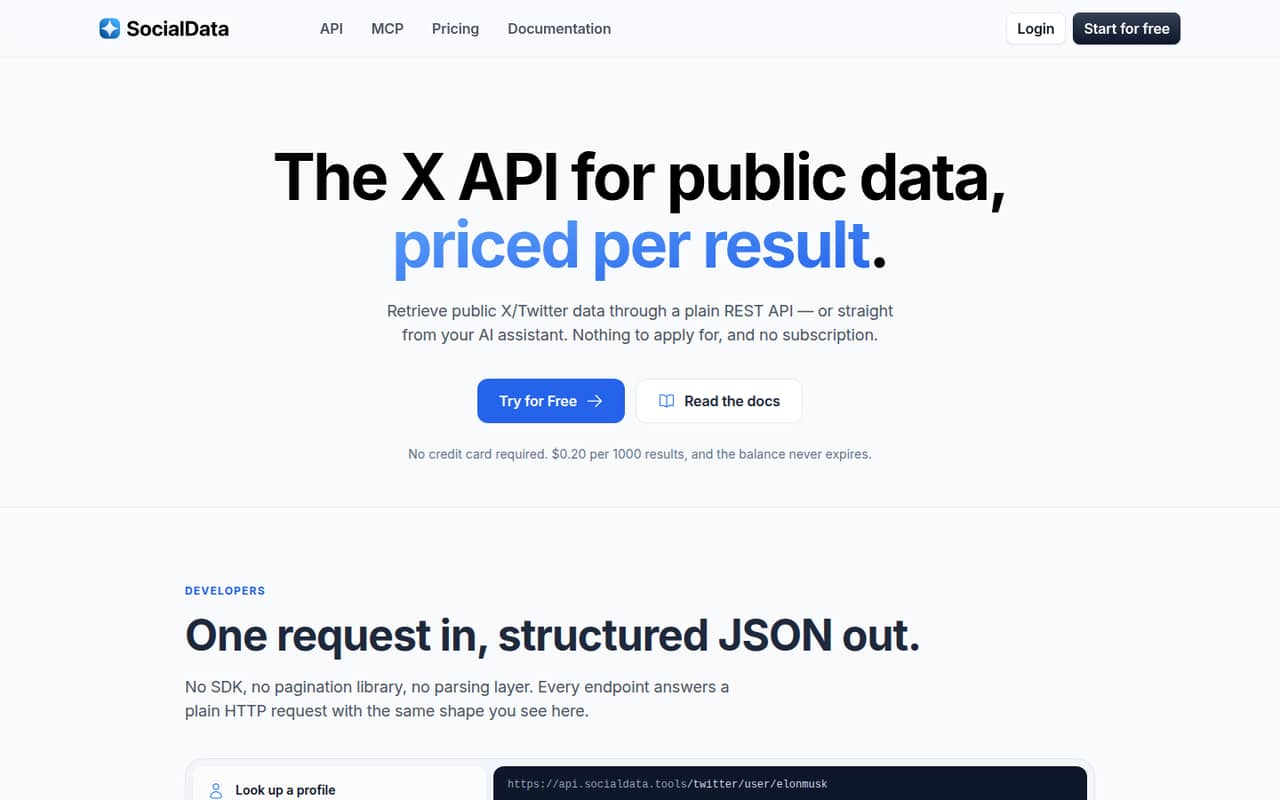
SocialData is a hosted REST API and MCP server for retrieving public X data as structured JSON. It is read-only, uses a bearer token, and charges for results rather than a recurring subscription. The homepage lists profiles, posts, search, followers and more among its data sources.
Most endpoints cost $0.20 per 1,000 results, and prepaid balance does not expire. The plain HTTP integration keeps setup simple, but the service has no SDK, and buyers should verify rate limits, uptime expectations and data-export needs before building a production dependency.
Good fit if
- Apps that need public X data
- AI assistants using MCP tools
- Variable-volume research and monitoring
Skip it if
- Teams requiring self-hosted infrastructure
- Projects dependent on vendor SDKs
- Workflows that need write access to X
ScoresHow it rates
What works
- Plain REST requests return structured JSON
- 14 read-only tools are available through MCP
- Most endpoints cost $0.20 per 1,000 results
- Prepaid balance does not expire
- Failed requests do not consume balance
What doesn't
- No SDK or pagination library is offered
- Standard rate limit is 120 requests per minute
- Custom rates and monitor pricing are not published
- Source availability and licence are not published
- Uptime and service-level commitments are not published
01What SocialData is, technically
SocialData is a hosted API service for retrieving public X (formerly Twitter) data. It offers a REST API and an MCP server; it is not a client library, a self-hosted server or a tool for posting to X. Applications make HTTP requests to SocialData and receive structured JSON, which can then feed an app, data pipeline, research workflow or dashboard.
The service targets teams that need public posts, profiles, follower information, search results and other public X data without building a scraping stack or connecting an X account. The homepage says requests are served against live data. Authentication uses one bearer token across endpoints, with no OAuth flow described. That places SocialData between an application and its X data source: your code asks the hosted service for results, then handles storage, analysis and downstream delivery. The service is read-only, so it does not post on a user's behalf.
02SocialData API, SDKs and docs
The main integration surface is a REST API: send a plain HTTP request with a bearer token and an Accept: application/json header, then handle the JSON response. The homepage shows a curl example for search and says requests also work from Postman or an HTTP client. It describes consistent response shapes and lists an API reference with endpoint parameters and response details. The homepage also advertises more than 30 endpoints beyond its examples, including lists, spaces, communities, threads, quotes and retweeters.
SocialData says it has no SDK and no pagination library. The homepage does not name language-specific SDKs, so confirm SDK support in the vendor's docs before choosing a language-specific integration. Cursor pagination and date ranges are mentioned for research datasets; build pagination into your own client. For AI workflows, an MCP server exposes 14 read-only tools for users, tweets, search and followers. The homepage names Claude Code, Codex, Cursor and Windsurf, and shows an HTTP transport setup command.
03SocialData pricing for developers
SocialData uses prepaid, per-result billing rather than a subscription, seat fee or monthly reset. The pricing page lists $0.0002 per tweet or profile result on most endpoints, equivalent to $0.20 per 1,000 results. Prepaid balance does not expire, and failed requests do not consume it. The homepage advertises a free allowance with no credit card required; the listed limit is up to 3 requests per minute. There is no separate free plan or published monthly free-result quota in the pricing details.
The standard rate limit is 120 requests per minute. Estimate spend from returned results, not just request count, and account for the limits on each endpoint before scaling collection. Add-ons can change the bill: extended bio lookup is $0.001 per request, while follow, retweet and reply checks cost $0.004–$0.008 per check. Search monitors cost $0.0002 per empty execution plus $0.0002 per delivered tweet. User monitors use unpublished hourly rates, with automatic volume discounts. Custom lower rates are available by contacting support, but the vendor does not publish their rates or usage limits.
04SocialData: open source, self-hosting and lock-in
SocialData is presented as a hosted service accessed through its REST API and MCP server. The homepage does not offer a self-hosting route. The vendor does not publish source availability or a licence on the vendor's site, so teams that need auditable code or permission to run a fork should ask SocialData directly before adopting it.
The API returns structured JSON, and the homepage says research datasets can retain source IDs and timestamps. It also mentions cursor pagination and date ranges, which can help build an external archive. The vendor does not describe a bulk-export feature, so plan to retrieve and store the records you need in your own system. Migrating away means replacing the API calls and MCP tools with another data source; your application can reduce coupling by keeping SocialData-specific response handling behind an internal adapter.
05SocialData in production
The published standard rate limit is 120 requests per minute, with a free allowance of up to 3 requests per minute. Check the endpoint-level limits and plan capacity around both request volume and result volume; the vendor says MCP calls have the same rates and limits as equivalent REST calls. Per-result billing makes large searches and recurring collection worth monitoring, while failed requests do not consume balance.
The service describes responses as live data, but the vendor does not publish uptime figures or service-level commitments in the published material. Confirm availability, support response times, retention and recovery terms before making it a critical dependency. Authentication relies on a bearer token, so store it as a secret and restrict its exposure in logs and client-side code. The API is read-only and covers public data; verify that your collection and retention practices meet your own privacy and compliance requirements. For resilience, consider recording returned IDs and timestamps and handling rate-limit errors in your client.
Questions people ask
What does SocialData cost?
The pricing page lists $0.0002 per tweet or profile result on most endpoints, or $0.20 per 1,000 results. Users pay from a prepaid balance that does not expire; there is no subscription or seat fee. Some checks and monitoring features have separate charges, and custom rates are available by contacting support.
Does SocialData have a free tier?
The homepage advertises a free allowance with no credit card required. Pricing details list up to 3 requests per minute for that allowance. SocialData does not list a separate free plan or a monthly free-result quota, so confirm any expected free usage with the vendor before relying on it.
Which data can I retrieve with SocialData?
SocialData provides access to public X data, including posts, profiles, followers and search results. Its homepage also lists endpoints for items such as lists, spaces, communities, threads, quotes and retweeters. The API is read-only; it does not post to X or require a connected X account.
Does SocialData offer SDKs or an MCP server?
SocialData says its REST API has no SDK and uses plain HTTP requests that return JSON. It also offers an MCP server with 14 read-only tools for users, tweets, search and followers. The homepage names Claude Code, Codex, Cursor and Windsurf as supported assistant integrations.
What are SocialData's rate limits?
The standard rate limit is 120 requests per minute. The free allowance is listed at up to 3 requests per minute. The homepage says MCP calls use the same rates and limits as equivalent REST calls. Check endpoint-specific documentation and ask the vendor about custom limits before estimating production throughput.