
We may earn a commission if you buy through links on this page. It never changes a score or a ranking. How we make money
The bottom line
A real-time HTAP database for teams trading some portability for one engine.
SingleStore is a database engine for transactions, analytics and AI context, with data queryable as it is written. Its HTAP approach suits applications that need current operational data and analytical queries without moving data between separate systems.
The trade-off is workload fit and portability. Reddit users report mixed results against PostgreSQL, and a SingleStore employee says the storage format is not open. Evaluate with representative queries and confirm licensing, export paths and production costs before committing.
Good fit if
- Real-time analytics on operational data
- AI agents querying current business data
- Teams consolidating mixed database workloads
Skip it if
- Workloads that need open storage formats
- Simple applications suited to one PostgreSQL instance
- Teams requiring published SDK or API specifics
ScoresHow it rates
What works
- Combines transactions and analytics in one engine
- Queries data as it is written
- Supports relational SQL and multiple data models
- Analyst queries the live database in plain English
- Connects operational data to Apache Iceberg
What doesn't
- Storage format is not open, per an employee
- Reddit users report feature and compatibility trade-offs
- Workload-specific performance needs a representative evaluation
- Vendor does not publish SDK details on its homepage
- Managed production costs rise with hourly usage
01What SingleStore is, technically
SingleStore is a database engine offered as a managed service. It combines online transaction processing and analytics in one HTAP system, so applications can query data as it is written rather than relying on a separate warehouse copy. It sits in the data layer beneath applications, dashboards and AI agents that need current business data.
The engine supports relational SQL, JSON, time-series, full-text, vector and geospatial data. The homepage describes millisecond response as its operating goal and says data can be written and queried in the same second. Those are product claims, not a guarantee for every schema or workload; validate latency and throughput with your own query mix.
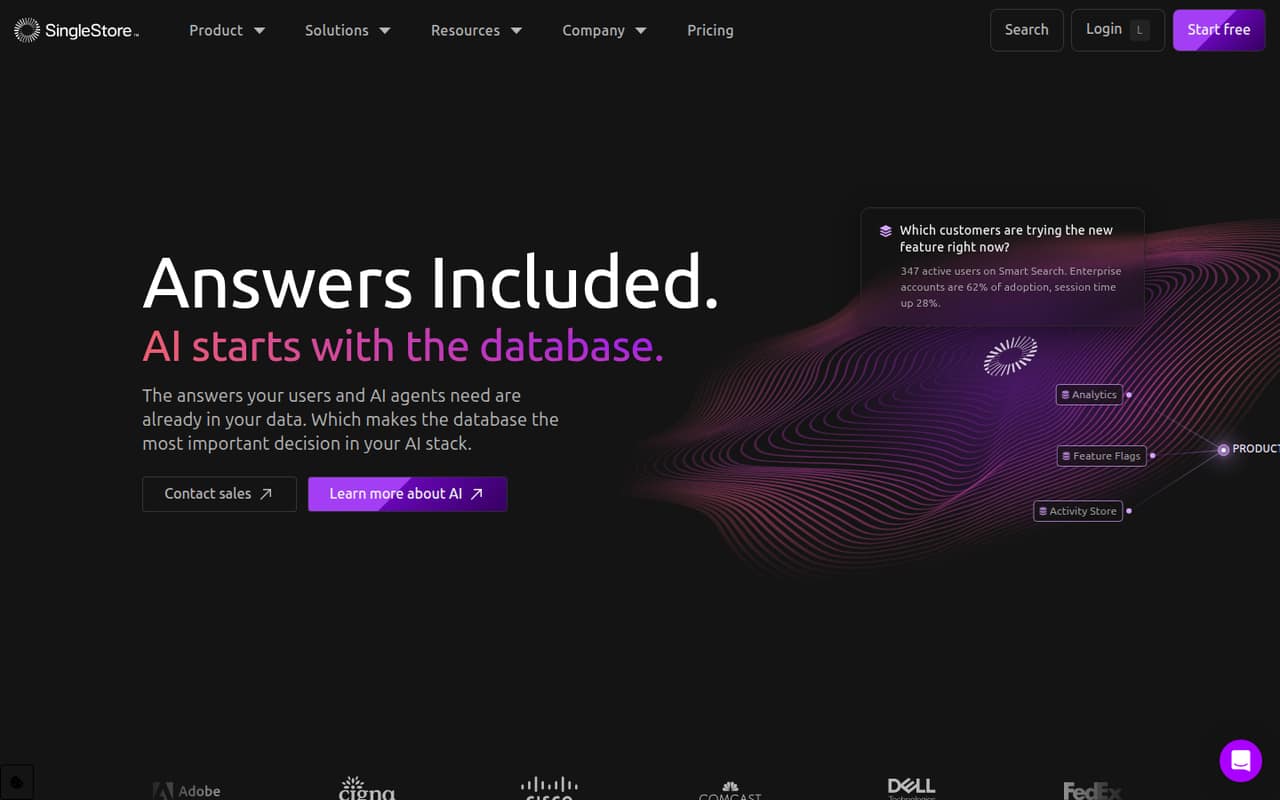
For AI use, Aura Intelligence includes Analyst, which takes plain-English questions and executes planned queries against the live database, and a Context Engine that maps schemas, relationships and definitions. Iceberg connectivity links operational data to Apache Iceberg formats.
02SingleStore API, SDKs and docs
The integration surface named on the homepage is SQL: SingleStore describes a relational database, and its Shared plan includes SQL and programmability features. Analyst adds a natural-language path for querying the live database. The homepage does not name a REST API, CLI, language SDK or specific driver, so confirm the supported connection methods and SDKs in the vendor’s developer docs before choosing a stack.
The product also connects to Apache Iceberg, which gives teams an open-format path for data exchange. The homepage does not enumerate other integrations or provide implementation details for that connection. Ask the vendor which Iceberg catalogs, formats and workflows are supported for your deployment.
For evaluation, confirm that the documentation covers your language, connection pooling, schema changes, retries and observability needs. Teams moving an existing application should test its SQL features and compatibility rather than assume a drop-in replacement for another database. Database branching is listed on Standard, while Shared includes monitoring and self-support.
03SingleStore pricing for developers
SingleStore’s Shared plan costs $0 per month and includes one free workspace, a shared workspace, SQL and programmability features, monitoring and self-support. The vendor does not publish a free-tier usage limit in the pricing details here, so check workspace capacity, compute and storage limits before using it for a sustained workload.
Managed production editions bill by the hour. Standard starts at $0.99/hr and lists read replicas, database branching, 30-day monitoring and a 99.9% or 99.99% SLA. Enterprise starts at $1.49/hr and lists online PITR, Smart DR, audit logging and CMEK. These are starting rates, not fixed monthly totals: compute hours and storage usage affect the bill, and the page lists no annual rates.
Optional SingleStore Flow has a pricing example of $3.96 per credit and $0.02/GB processed. Storage examples list $0.023/GB and $0.025/GB, varying by example and region. SingleStore says it does not charge for data ingress, though cloud-provider charges may apply.
04SingleStore: open source, self-hosting and lock-in
Reddit commenters say SingleStore’s core engine is open source and can be run in a container, but the licensing terms are not established in those discussions. Confirm the current licence and permitted production use with the vendor before treating self-hosting as an option. The available pricing details describe managed Shared, Standard and Enterprise editions; they do not establish a supported self-hosted production offering.
A SingleStore employee says the storage format is not open, which can make migration harder than moving data between systems that share an open storage format. The homepage presents Apache Iceberg connectivity as a way to connect operational data to an open format, but that does not establish a complete export or recovery path. Ask how to export data, schema and change history, and test that process before storing critical workloads. The homepage’s claim of avoiding catalog or vendor lock-in should be assessed against those practical migration requirements.
05SingleStore in production
The pricing page lists a 99.9% or 99.99% SLA with Standard, depending on the selected offering, and Enterprise includes online point-in-time recovery, Smart DR, audit logging and customer-managed encryption keys. Confirm which SLA applies to your configuration, how recovery objectives work, and whether the security controls meet your requirements. The listed 30-day monitoring is a Standard feature; Shared includes monitoring but no stated retention period.
The homepage positions SingleStore for millisecond responses, but real performance depends on the workload. One Reddit user reports comparable performance to PostgreSQL in a test but says SingleStore had fewer features and less compatibility. Another commenter cautions that a benchmark using simple, highly compressible data may not predict other workloads. Build a proof of concept with representative data, write rates and queries.
Check transaction semantics, capacity scaling, storage costs and export procedures before production. A Reddit commenter affiliated with SingleStore says regular transactions provide READ COMMITTED isolation and SNAPSHOT is available for backup; verify current behavior in the vendor’s docs.
From the threadsWhat users say
Reddit sentiment is mixed: some users value the open-source core for evaluation, while others question portability, compatibility and workload-specific performance. The discussions also contain workload-specific advice rather than a consensus that one database replaces every part of a stack.
The core engine is open source, you could always spin up a container to test it
In my tests with our real use case, SingleStore had comparable performance to PostgreSQL, with a vast reduction in features and compatibility
Our storage format is not open. I will be the first to agree that this is suboptimal for certain use cases
This is exactly the kind of workload we’re built for: high ingest (100GB/day), low-latency dashboards, and AI on fresh operational data in one engine
Questions people ask
What is SingleStore?
SingleStore is a database engine for transactions, analytics and AI context. It uses an HTAP approach to support operational writes and analytical queries in one engine, with data queryable as it is written. Its supported data models include relational SQL, JSON, time-series, full-text, vector and geospatial data.
Is SingleStore open source?
Reddit commenters describe the core engine as open source and say it can be run in a container. A commenter who identifies as a SingleStore employee says the storage format is not open. Confirm the current licence, production-use rights and self-hosting support with the vendor before relying on those options.
Does SingleStore support AI applications?
SingleStore positions its database for AI agents that need current business data. Aura Intelligence includes Analyst, which accepts plain-English questions and executes queries against the live database, and a Context Engine that maps schemas, relationships and definitions. The database also supports vector data, according to the product facts.
Can I connect SingleStore to Apache Iceberg?
Yes. SingleStore says it connects real-time operational data to Apache Iceberg. The homepage does not detail supported catalogs or workflows, so confirm those requirements with the vendor and test the data paths you plan to use.
What isolation levels does SingleStore support?
A Reddit commenter identifying as a SingleStore employee says regular transactions provide READ COMMITTED isolation and SNAPSHOT is available for backup. Confirm the current transaction behavior and any workload-specific constraints in the vendor’s documentation before migrating applications that depend on particular isolation semantics.