We may earn a commission if you buy through links on this page. It never changes a score or a ranking. How we make money
The bottom line
Extensive SEO and local data APIs, but opaque pricing and subscription gates complicate planning.
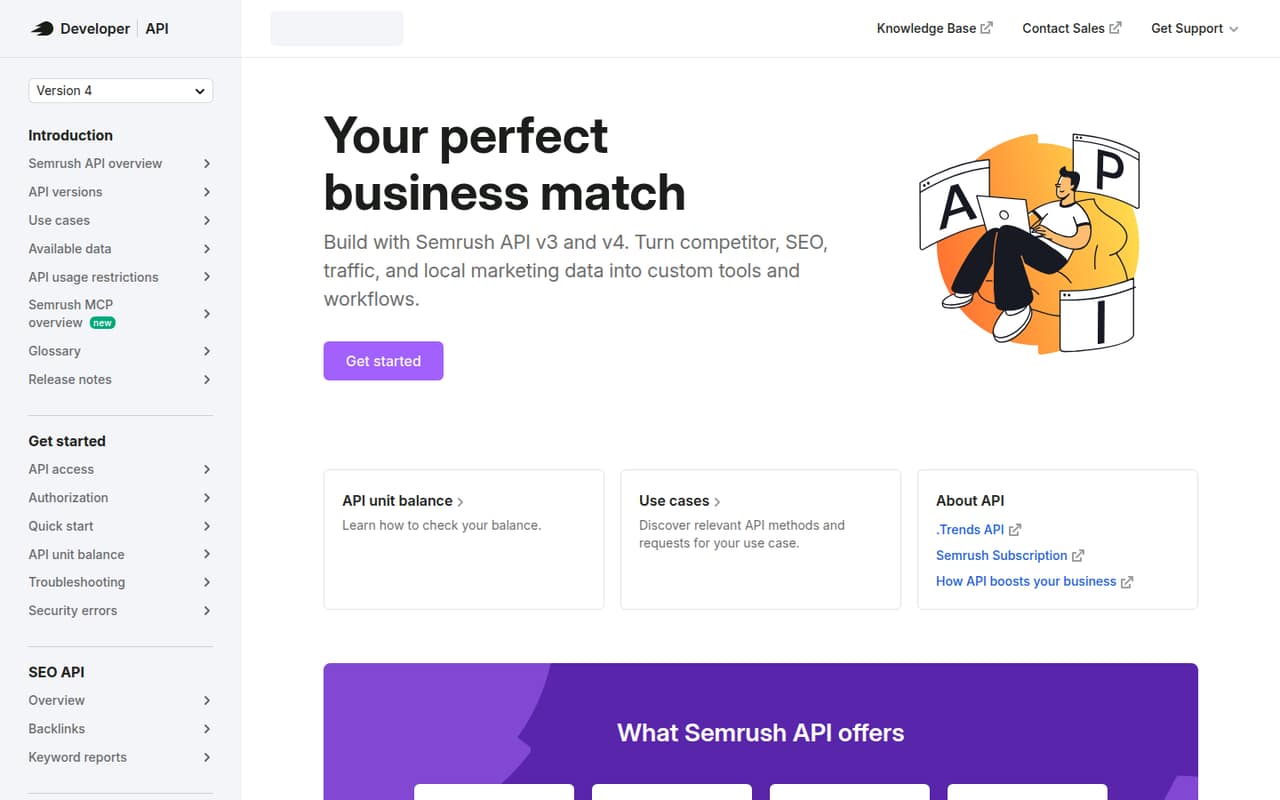
Semrush API is a hosted set of data APIs for SEO, traffic, projects, local marketing, rank tracking and enterprise visibility workflows. The docs cover authentication, request construction, response handling, filtering and endpoint references, plus a Semrush MCP server for AI tools.
The range is useful for teams building reporting or internal marketing tools, but pricing is a material constraint: Standard API has no included units, unit package prices are unpublished, and some APIs require separate subscriptions or custom quotes. We would confirm total cost and rate limits before making it a production dependency.
Good fit if
- SEO platforms needing broad data coverage
- Teams managing local listings by API
- Enterprise brand visibility reporting
Skip it if
- Teams needing predictable published pricing
- Projects requiring self-hosted data services
- Small tools without a Semrush subscription
ScoresHow it rates
What works
- SEO, traffic, project, local and enterprise APIs
- Detailed endpoint references for major workflows
- OAuth 2.0 access tokens and API keys
- MCP setup guides for several AI tools
- Map Rank Tracker API does not consume API units
What doesn't
- Standard API includes zero API units
- API unit package prices are unpublished
- Several APIs require separate subscriptions
- No published SDK or language list
- No published uptime or service-level commitment
01What Semrush API is, technically
Semrush API is a vendor-hosted set of HTTP APIs that exposes Semrush data and account operations to custom applications. It is not a client library, command-line product or server you install in your own infrastructure. The APIs sit behind the reporting, data-processing or marketing tools your team builds, with authentication and requests handled by your application.
The coverage includes keyword, domain, backlink and competitive search data; Trends API traffic and market data; project creation and management; local listings, reviews and Google Business Profile data; rank tracking; and enterprise brand visibility, mentions, sentiment, citations and raw responses. The Projects API supports creating, retrieving, updating and deleting projects. Position Tracking API endpoints cover campaign, keyword and reporting operations. This makes the product a data layer for SEO platforms, internal dashboards and local marketing workflows. You still need to build the application logic, storage, scheduling and user experience around it.
02Semrush API API, SDKs and docs
The docs describe HTTP requests, methods, parameters, responses, status codes, filtering and error handling. Authentication options include API keys and OAuth 2.0 access tokens. There are quick-start instructions for obtaining a key, constructing and testing a call, then retrieving and processing data. References cover endpoint-specific inputs and outputs across SEO, Projects, Position Tracking, Local and Enterprise APIs.
The docs do not name a language-specific SDK or a general-purpose CLI; confirm SDK support in Semrush's current documentation before choosing a stack. They do list a Semrush MCP server, with setup guides for Claude, Claude Code, Microsoft Copilot, ChatGPT, Cursor, VS Code, Gemini, Antigravity, Perplexity, Lovable and Notion. Antigravity CLI setup is also listed. That MCP surface targets AI-tool access; it is separate from integrating the data APIs into a conventional application. Expect to write and maintain your own API client unless Semrush confirms a supported SDK for your language.
03Semrush API pricing for developers
Semrush does not list a free plan or public monthly API prices. Standard API has zero API units included and requires an eligible Semrush subscription. Calls consume units per response: the pricing information lists 10 units per line for live keyword data and 50 units per line for historical keyword data. Standard API units are sold in packages of 2,000,000, 5,000,000, 10,000,000 or 20,000,000, but package prices are not published.
Trends API Basic and Premium each include 10,000 requests per month and allow up to 10 requests per second per account. Basic is an add-on; Premium is available by custom quote and includes 16 additional data types. Extra Trends API requests or units can be purchased, with prices not published. Local API requires Local Pro or Local Business and does not consume API units. Map Rank Tracker API is available to Semrush account users without a specific subscription and does not consume units. Enterprise API v4 requires an Enterprise subscription, is custom quoted and does not consume API units. Get a quote for the exact mix before forecasting production spend.
04Semrush API: open source, self-hosting and lock-in
Semrush API is documented as a hosted service, not an open-source package or self-hosted server. Semrush does not publish an open-source licence or a self-hosting option for these APIs. You make requests to Semrush and build your own systems around the returned data.
The API references provide ways to retrieve data, but Semrush does not publish a general data-export or migration guarantee for API customers. Before adopting it, decide which data your application will retain, how you will store responses and whether your contract permits the retention and reuse your product needs. Migration effort depends on how tightly your code couples Semrush-specific fields, metrics and units to internal models. Keep a provider-neutral schema and isolate Semrush request logic behind an adapter if you may switch data vendors. Do not assume another provider's metrics are interchangeable.
05Semrush API in production
The clearest published request limit is for Trends API: up to 10 requests per second per account, with 10,000 requests per month included on Basic and Premium. Standard API usage consumes units per response, and the docs include API unit balance, consumption limits, insufficient-unit errors, partial-line handling and query logs. Enterprise API documentation also has a rate-limiting section, but confirm the applicable limits with Semrush before sizing a workload.
The docs cover API keys, OAuth 2.0, suspicious requests, blocked IP addresses and unavailable regions. We found no published uptime commitment or compliance details in the API overview, so ask Semrush about service levels, data handling and support terms before relying on it for a customer-facing service. Developers on Reddit report that renewal costs can become a problem at higher usage; one agency poster said its renewal math had stopped working. That is anecdotal, but it reinforces the need to model unit consumption and renewal pricing.
From the threadsWhat users say
The Reddit material is skeptical about API costs, with posters describing budget pressure and renewal concerns. It offers little feedback on implementation quality, so sentiment on developer experience remains unclear.
the renewal math finally broke for us this year
paying hundreds every month just isn't happening anymore
DataForSEO is definitely the gold standard
Questions people ask
What can I build with Semrush API?
The APIs provide SEO, keyword, domain, backlink, competitor, traffic and market data, plus project management, local listings, review, Google Business Profile and rank tracking operations. Enterprise API v4 covers brand visibility, mentions, sentiment, citations and raw responses. You provide the application, storage and workflows that use the data.
Does Semrush API require a Semrush subscription?
Standard API requires an eligible Semrush subscription. Local API requires a Local Pro or Local Business subscription, and Enterprise API v4 requires a Semrush Enterprise subscription. Map Rank Tracker API is available to Semrush account users without a specific subscription. Trends API is available as an add-on.
How does Semrush API authentication work?
The docs list API keys and OAuth 2.0 access tokens as authorization options. They also provide quick-start instructions for getting an API key and constructing a request. Check the documentation for the authentication method supported by the specific API and endpoint you plan to use.
Are Semrush API calls rate limited?
Trends API Basic and Premium allow up to 10 requests per second per account and include 10,000 requests per month. Standard API calls consume API units per response. Enterprise API has a rate-limiting documentation section; ask Semrush for the current limits that apply to your account and workload.
Can I self-host Semrush API or use it without Semrush?
Semrush API is a hosted service, not a self-hosted server or open-source library. Most API access depends on a Semrush account or a qualifying subscription, and specific products have additional access requirements. If you need to change providers later, store data in your own systems and isolate Semrush-specific fields behind an adapter.
Sources
- Semrush API homepage
- Semrush API pricing, compiled via web search from ryandoser.com, cloro.dev, justpricing.com, semrush.com, seoinformatica.com
- Reddit: I tested 5 Semrush API alternatives over 6 weeks! Here's my honest writeup of what actually held up:
- Reddit: What are the best Semrush API alternatives right now?
- Reddit: Semrush API vs Ahrefs API
- Reddit: SEMrush API