
We may earn a commission if you buy through links on this page. It never changes a score or a ranking. How we make money
The bottom line
A straightforward hosted gateway for routing models, with costs and service limits to confirm.
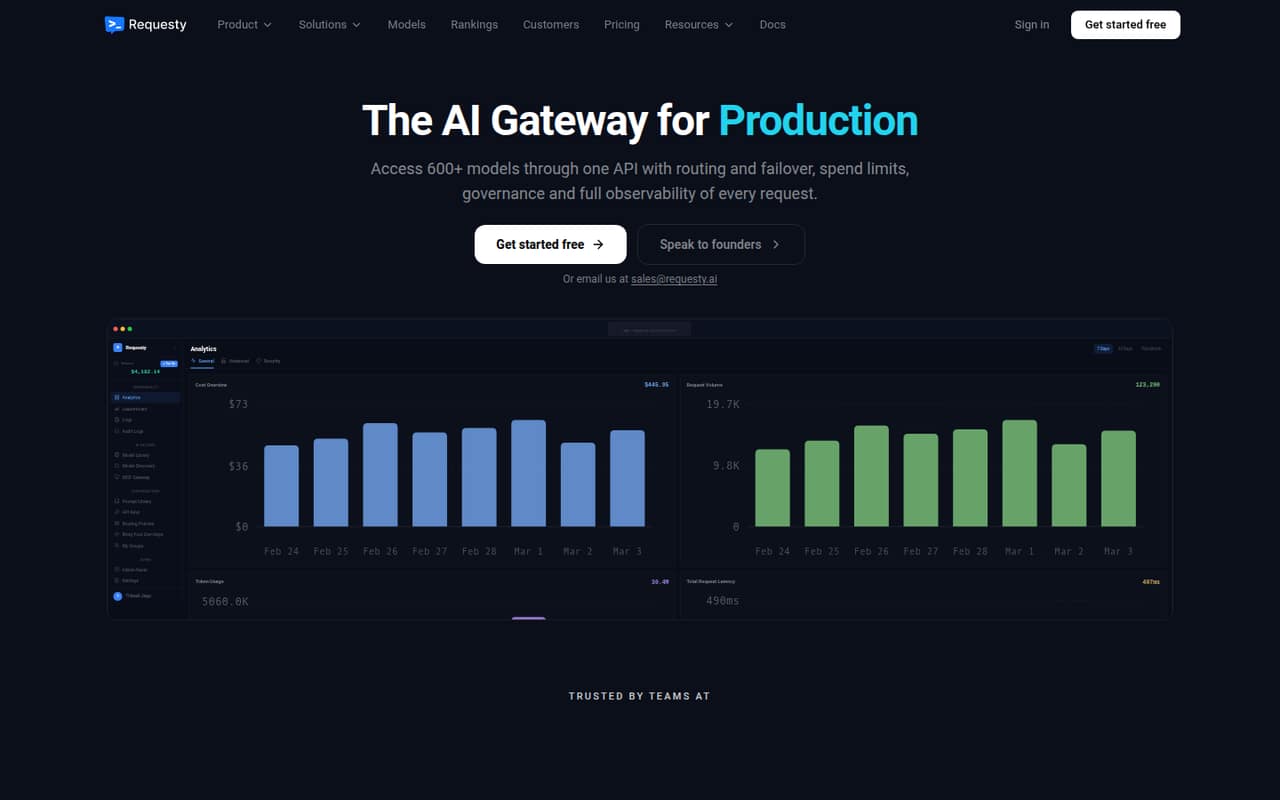
Requesty is a hosted AI gateway that puts an OpenAI-compatible API between an application and 600+ models. It combines routing, failover, spend controls and request-level observability, with governance features for model access, regions and PII.
The integration path is familiar if your application already uses the OpenAI SDK. The Free plan is capped at 200 requests per day; Pay as you go adds a 5% markup on model spend. Requesty does not publish gateway rate limits or a self-hosting option, so confirm those details before relying on it at scale.
Good fit if
- Teams routing across multiple model providers
- Apps needing fallback without custom retry logic
- Organizations centralizing AI spend controls
Skip it if
- Teams requiring self-hosted infrastructure
- Workloads needing published rate limits
- Projects unwilling to pay a model-spend markup
ScoresHow it rates
What works
- OpenAI-compatible API and familiar SDK integration
- Routing policies cover latency, geography and traffic shares
- Automatic failover handles provider errors and rate limits
- Per-request visibility into tokens, cost and latency
- Monthly spend limits apply to keys, users, teams and organizations
What doesn't
- Pay as you go adds a 5% model-spend markup
- Free plan is limited to 200 requests per day
- Gateway rate limits are not published
- Open-source licence and self-hosting option are not published
- Reddit discussion raises concerns about payment processing and USD billing
01What Requesty is, technically
Requesty is a hosted AI gateway and SaaS control plane, not a model, SDK or self-hosted server. An application sends model requests to Requesty’s OpenAI-compatible API; Requesty routes them to a provider and model according to configured policies. Its advertised catalog covers 600+ models.
That places Requesty between application code and model providers. The gateway offers routing by policy, latency, geography or traffic share, plus automatic failover when a provider errors or rate limits. It also centralizes monthly spend limits and request-level observability, including model, provider, tokens, cost, latency and finish reason. Governance features include model and region access rules, PII scanning and SSO.
The architectural tradeoff is centralization: teams can manage provider choices and controls in one service rather than implementing them separately. In return, requests and gateway-specific configuration depend on Requesty’s hosted service. The vendor describes regional routing and EU data residency, but teams should verify the exact regions and controls that apply to their deployment.
02Requesty API, SDKs and docs
The integration surface is an OpenAI-compatible API at https://router.requesty.ai/v1. The homepage’s Python example uses the OpenAI Python SDK, sets base_url to that endpoint and passes a Requesty API key. It then calls chat.completions.create with a provider-qualified model name. Requesty says the API works with any SDK and names Python, Node.js and cURL as integration options.
You can change the model in a request and configure routing policies in Requesty’s app. The vendor says failover and load balancing are handled by the gateway, so application code does not need its own retry logic for those routes. Routing options include traffic shares, latency, geography and automatic selection.
The homepage does not name a CLI or list specific Node.js packages. Confirm SDK support, endpoint compatibility and request behavior in the vendor’s docs before standardizing on an integration. Teams should also check how model-specific parameters, streaming and errors behave through the gateway; these details affect compatibility even when the API follows the OpenAI format.
03Requesty pricing for developers
Requesty has three plans. Free costs $0 per month and includes all free models, routing, caching, fallbacks and EU data residency, with a limit of 200 requests per day. It requires no credit card. That makes it suitable for evaluation or small experiments, but the daily cap makes it a poor fit for steady production traffic.
Pay as you go is usage-based and adds a 5% markup on model spend. It includes access to 600+ models, bring-your-own keys, spend limits, budget caps and the MCP Gateway. The pricing page does not list a monthly or annual billing schedule, a separate per-request fee, or a minimum spend. Confirm how the markup applies when using your own provider keys.
Enterprise pricing is custom. It adds SSO, full RBAC, audit logs, teams, groups, spend controls, guardrails, PII detection, dedicated support and custom SLAs. No add-ons are listed. Requesty does not publish gateway rate limits or overage pricing, so ask about both before estimating a production bill.
04Requesty: open source, self-hosting and lock-in
Requesty does not publish an open-source licence or a self-hosting option. Treat it as a hosted service unless the vendor confirms otherwise; teams that require a deployable gateway should ask directly about source availability and deployment rights. Data-export options are also not published, so confirm how to export logs, audit records and configuration before adopting it.
The OpenAI-compatible API can reduce application migration work: a client already using the OpenAI SDK can point to a different base URL and select another model. That does not make the full setup portable. Routing policies, spend controls, governance rules and observability data are Requesty-specific surfaces, and the vendor does not describe an export path for them. Keep model calls behind an application-owned interface and document gateway configuration if you want a cleaner exit.
05Requesty in production
Requesty advertises automatic failover when a provider errors or rate limits, plus regional routing and request-level cost, token and latency tracking. It says teams can set monthly hard limits by API key, user, team or organization. The homepage also advertises 99.25% success with fallback policies, but that figure is not a published uptime SLA. Enterprise includes custom SLAs; the terms are not listed publicly.
The vendor describes EU routing through Frankfurt, US routing through Virginia and APAC routing through Singapore. Its Free plan includes EU data residency, while the pricing page lists gateway limits and a 200-request daily cap for that tier. Requesty does not publish general gateway rate limits, so confirm throughput, timeout, retry and incident-handling expectations before moving production traffic.
A Reddit thread about buying credits raises a procurement concern: commenters objected to Stripe and USD billing when looking for a European alternative. A Requesty representative said the company was evaluating payment options and that most payments were transfers with invoicing. That exchange is not evidence about runtime reliability, but payment and currency details may matter to EU buyers.
Questions people ask
Is Requesty compatible with the OpenAI API?
Requesty describes its gateway as OpenAI-compatible and gives an endpoint at https://router.requesty.ai/v1. Its example uses the OpenAI Python SDK with a Requesty API key and a provider-qualified model name. Confirm model-specific parameters, streaming behavior and error handling in the vendor’s docs.
How does Requesty handle provider failures?
Requesty says it can move a request to another model when a provider errors or rate limits. You configure a fallback chain or routing policy in the gateway, which the vendor says avoids putting retry logic in your application. Confirm how retries, timeouts and errors are handled for your models.
Can Requesty keep EU requests in the EU?
Requesty lists EU data residency on its Free plan and describes routing EU requests through Frankfurt. The homepage says teams can choose a region with the base URL. Confirm which models and providers support the residency requirements you need, and whether the controls cover logs and other stored data.
What are Requesty’s production rate limits?
Requesty’s Free plan is limited to 200 requests per day. The vendor does not publish general gateway rate limits in its pricing information. Ask Requesty about account-level throughput, burst behavior and any provider-specific limits before sizing production traffic.
Can I use my own model-provider keys?
Yes. Requesty lists bring-your-own keys as a Pay as you go feature. That plan also lists a 5% markup on model spend. Confirm with the vendor how the markup is calculated when provider keys are your own, and how provider billing and Requesty billing are separated.