
We may earn a commission if you buy through links on this page. It never changes a score or a ranking. How we make money
The bottom line
Relay.app makes human-reviewed automations easy to build, but check its status before depending on it.
Relay.app is a hosted, no-code workflow automation service that connects business apps, adds built-in AI steps and pauses for human input or approval. Its visual editor supports branches, merged paths, subflows and iterators; plans meter workflow steps and AI credits.
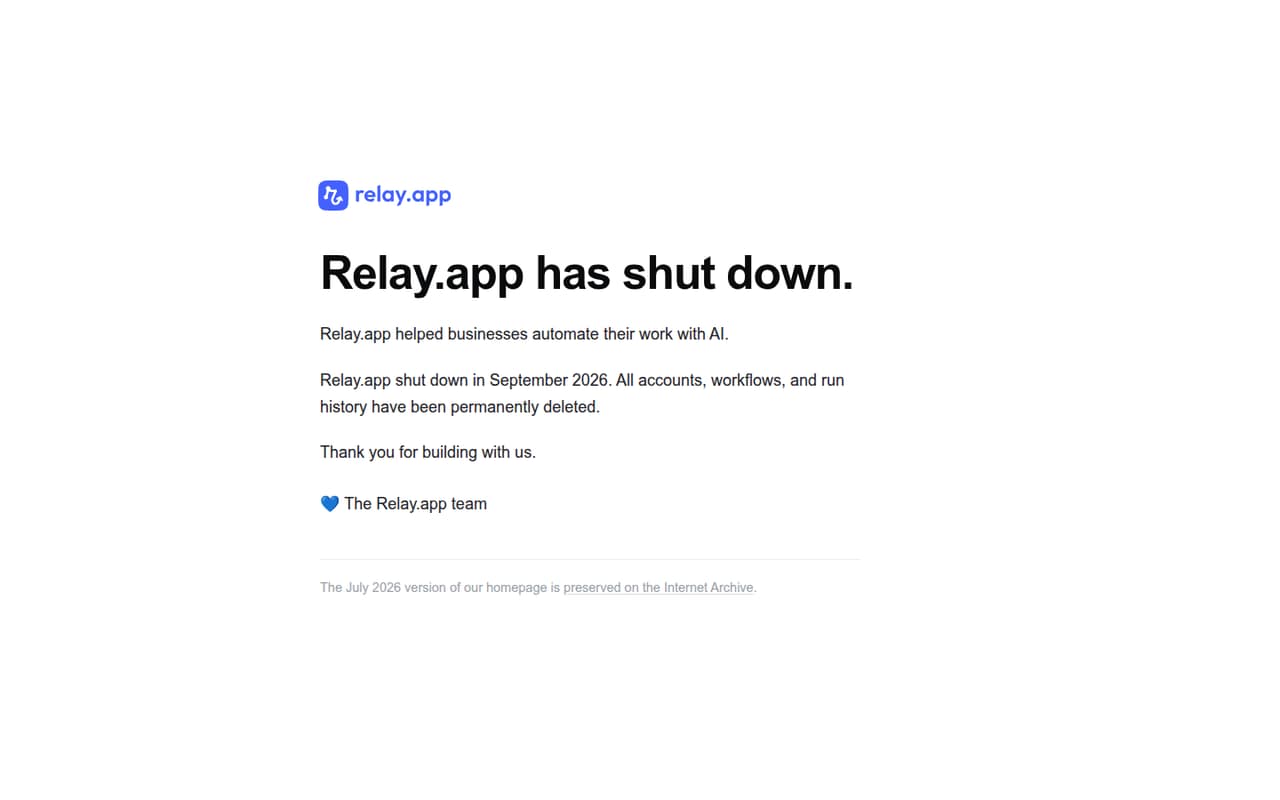
The interface and workflow features draw praise in Reddit discussions, but a thread reports users received an email about Relay.app shutting down. That is a material risk for new projects: verify the service’s status and export options before moving production workflows onto it.
Good fit if
- Human-reviewed business workflows
- Teams using supported SaaS integrations
- No-code workflow builders
Skip it if
- Self-hosted automation stacks
- Projects needing published SDKs
- Workflows requiring proven long-term availability
ScoresHow it rates
What works
- Human review pauses for approval, edits or missing input
- Built-in GPT-4o, Claude and Gemini steps
- Visual branches, merged paths, subflows and iterators
- Triggers include schedules, app events and webhooks
- Native tables and shared team credentials
What doesn't
- Closed-source and hosted-only
- No named SDK, programming language or CLI
- Workflow-step overage rates are not published
- Export and migration paths need confirmation
- A Reddit thread reports shutdown emails
01What Relay.app is, technically
Relay.app is a cloud-based, no-code SaaS application for connecting software and coordinating multi-step business processes. It sits between the apps a team already uses: triggers start a workflow, actions move data or call connected services, and conditional paths control what happens next. The product combines those actions with built-in AI and human checkpoints, so a workflow can pause for review, approval, edits or missing input before continuing.
The visual editor supports branches, merged paths, subflows and iterators for lists. Connectors handle nested and linked data structures, and native tables store structured records inside Relay.app. Workflows can start from app events, schedules, incoming webhooks, or manual and API triggers. This is a browser-accessed managed service, not a library, CLI or self-hosted server. It targets operations, sales, marketing and support teams that need automation with human oversight, rather than an autonomous process that runs without review.
02Relay.app API, SDKs and docs
Relay.app is built around a visual workflow editor and prebuilt app connectors, rather than a code-first SDK. The named integration surfaces are third-party app events, incoming webhooks, and manual and API triggers. The vendor lists a catalog of 100–200 native integrations, including Gmail, Slack, HubSpot, Notion, Webflow, Airtable, Stripe, Jira and Google Workspace.
The homepage does not name an API style, SDK, programming language or CLI. If your integration needs custom code, confirm SDK and language support in Relay’s docs before adopting it; do not assume an API trigger means a general-purpose REST API. Built-in AI steps can use OpenAI GPT-4o, Anthropic Claude and Google Gemini without external API keys. For developers, the main integration work is configuring triggers, mapping connector data and arranging workflow control in the editor. Test nested data, error handling and authentication behavior in the specific connectors your workflow depends on.
03Relay.app pricing for developers
The Free plan costs $0 and includes one user, 200 workflow steps per month and 500 AI credits per month. It is enough to explore basic automations, but its step and AI-credit caps can constrain a live workflow. Professional costs $19 per month with annual billing or $38 month to month, for one user, 750 steps and 5,000 AI credits per month.
Team costs $59 per month with annual billing or $118 month to month. It includes 10 users, 2,000 steps and 5,000 AI credits per month. Enterprise has custom pricing, seat limits and workflow and AI-credit limits. The pricing page lists an add-on of 5,000 AI credits from $11 per month, billed annually. Additional seat costs and workflow-step overage rates are not published, so ask how usage is handled before designing around higher volumes. The product is proprietary rather than an open-source option, so self-hosting is not a way to avoid plan limits.
04Relay.app: open source, self-hosting and lock-in
Relay.app is closed-source proprietary software. It runs as a managed cloud service; there are no open-source repositories, Docker containers or self-hosting option. That means your workflows depend on Relay.app’s service, connectors and plan limits, rather than infrastructure you control.
The vendor does not publish a workflow or data export path in its public product details. Confirm whether workflows, native-table records, credentials and run history can be exported, and in what format, before committing important processes. A Reddit commenter advised users to export their work ahead of a reported shutdown, and another described rebuilding workflows elsewhere. Treat migration as a possible rebuild: document branches, mappings, app dependencies and approval steps, and keep copies of business data outside Relay.app where your policies allow.
05Relay.app in production
Relay.app’s workflow-step and AI-credit allowances are the first production constraints to model. A busy workflow may consume steps across its actions and branches, while AI steps also draw from a monthly credit allowance. The vendor doesn't publish rate limits, uptime commitments, or security and compliance certifications; confirm these, plus data retention and incident support, before routing sensitive or time-critical processes through the service.
Human checkpoints can reduce the risk of sending an unreviewed message or routing a record incorrectly, but they also make approval latency part of the workflow. Test what happens when a reviewer does not respond, an app connector changes, or a run fails partway through. Reddit users praise Relay.app’s usability, while a thread reports an email about the service shutting down. That is an availability and continuity concern, not confirmation of the company’s current status. Verify service status and export options before making Relay.app a production dependency.
From the threadsWhat users say
Reddit commenters praise Relay.app’s usability and clean interface, while posts reporting shutdown emails raise serious continuity concerns. The overall sentiment is mixed, with concern about migration and uncertainty about the service’s future.
I’m super sad too. I was a happy paying relay customer and it was such a clean UI, and easy to use
Relay was better from user experience perspective
Just read the email about Relay app shutting down :( I have several client workflows set up on it and I'm gutted
Whatever you pick, export everything from Relay now, not at the deadline
Questions people ask
What does Relay.app do?
Relay.app connects business software and automates multi-step workflows through a visual editor. Workflows can use built-in AI, branch based on conditions, process lists and pause for human review, approval, edits or input.
Does Relay.app cost money?
It has a Free plan with one user, 200 workflow steps per month and 500 AI credits. Paid plans are Professional, listed at $19 monthly with annual billing or $38 month to month, and Team, listed at $59 or $118 respectively.
Is Relay.app shutting down?
A Reddit thread reports that users received an email about Relay.app shutting down. That report does not establish the service’s current status. Confirm directly with Relay.app before starting a project, and ask about export and migration options for existing workflows.
Can I self-host Relay.app?
No. Relay.app is a closed-source, proprietary cloud service. It offers no self-hosting option, open-source repository or Docker container, so workflows run on Relay.app’s managed service.
Does Relay.app have an API or SDK?
Relay.app supports API triggers and incoming webhooks, but its homepage does not name an API style, SDK, programming language or CLI. Confirm the specific integration and developer support your project needs in Relay’s docs before building around it.