
We may earn a commission if you buy through links on this page. It never changes a score or a ranking. How we make money
The bottom line
A flexible hosted Redis platform, but confirm client support, capacity costs and production limits first.
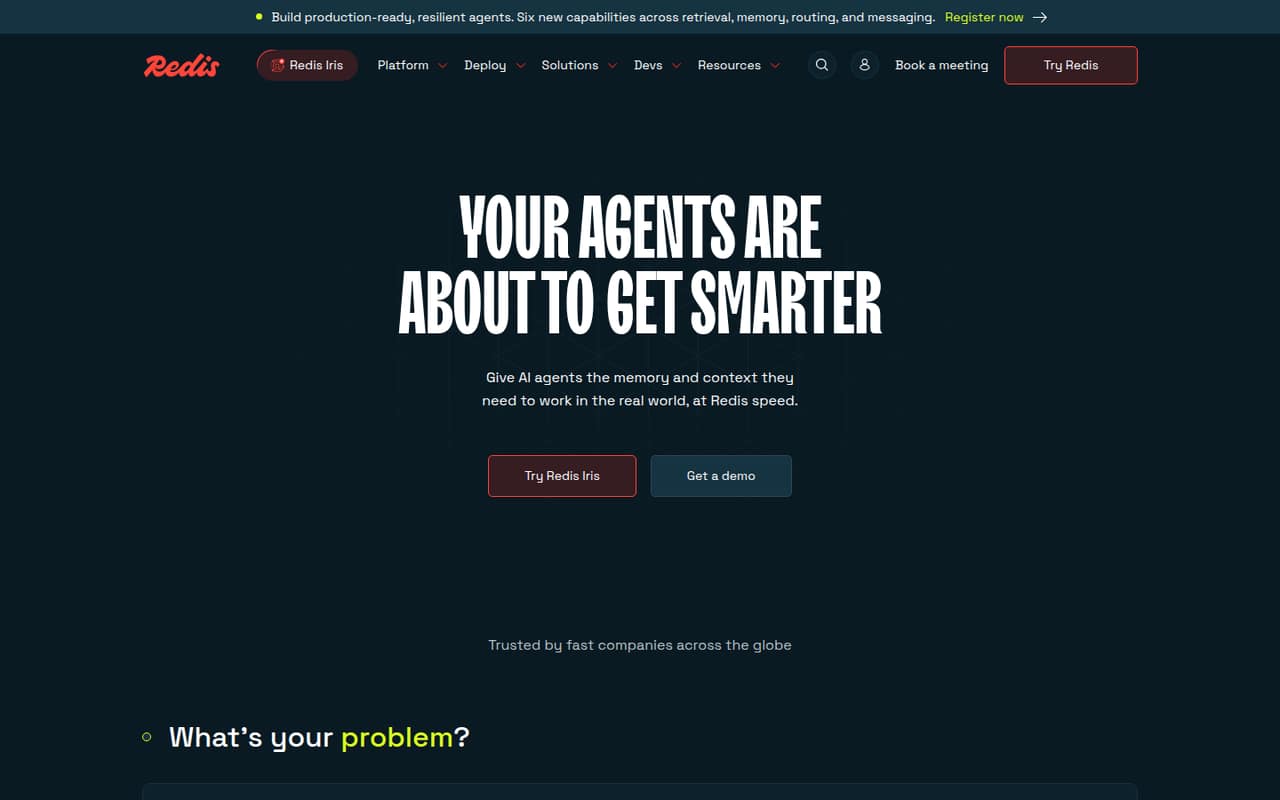
Redis Cloud is a hosted Redis data platform for apps that need caching, streaming, search or vector search. It also supports agent memory and context, tiered RAM-plus-flash storage, and multi-region active-active replication.
The range runs from a 30 MB free shared database to dedicated and hybrid deployments. The trade-offs are capacity-based pricing, limited public detail on integration specifics and production limits, and a need to check network placement for latency-sensitive workloads.
Good fit if
- Real-time apps needing Redis features
- AI agents needing retrieval and memory
- Teams wanting hosted or hybrid deployment
Skip it if
- Teams requiring published rate limits
- Apps that cannot tolerate network latency
- Projects needing fixed Enterprise pricing
ScoresHow it rates
What works
- Free shared-cloud plan includes one database
- Combines caching, streaming, search and vector search
- Supports RAM-plus-flash tiered storage
- Active-active replication supports multi-region deployments
- On-premises and hybrid deployment options are available
What doesn't
- Free plan is limited to 30 MB
- Pro has a $200 monthly minimum
- Enterprise pricing is custom and unpublished
- Published API, SDK and language details are limited
- Rate limits and data export details need confirmation
01What Redis Cloud is, technically
Redis Cloud is a hosted Redis data platform, not an application framework or a local cache library. Redis hosts the service in the cloud, and application teams use it as a real-time data layer for caching, streaming, search and vector search. That puts it alongside an application’s other data services, where it can supply fast lookups, retrieval context or agent memory.
The platform also includes tiered storage that combines RAM and flash for terabyte-scale data, plus active-active replication for multi-region reads and failover. The homepage presents cloud hosting alongside on-premises and hybrid deployment options, so teams can choose a managed service or manage their own deployment. Redis 8 is separately described as free open-source software. The product is therefore broader than a hosted cache, but deployment model, data size and availability requirements will shape both the architecture and the bill.
02Redis Cloud API, SDKs and docs
The homepage directs developers to Redis docs and says they can get started in their favorite LLM’s coding tools. It also describes Redis Context Gateway for retrieving context from structured and unstructured data, and Redis Iris as a context engine for agent memory, context and messaging. Redis says the platform works with any LLM, agent framework or cloud.
Those statements describe the integration surface, but they do not name a particular API style, language, SDK, CLI or framework package. Before choosing a client library or writing deployment automation, check the Redis docs for supported SDKs, connection methods and language-specific instructions. The same check applies to Redis Iris and Context Gateway: confirm how each connects to your existing agent stack rather than assuming a particular protocol or package. Redis’s positioning is to fit into an existing stack, not require a specific model provider or agent framework.
03Redis Cloud pricing for developers
The Free plan is $0 per month for one shared-cloud database with 30 MB, best-effort SLA and community support. Redis 8 is also described as free open-source software, but it is a separate deployment option rather than extra hosted capacity. Essentials starts at $5 per month and covers 250 MB–100 GB of RAM and SSD for one database, with up to 99.99% uptime.
Pro is for dedicated deployment: the listed starting rate is $0.014 per hour, with a $200 monthly minimum, unlimited RAM, multiple databases and up to 99.999% uptime. The bill therefore moves from a fixed entry price to capacity and deployment requirements. Enterprise pricing is custom and unpublished; data transfer is usage-based, and hybrid or multi-cloud deployment is available with an annual plan. The pricing page lists Free, Essentials and Pro as on-demand. It does not publish Enterprise’s annual price. Confirm expected capacity, transfer charges and availability needs before estimating production spend.
04Redis Cloud: open source, self-hosting and lock-in
Redis’s homepage describes Redis 8 as free open-source software and offers on-premises and hybrid deployment options. That gives teams alternatives to running every workload on Redis Cloud, but the homepage does not name Redis 8’s licence. Check the current licence terms before selecting it for a commercial deployment.
Redis Cloud is hosted, while the on-premises and hybrid options let organizations manage deployments themselves. The vendor’s homepage does not describe a data-export process or migration tooling, so ask Redis how to export data and move workloads between deployment types before committing. Because the platform is Redis-based, an application built around Redis data structures may have a path to another Redis deployment, but migration effort still depends on configuration, persistence, replication and any Redis-specific features in use. Confirm compatibility and test the move against your workload.
05Redis Cloud in production
The listed availability differs by plan: Free has a best-effort SLA, Essentials offers up to 99.99% uptime, and Pro offers up to 99.999%. Essentials includes SAML SSO, RBAC, and encryption at rest and in transit. The vendor describes active-active replication for multi-region reads and failover, but teams should confirm the behavior and terms that apply to their selected plan.
The homepage and pricing details do not publish request rate limits, detailed capacity ceilings for every configuration, compliance certifications or a data-export procedure. Ask Redis about these before sizing a production system, along with transfer charges and support coverage. Network placement also matters: a Reddit commenter says latency is usually the biggest bottleneck with a distributed cache and recommends hosting Redis on the same network as the application. Plan for connection failures and measure end-to-end latency in the deployment architecture you intend to run.
From the threadsWhat users say
The Reddit discussion is limited and does not provide much direct evaluation of Redis Cloud. Comments are mixed: one notes that hosted Redis can start at dollars per month, while another emphasizes the network-latency trade-off of a distributed cache.
Network latency is usually the biggest bottleneck to overcome when using a distributed cached like Redis
Typically, you'll want to host Redis on the same network you are using for the rest of your application
Cloud offerings often start at dollars per month
Why not push the messages directly into kafka, then from kafka into redis using kafka connect for the read path?
Questions people ask
What can I build with Redis Cloud?
Redis Cloud is positioned for real-time applications and AI agents. Its platform includes caching, streaming, search and vector search. Redis also describes agent memory, context and messaging, plus tiered RAM-and-flash storage and active-active replication for multi-region use.
Does Redis Cloud have a free plan?
Yes. The Free plan costs $0 per month and includes one shared-cloud database with 30 MB, a best-effort SLA and community support. Redis 8 is separately described as free open-source software; it is not additional hosted capacity on the Free plan.
Can I deploy Redis Cloud on-premises or in a hybrid setup?
Redis describes on-premises and hybrid cloud deployment options alongside its hosted cloud service. The pricing details list multi-cloud and hybrid deployment as available with an Enterprise annual plan. Ask Redis which deployment arrangement and commercial terms fit your architecture.
What uptime does Redis Cloud offer?
The Free plan has a best-effort SLA. Essentials lists up to 99.99% uptime, and Pro lists up to 99.999%. Confirm the SLA terms for your configuration and plan with Redis, including how they apply to replication and failover.
Which SDKs and programming languages does Redis Cloud support?
Redis’s homepage points developers to its docs and says the platform works with any LLM, agent framework or cloud, but it does not name specific SDKs or languages. Check the Redis docs for supported clients and setup instructions for your language before committing.