
We may earn a commission if you buy through links on this page. It never changes a score or a ranking. How we make money
The bottom line
Good coverage and low volume rates; verify SDKs, limits and operating terms before committing.
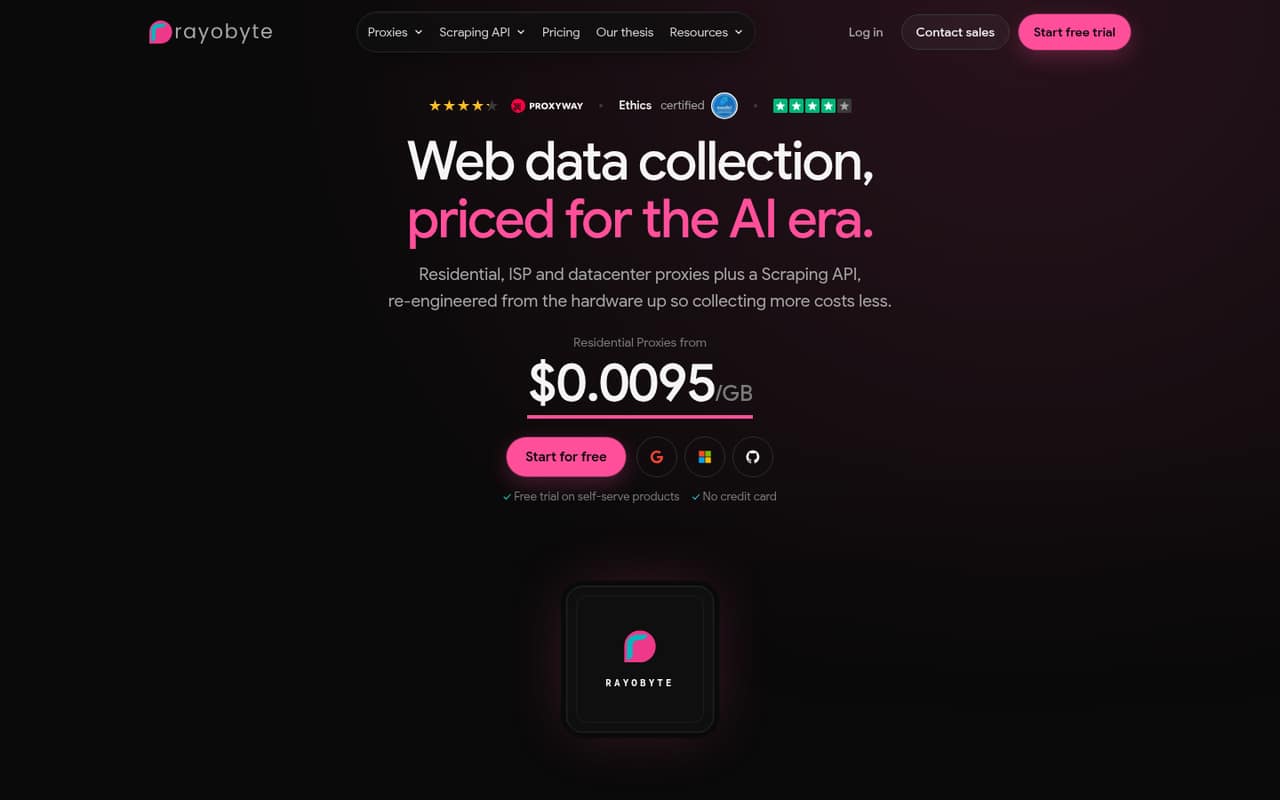
Rayobyte is a hosted proxy provider with residential, ISP and datacenter options, plus a Scraping API that takes a URL and returns a page while handling proxies, browsers and retries. Its product range covers targeted residential traffic, static IPs and rotating proxies as well as managed scraping.
The Scraping API has a 5,000-request free plan, then charges $0.0018 per successful request up to 500,000 monthly requests. Volume pricing is listed at $0.00004 per request from 500,000 requests per month, with rates depending on the site. Before production use, confirm integration support, rate limits, reliability commitments and data-handling terms with Rayobyte.
Good fit if
- Teams collecting web data at scale
- Geo-targeted SERP and price tracking
- Teams wanting managed proxy retries
Skip it if
- Teams requiring self-hosted infrastructure
- Buyers needing documented SDK coverage
- Workloads requiring published SLAs
ScoresHow it rates
What works
- Scraping API handles proxies, browsers and retries
- 5,000-request free plan requires no plan
- Residential targeting includes country, city, ZIP and ASN
- Multiple static and rotating proxy options
- Volume Scraping API rate listed at $0.00004 per request
What doesn't
- No open-source licence or self-hosted option is listed
- SDKs, languages and protocol details need confirmation
- Scraping API pricing depends on the target site
- Rate limits and service-level commitments are not published
- Static datacenter prices vary by country
01What Rayobyte is, technically
Rayobyte is a hosted proxy service and managed Scraping API, not a library or self-hosted server. Its proxy products provide residential, ISP and datacenter IPs, with rotating and static options. The Scraping API takes a URL and returns the page; Rayobyte says it handles proxies, browsers and retries.
In a collection stack, proxies sit between your scraper or crawler and target sites. The API can take over more of that request path, leaving your application to provide URLs and process returned pages. The homepage presents both approaches: a sample crawler that uses a proxy, and use cases such as SERP tracking, e-commerce intelligence, research and AI training. Residential Premium supports country, city, ZIP code and ASN targeting; Scale Residential is positioned for high-volume collection. Static ISP and datacenter IPs are another option when a persistent address is needed. Rayobyte says residential IP owners opt in and can opt out, and that risky targets are blocked.
02Rayobyte API, SDKs and docs
The main managed integration surface is a URL-in/page-out Scraping API: send a URL, then receive the page while Rayobyte handles proxies, browsers and retries. The homepage also shows a Python-style crawler example that assigns a Rayobyte proxy to a fetch call. Treat that as an illustration, not evidence of a maintained Python SDK.
The homepage names no SDK, programming language support, CLI, webhook, plugin or API protocol. Confirm available SDKs and protocol details in Rayobyte’s documentation before choosing an implementation. The proxy products imply a different integration path from the managed API: your collector uses proxy access rather than handing the URL to the scraping service. The homepage does not explain the authentication flow, response format, error model, pagination or retry controls. Those details matter when wiring the API into queues and workers, so verify them in the docs or with sales. Rayobyte advertises free trials on self-serve products and says no credit card is required to start.
03Rayobyte pricing for developers
The Scraping API Free plan includes 5,000 requests with no plan required. Self-Serve costs $0.0018 per successful request, up to 500,000 requests per month. Volume pricing is listed at $0.00004 per request from 500,000 monthly requests; the rate depends on the site, and Rayobyte offers quotes based on sample URLs. Confirm how billing works around the threshold and whether failed requests are charged before forecasting spend.
Proxy costs vary by product and commitment. Scale Residential starts at $100 per month for 6,600 GB, with the listed rate falling to $0.0095/GB on the $5,000 plan. Premium Residential is pay as you go, from $3.50/GB at 1–49 GB, with enterprise pricing from $0.50/GB through sales. Rotating datacenter Scale starts at $100 per month; its listed $5,000 tier costs $0.0080/GB. Static ISP pricing starts at $5 per IP per month for 5–99 IPs. The pricing page lists no annual billing; static datacenter discounts apply when paying three, six or 12 months ahead. Mobile bandwidth expires after 30 days.
04Rayobyte: open source, self-hosting and lock-in
Rayobyte sells hosted proxy access and a hosted Scraping API. The vendor does not publish an open-source licence or a self-hosted deployment option, so teams that need to run the proxy network or scraping service inside their own infrastructure should treat Rayobyte as a hosted dependency.
The homepage does not describe a data-export facility or a migration path. Ask what request and response data can be exported, how long it is retained, and what happens to credentials and account data when service ends. The API’s URL-in/page-out model may keep application-side integration relatively contained, but replacing it still means selecting another provider and adapting request handling, retries and response processing. Direct proxy use may involve more changes because your collectors depend on the proxy configuration and network behavior. Keep those boundaries behind an internal interface to reduce migration work.
05Rayobyte in production
The clearest published operating constraint is billing: Scraping API Self-Serve covers up to 500,000 requests monthly, while higher-volume pricing depends on the site. Rayobyte asks customers to provide sample URLs for volume quotes. The listed plans do not establish request concurrency, rate limits, retry budgets or overage handling, so confirm those before sizing workers and queues.
For proxy workloads, Scale plans trade monthly spend for lower per-GB rates; Premium tiers are pay as you go. The pricing page lists unlimited bandwidth for static ISP and datacenter IPs, while mobile bandwidth expires after 30 days. The homepage says residential IP owners opt in and can opt out, and that risky targets are blocked. Rayobyte calls itself ethics certified, but teams should confirm the certification scope and target-site rules for their use case. Ask for service-level commitments, incident procedures, security controls, retention terms and support response expectations; these are not listed on the vendor's site.
Questions people ask
Does Rayobyte have a free Scraping API plan?
Yes. Rayobyte lists a Scraping API Free plan with 5,000 requests and no plan required. Its homepage also advertises free trials on self-serve products and says no credit card is required to start. Confirm any trial-specific limits in the product terms before building a workload around them.
How much does the Rayobyte Scraping API cost?
The Self-Serve plan costs $0.0018 per successful request and covers up to 500,000 requests per month. Volume pricing is listed at $0.00004 per request from 500,000 requests per month. Rayobyte says the rate depends on the site and offers quotes based on sample URLs.
What proxy types does Rayobyte offer?
Rayobyte lists residential, ISP and datacenter proxies. The options include rotating ISP and datacenter proxies, static ISP and datacenter IPs, and mobile proxies. Residential Premium supports country, city, ZIP code and ASN targeting; Residential Scale is aimed at high-volume collection.
Does Rayobyte provide SDKs or a CLI?
The homepage describes a hosted Scraping API and shows a Python-style crawler example using a proxy, but names no SDK, CLI or supported language list. Check Rayobyte’s documentation for current client libraries, protocol details, authentication and examples before selecting an integration approach.
Can Rayobyte be self-hosted?
Rayobyte is presented as a hosted proxy network and hosted Scraping API. The vendor does not publish a self-hosted deployment option or an open-source licence. If your architecture requires on-premises processing, ask Rayobyte about deployment, data handling and export options before signing up.