
We may earn a commission if you buy through links on this page. It never changes a score or a ranking. How we make money
The bottom line
Qoder spans IDE, CLI and agent APIs, but check its security and hosting terms before adopting it.
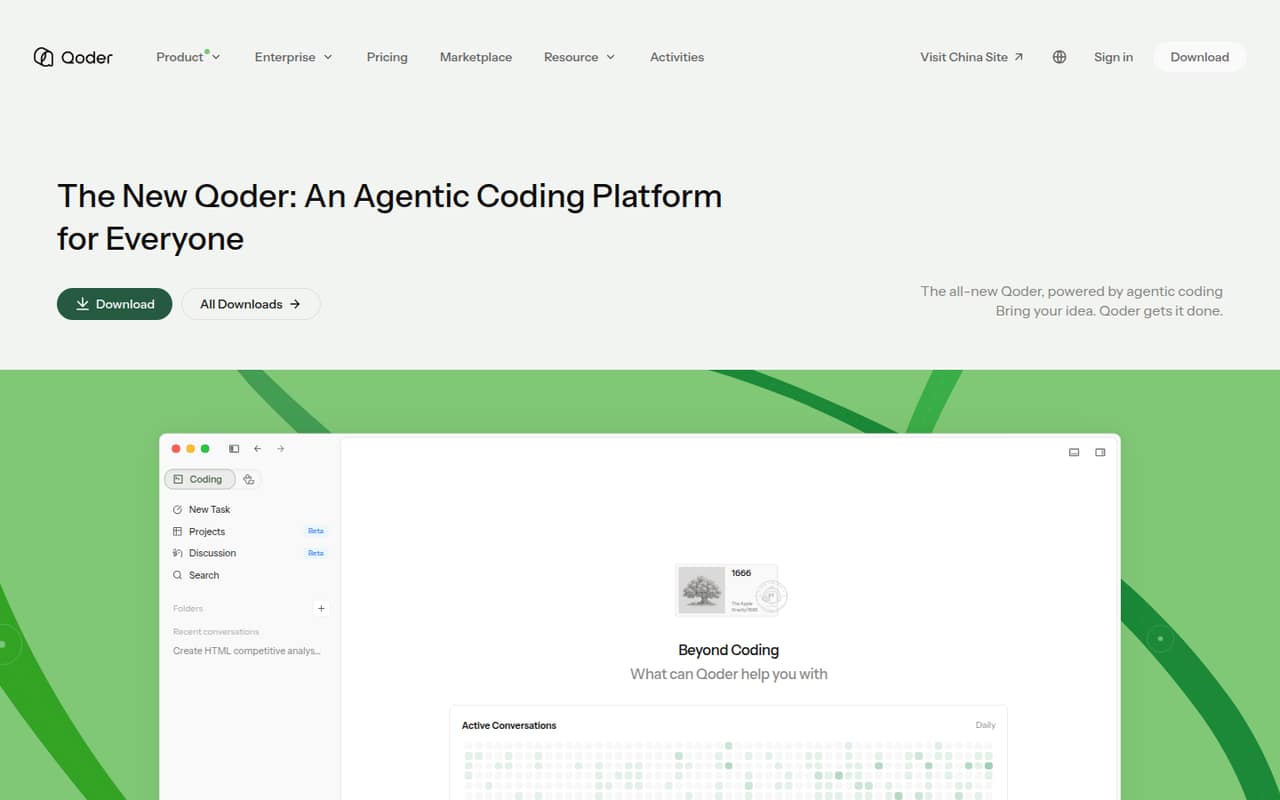
Qoder is an agentic coding platform available as a desktop app, mobile app, IDE, JetBrains plugin and CLI. Its agents work on coding tasks with codebase awareness; the platform also names an Agent SDK and Cloud Agents APIs for building agent-powered products.
The breadth is useful, but Qoder’s open-source status, self-hosting options, API details and production guarantees need closer scrutiny. Reddit users praise its context handling while raising concerns about model choice, permissions and who operates the service.
Good fit if
- Developers delegating coding tasks
- JetBrains backend workflows
- Teams evaluating agent APIs
Skip it if
- Teams requiring local models
- Sensitive code without clear controls
- Builders needing published API limits
ScoresHow it rates
What works
- Desktop, mobile, IDE, JetBrains plugin and CLI options
- Agents can handle autonomous programming tasks
- Codebase awareness and autocomplete in the IDE
- Mobile controls for progress and approvals
- Agent SDK and Cloud Agents APIs
What doesn't
- API protocols and language support need verification
- Rate limits and service guarantees are not published
- No published self-hosting or open-source path
- Individual credits expire monthly without rollover
- Reddit users raise model and permission concerns
01What Qoder is, technically
Qoder is an agentic coding platform, not just a model API or editor plugin. Its product family includes a desktop app, a mobile app for monitoring and approving agent work, an IDE, a JetBrains plugin and a CLI. The IDE combines codebase-aware coding agents with autocomplete and conversational coding; agents can also take on delegated programming tasks.
That puts Qoder across several layers of a development stack: developers can work in its editor or terminal, use its JetBrains integration, or control agent progress from a phone. For teams building their own agent-powered products, Qoder also names an Agent SDK and Cloud Agents APIs. Those are separate integration surfaces from the end-user coding tools. The vendor presents Qoder as a way to build, debug and ship software, but developers should check what runs locally and what requires Qoder’s services before placing it in a restricted environment.
02Qoder API, SDKs and docs
The product family gives developers several ways into Qoder: desktop and mobile apps, an IDE, a JetBrains plugin and a CLI. The IDE supports codebase-aware agent tasks, autocomplete and conversational coding. The JetBrains plugin is positioned for backend work, with refactoring, database awareness and framework support. Mobile is for monitoring progress, approving actions and giving agents further instructions.
For software teams integrating agents into their own products, Qoder names an Agent SDK and Cloud Agents APIs. The vendor does not name API protocols, SDK language support, authentication details, or specific IDE and framework versions in its homepage text. Confirm those details, along with API limits and supported environments, in Qoder’s developer docs before planning an integration. The CLI is a terminal-facing product surface; the vendor’s homepage does not name its commands or scripting interface. Treat the product’s advertised surfaces as starting points, not evidence that a particular language or automation path is supported.
03Qoder pricing for developers
Qoder’s Free plan costs $0 per month for one user. It includes basic models with limited messages, limited completions and next edits, and Bring Your Own Key; it also lists a 14-day Pro trial with 300 credits. Paid individual plans start at Lite for $10 per month, with 1,000 credits. Pro is $20 for 2,000 credits, Pro+ is $60 for 6,000, and Ultra is $200 for 20,000. Lite uses curated models; the higher tiers include the full model lineup. Credits reset monthly and do not roll over.
Teams costs $40 per seat per month, requires at least two seats and includes 3,000 credits per seat. Those credits cannot be shared or transferred. Enterprise lists $20 per seat per month, with zero included credits. Credit Packs cost $20 for 1,500 credits, valid for one month, on Lite through Ultra; Teams and Enterprise shared add-on credits cost $40 for 3,000, valid for one year. Overage costs are not published; individual plans fall back to basic models when credits run out. Annual prices are not published.
04Qoder: open source, self-hosting and lock-in
The vendor does not publish an open-source licence or a self-hosting option on its homepage. It names Cloud Agents APIs and a hosted product family, but does not describe a deployment model for running Qoder’s agent service on your own infrastructure. A Reddit commenter also questioned whether Qoder can use local models; treat that as a user concern, not a definitive statement about current support.
The vendor does not publish a data-export path in the homepage text. Your code remains part of your own repository workflow, but agent history, settings or other Qoder-specific state may not migrate with it. Before adopting Qoder for a long-lived project, ask what data it stores, how to export it, and whether agent workflows can be reproduced outside the service. Keep source changes under version control and review diffs so switching tools does not depend on retaining Qoder’s conversation history.
05Qoder in production
The pricing page gives monthly credit quotas, but the vendor does not publish rate limits, uptime figures or service-level commitments in the homepage text. Individual plans fall back to basic models after credits run out; teams cannot share or transfer their per-seat credits. Plan around that behavior and confirm what happens to Cloud Agents API calls when an account reaches its quota before making it part of a production workflow.
Security and governance also need a direct review. Ask the vendor about code and prompt retention, model providers, access controls, audit logs and deployment boundaries; the homepage does not establish those details. A Reddit commenter warned that Qoder’s terms appeared to grant broad permissions over code, while other Reddit users questioned local-model support and the company’s relationship to Alibaba. Those comments are not verified security findings, but they are reasons to review the current terms and privacy documentation before connecting private repositories.
From the threadsWhat users say
Reddit sentiment is mixed: one user says Qoder handles codebase context well, while others question model choice, permissions and corporate identity. These are individual reports, not verified assessments.
Qoder just seems to understand and maintain context far better
I searched for it, and some people mention it does not allow to choose a model, which implies it probably cloud-only and not local
one of them gives *permissions* to do anything with your code, so dont use it with not-open-source
Qoder’s own legal/privacy pages list BRIGHT ZENITH PRIVATE LIMITED (Singapore) as the company operating the service
Questions people ask
Is Qoder free to use?
Yes. Qoder’s Free plan is $0 per month for one user, with basic models, limited messages, limited completions and next edits, and Bring Your Own Key. It also includes a 14-day Pro trial with 300 credits. The paid Lite plan starts at $10 per month.
Does Qoder support JetBrains IDEs?
Yes. Qoder offers a JetBrains plugin that the vendor describes as supporting refactoring, database awareness and framework support for backend workflows. Confirm the specific IDE versions and supported frameworks in Qoder’s current documentation before rolling it out to a team.
Can Qoder run with local models?
The homepage does not establish whether Qoder supports local models. A Reddit commenter questioned model choice and whether the product is cloud-only, but that is a user report, not a confirmed product limitation. Ask Qoder which models can run locally and what data is sent to external services.
Does Qoder offer an API or SDK?
Qoder names an Agent SDK and Cloud Agents APIs for building agent-powered products. Its homepage does not identify the API protocol, SDK languages, authentication method or usage limits. Check the developer docs for those details before estimating integration work or production capacity.
Can I self-host Qoder?
Qoder’s homepage does not describe a self-hosting option. It lists desktop, mobile, IDE, JetBrains plugin and CLI products, plus Cloud Agents APIs, but that does not establish that the agent service can run on your infrastructure. Ask the vendor about deployment options and data handling if self-hosting is a requirement.
Sources
- Qoder homepage
- Qoder pricing, compiled via web search from qoder.com, mintlify.app, kunavo.com, twitterapi.io
- Reddit: Alibaba reportedly bans Claude Code internally over "backdoor" security concerns, recommending Qoder
- Reddit: Qoder >>> Cursor, Windsurf, kilocode, cline, roo, gemini cli
- Reddit: What’s the situation of Qoder IDE, is it from Alibaba or is it faking being developed by Alibaba but in reality has no attachment to it?
- Reddit: How is Qoder