
We may earn a commission if you buy through links on this page. It never changes a score or a ranking. How we make money
The bottom line
A flexible hosted proxy service; confirm API limits and production terms before committing.
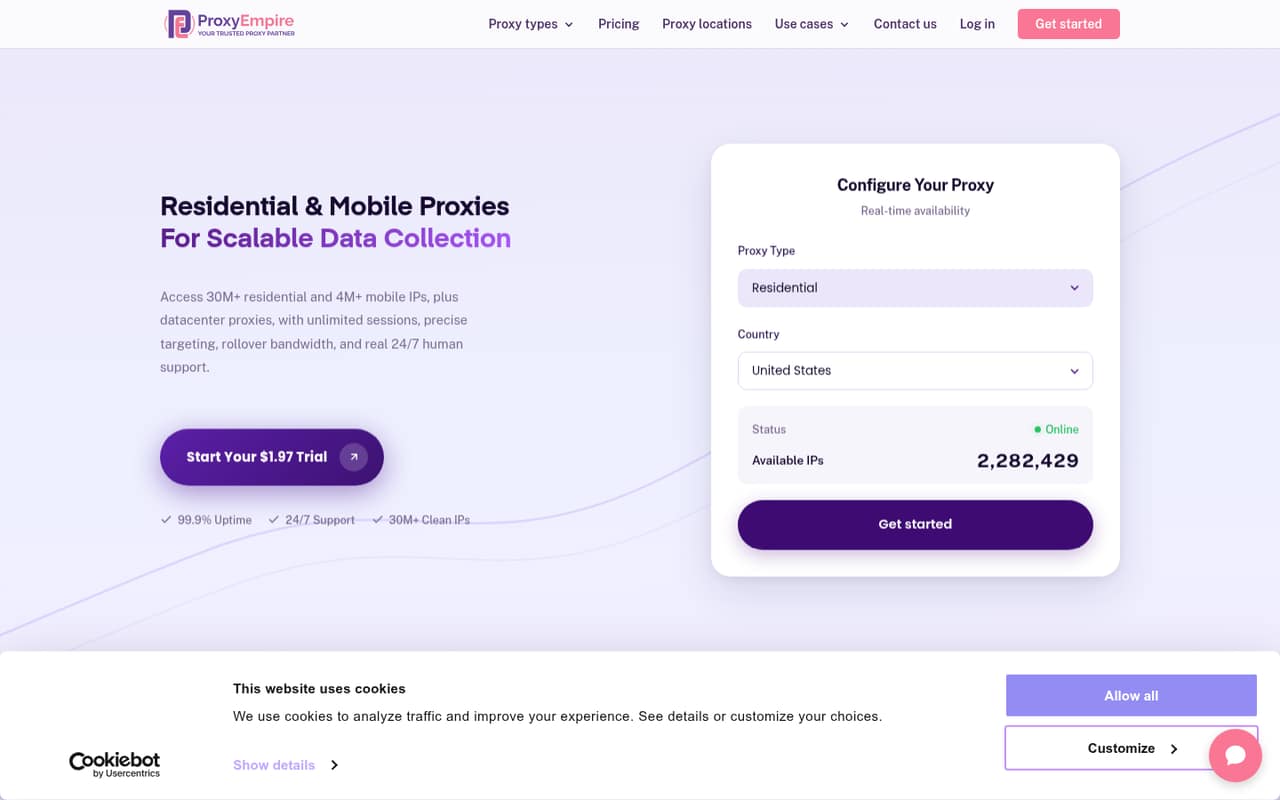
ProxyEmpire is a hosted proxy network for public data collection, with rotating residential and mobile proxies, static ISP IPs, dedicated mobile proxies, and datacenter proxies. Its homepage lists API management, endpoint configuration, location targeting, and unlimited concurrent sessions. It also offers a Chrome extension and Android app.
There is no free plan. Residential plans start at $3.50 for 1 GB, and mobile plans at $4.50 for 1 GB; both have rollover bandwidth. A $1.97 paid trial includes 100 MB residential and 50 MB mobile bandwidth. The range of proxy types is useful, but ask the vendor about API rate limits, usage caps, and production support terms before building a dependency on the service.
Good fit if
- Public data collection across locations
- Scraping with rotating residential IPs
- Workflows needing static or mobile IPs
Skip it if
- Teams requiring a free tier
- Self-hosted proxy infrastructure
- Projects needing published API limits
ScoresHow it rates
What works
- Residential, mobile, ISP and datacenter proxy types
- Country, region, city and ISP targeting
- Unlimited concurrent sessions listed
- Rollover on GB-based residential and mobile plans
- HTTP, HTTPS, SOCKS5 and HTTP/2 protocols
What doesn't
- No free plan; the trial costs $1.97
- API rate limits are not published
- No self-hosting option or open-source license listed
- Dedicated ISP plans have a 100 GB fair-use cap per IP
- Overage pricing and annual billing are not listed
01What ProxyEmpire is, technically
ProxyEmpire is a hosted proxy network, not a proxy library, CLI, or self-hosted server. Your application sends traffic through its proxy endpoints; ProxyEmpire supplies the IPs and controls for choosing proxy type, location, and session behavior. The service is intended for public data collection, SEO monitoring, price research, ad verification, and account workflows.
The network includes rotating residential and mobile proxies, static ISP proxies, dedicated mobile proxies, and datacenter proxies. The homepage lists more than 30 million residential IPs and 4 million mobile IPs, with targeting by country, region, city, and ISP. It also lists HTTP, HTTPS, SOCKS5, and HTTP/2 support, unlimited concurrent sessions, and time-based, session-based, or on-request IP changes. In a stack, it sits between your scraper, monitoring job, or browser workflow and the target site. Your application still handles requests, parsing, retries, and storage; ProxyEmpire provides the network path and proxy controls.
02ProxyEmpire API, SDKs and docs
The homepage lists API management for proxy sessions, locations, and settings, plus configurable endpoints. It also lists HTTP, HTTPS, SOCKS5, and HTTP/2 as supported protocols. It does not describe the API’s request format, authentication method, or rate limits, so confirm those details in the vendor’s developer docs before designing a client or deployment.
ProxyEmpire lists C#, Java, Go, PHP, Node.js, cURL, and Python on its integration page. Those are named integration options; the homepage does not identify them as official SDKs. Check the developer docs to confirm whether a language has a maintained SDK or whether setup uses a standard proxy endpoint. The homepage describes the documentation as step-by-step. For browser workflows, it lists a free Chrome extension that also works in Edge and Brave, and an Android app. There is no CLI or webhook integration listed on the homepage. Endpoint configuration and protocol support are the main integration surfaces to evaluate against your existing HTTP client, scraper, or browser automation stack.
03ProxyEmpire pricing for developers
There is no free plan. The $1.97 paid trial includes 100 MB of residential and 50 MB of mobile bandwidth. Rotating residential pay-as-you-go costs $3.50 for 1 GB; monthly plans start at $20 for 7 GB, with listed rates falling to $1.50/GB on the 1,000 GB Enterprise plan. Rotating mobile starts at $4.50 for 1 GB, or $25/month for 6 GB, and reaches $2.00/GB on the 1,000 GB plan. Unused bandwidth rolls over on GB-based residential and mobile plans.
Datacenter plans start at $25/month for 40 GB, with listed rates down to $0.35/GB on the 5,000 GB Company plan. Dedicated ISP plans start at $3.50/month per IP and include a 100 GB fair-use cap per IP. Dedicated mobile plans include unlimited GB, with listed options from $20 per day for a US 5G device. Unlimited residential plans are sold by speed and term; the 100 Mbit monthly option is $1,500. The pricing page lists no annual billing or overage rates. Code EMPIRE50 takes 50% off eligible rotating residential and mobile GB plans. Model monthly traffic and confirm billing behavior for any usage beyond plan allowances.
04ProxyEmpire: open source, self-hosting and lock-in
ProxyEmpire is presented as a hosted proxy service: the provider operates the IP network and supplies endpoints for your applications. The vendor does not publish an open-source license or list a self-hosted proxy server, so treat the service as hosted-only unless sales confirms another deployment option.
The homepage lists API management and endpoint configuration, but it does not describe data export or a migration tool. Your application can be written to use standard proxy protocols, which may reduce dependence on a provider-specific client, but location targeting and session controls can still require changes when switching services. Keep proxy configuration separate from scraping logic and avoid scattering provider-specific endpoint formats throughout a codebase. Before adoption, ask how to export account or usage data, what happens to remaining rollover bandwidth if you leave, and whether your chosen target locations and session controls are available from another provider.
05ProxyEmpire in production
The homepage claims 99.9% uptime and 24/7 support, but does not publish an uptime SLA or API rate limits. It lists unlimited concurrent sessions; confirm any account-level or endpoint-level constraints with the vendor, along with location availability and session behavior under your workload. For dedicated ISP plans, account for the stated 100 GB fair-use cap per IP. GB-based residential and mobile plans include rollover, but the pricing page does not list overage rates.
Build retries and monitoring around proxy failures, timeouts, and target-site responses rather than treating a successful proxy connection as a successful scrape. The vendor lists real-time availability and a proxy test, but ask what support and escalation terms apply to your plan. The homepage does not describe security controls, compliance certifications, or data-retention policies. Review those points with the vendor if your workload handles sensitive information or has specific compliance requirements. Also check whether the target sites’ terms and your use case permit automated access.
Questions people ask
Does ProxyEmpire have a free plan?
No free plan is listed. The pricing page lists a $1.97 paid trial that includes 100 MB of residential and 50 MB of mobile bandwidth. If you need ongoing access, residential plans start at $3.50 for 1 GB pay-as-you-go, and mobile plans start at $4.50 for 1 GB.
Which programming languages can I use with ProxyEmpire?
The homepage lists C#, Java, Go, PHP, Node.js, cURL, and Python as integration options. It does not identify these as official SDKs. Check the developer docs to confirm whether your language has a maintained SDK or whether you should configure a standard proxy endpoint in your HTTP client.
What protocols does ProxyEmpire support?
The homepage lists HTTP, HTTPS, SOCKS5, and HTTP/2. It also describes configurable endpoints and API management for sessions, locations, and settings. Confirm the endpoint format, authentication method, and any protocol-specific setup in the developer docs before integrating.
Do unused ProxyEmpire bandwidth allowances roll over?
The pricing page lists rollover for GB-based rotating residential plans and rotating mobile plans. For dedicated ISP IPs, the listed fair-use cap is 100 GB per IP. Check the terms for your specific plan before estimating how much unused allowance will carry forward.
Does ProxyEmpire publish API rate limits or an uptime SLA?
The homepage claims 99.9% uptime and lists unlimited concurrent sessions, but it does not publish an uptime SLA or API rate limits. Ask the vendor about request limits, account-level concurrency restrictions, service credits, and escalation terms before relying on ProxyEmpire for a production workload.