
We may earn a commission if you buy through links on this page. It never changes a score or a ranking. How we make money
The bottom line
Portkey centralizes model access and operations, with production pricing and deployment details to verify.
Portkey is a hosted AI gateway and SaaS platform for routing model requests, reviewing usage and applying controls. Its unified API covers 1,600+ LLMs, alongside observability, guardrails, prompt management and an MCP gateway.
The Developer plan is free but capped at 10,000 recorded logs per month. Production starts at $49 per month and raises that allowance to 100,000 logs. Portkey fits teams that want a managed control plane; check SDK support, usage metering and deployment needs before adopting it.
Good fit if
- Teams routing requests across LLM providers
- Apps needing centralized logs and controls
- Enterprise teams evaluating private deployment
Skip it if
- Teams requiring a named SDK today
- Projects needing predictable unlimited usage
- Teams requiring confirmed open-source licensing
ScoresHow it rates
What works
- Unified API provides access to 1,600+ LLMs
- Routing supports fallbacks, load balancing and retries
- Logs, traces and usage are available for review
- Prompt templates can be managed and versioned
- Enterprise plan includes private cloud deployment
What doesn't
- Homepage names no SDKs or programming languages
- Developer plan allows only 10,000 recorded logs monthly
- Production overages are metered by requests, not logs
- Enterprise pricing and overages are custom
- Licence and source availability are not published
01What Portkey is, technically
Portkey is a hosted AI gateway and SaaS control plane that sits between an application and model providers. Instead of connecting each app directly to separate model endpoints, teams use Portkey’s unified API to access 1,600+ LLMs. The platform adds routing options such as fallbacks, load balancing, retries and request timeouts.
It also brings operational features around that gateway: observability for logs, traces and usage; guardrails for requests and outputs; and prompt-template management and versioning. The MCP gateway centralizes authentication, access and observability for MCP servers. That makes Portkey an infrastructure layer, not a model or an application framework.
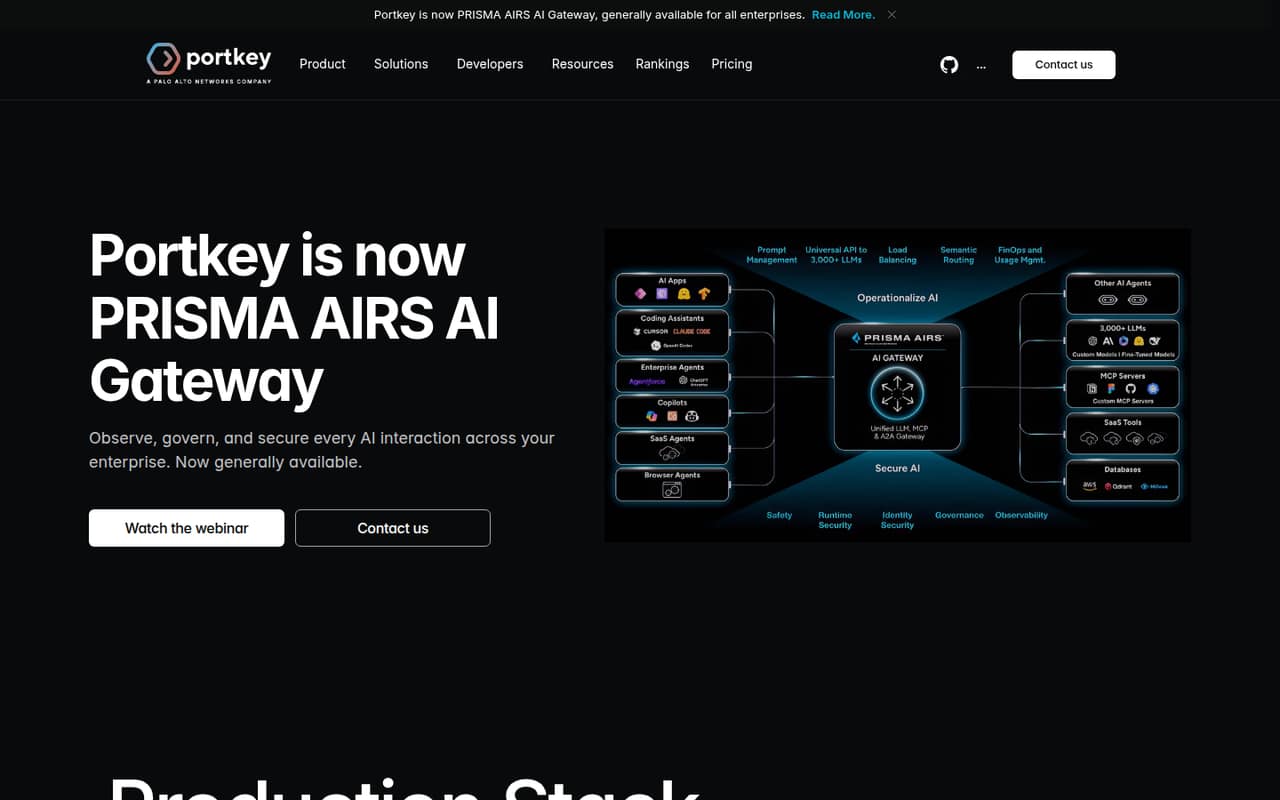
The homepage says Portkey is now PRISMA AIRS AI Gateway and generally available for enterprises. The Production plan is hosted; the Enterprise plan lists private cloud deployment. Teams choosing either route should check how deployment, data handling and their existing model-provider credentials fit their architecture.
02Portkey API, SDKs and docs
The main integration surface named on the homepage is a unified API for accessing 1,600+ LLMs. The gateway supports routing rules, including fallbacks, load balancing, retries and request timeouts. Teams can also use the MCP gateway to centralize authentication, access and observability for MCP servers. These pieces can put a shared control point between application services and model infrastructure.
The homepage does not name programming languages, SDKs, a CLI, webhooks or plugins. Before selecting Portkey, check its developer docs for SDK availability, API compatibility, authentication steps and examples in your application’s language. Confirm how provider-specific parameters and model features pass through the unified API, and how you configure routing and retries.
The platform also includes logs, traces and usage review, plus prompt templates that can be managed and versioned. The developer-facing fit depends on whether those surfaces match your deployment and observability workflows; the feature list alone does not establish integration effort.
03Portkey pricing for developers
The Developer plan costs $0 per month and includes 10,000 recorded logs monthly, three-day log retention, 30-day metrics retention, three prompt templates and community support. It is a testing tier, not an unlimited production allowance. Production costs $49 per month and includes 100,000 recorded logs, 30-day log retention, 90-day metrics retention, unlimited prompt templates, role-based access control and service account API keys.
Production overages are listed at $9 per additional 100,000 requests; the detailed comparison says this applies up to 3 million requests. That is a different meter from the included recorded-log allowance, so confirm exactly how requests and logs count before estimating a bill. Enterprise is custom-priced and lists 10 million+ recorded logs, custom retention, SSO, granular budget and rate limits, private cloud deployment and dedicated onboarding. Enterprise overage pricing is custom. The pricing page lists monthly prices and does not state an annual billing option.
04Portkey: open source, self-hosting and lock-in
Portkey’s homepage does not publish its software licence or source availability, so teams should not assume the hosted service is an open-source gateway. The Enterprise plan lists private cloud deployment. Separately, a Reddit commenter reports running Portkey self-hosted on Cloudflare Workers and says the region can be chosen; treat that as a user report, not a current deployment guarantee.
The vendor does not publish a data-export path on the vendor's site; ask about exporting logs, traces, prompts and configuration before adoption. Portkey’s unified API can reduce direct provider-specific integrations, but moving away may still mean replacing the gateway endpoint, routing configuration, prompt workflows and observability pipeline. Confirm how much of your application depends on Portkey-specific behavior and what export formats are available.
05Portkey in production
Production checks should start with the plan limits: 100,000 recorded logs per month and 30-day log retention on Production, versus custom retention and 10 million+ logs on Enterprise. Production overage pricing is based on additional requests, so ask Portkey to clarify how request counts relate to recorded logs. Enterprise lists granular budget and rate limits; confirm the limits that apply to your plan and deployment.
For access control, Production includes role-based access control and service account API keys; Enterprise adds SSO. The homepage does not publish an uptime commitment, so ask for the applicable SLA and incident process. A Reddit commenter reports using Portkey in production for more than four million monthly active users and self-hosting on Cloudflare Workers. Another commenter says EU data residency on SaaS is pricey; verify current regional availability and costs with Portkey before putting regulated workloads on the service.
From the threadsWhat users say
The Reddit discussion includes a positive report of production use and self-hosting, but offers little broad evidence about reliability. Comments also flag questions to check around regional data residency and SSO costs.
We're running Portkey in production for over 4 million monthly active users. It works great
Self-hosting on Cloudflare Workers. I think you can choose the region
Data residency for EU is pricey
I've never seen a vendor charge for SSO specifically
Questions people ask
What is Portkey used for?
Portkey sits between applications and model providers as an AI gateway. Its unified API provides access to 1,600+ LLMs, with routing options including fallbacks, load balancing, retries and request timeouts. The platform also offers observability, guardrails, prompt management and an MCP gateway.
Does Portkey have a free plan?
Yes. The Developer plan costs $0 per month and includes 10,000 recorded logs monthly, three-day log retention, 30-day metrics retention, three prompt templates and community support. Teams that need 100,000 recorded logs, longer retention and role-based access control can consider the $49-per-month Production plan.
Can Portkey be self-hosted?
The Enterprise plan lists private cloud deployment. A Reddit commenter reports self-hosting Portkey on Cloudflare Workers, but that user report is not a current deployment commitment. Ask Portkey which self-hosted options it supports, what regions are available and whether the option fits your plan and security requirements.
Which programming languages and SDKs does Portkey support?
Portkey’s homepage names a unified API and an MCP gateway, but does not name programming languages or SDKs. Check the developer docs for the client libraries and examples that match your stack. Also confirm API compatibility, authentication and how provider-specific parameters behave through the gateway.
What are Portkey’s production limits?
The Production plan includes 100,000 recorded logs per month, 30-day log retention and 90-day metrics retention. Its listed overage is $9 per additional 100,000 requests, up to 3 million requests according to the detailed comparison. Confirm how request billing relates to log allowances before forecasting usage.