
We may earn a commission if you buy through links on this page. It never changes a score or a ranking. How we make money
The bottom line
A capable hosted integration layer, but verify quotas and recovery behavior before routing production events.
Pipedream is a managed integration service for apps and AI agents. Its npm SDK, remote MCP server, prebuilt tools, OAuth handling and API proxy cover the path from user authorization to API calls without running your own integration runtime.
The main production concern is quota behavior: one Reddit user reports that, after free credits ran out, Pipedream returned success while dropping incoming webhook events. Treat that as an individual report, and test event recovery and alerting before relying on the service.
Good fit if
- AI apps that need MCP tools
- Teams avoiding OAuth infrastructure
- Apps connecting many third-party APIs
Skip it if
- Teams requiring self-hosted infrastructure
- Workloads needing guaranteed event replay
- Projects needing predictable unlimited usage
ScoresHow it rates
What works
- Managed OAuth flows, credential storage and token refresh
- 10,000+ tools and triggers across 3,000+ APIs
- Remote MCP server supports per-user authentication
- Proxy can call API endpoints without prebuilt tools
- Free plan includes development features and team members
What doesn't
- Free-plan usage allowance is not stated
- Startup usage and external users add variable costs
- Core-platform licence and self-hosting path are not published
- Rate limits and event-recovery guarantees need vendor confirmation
- A Reddit user reports silent event loss at the free-tier limit
01What Pipedream is, technically
Pipedream is a hosted integration service and managed runtime, not a library or self-hosted server. It sits between an application or AI agent and the third-party APIs its users connect. Pipedream handles authorization, stores and refreshes credentials, then runs prebuilt actions, triggers or API requests on its infrastructure.
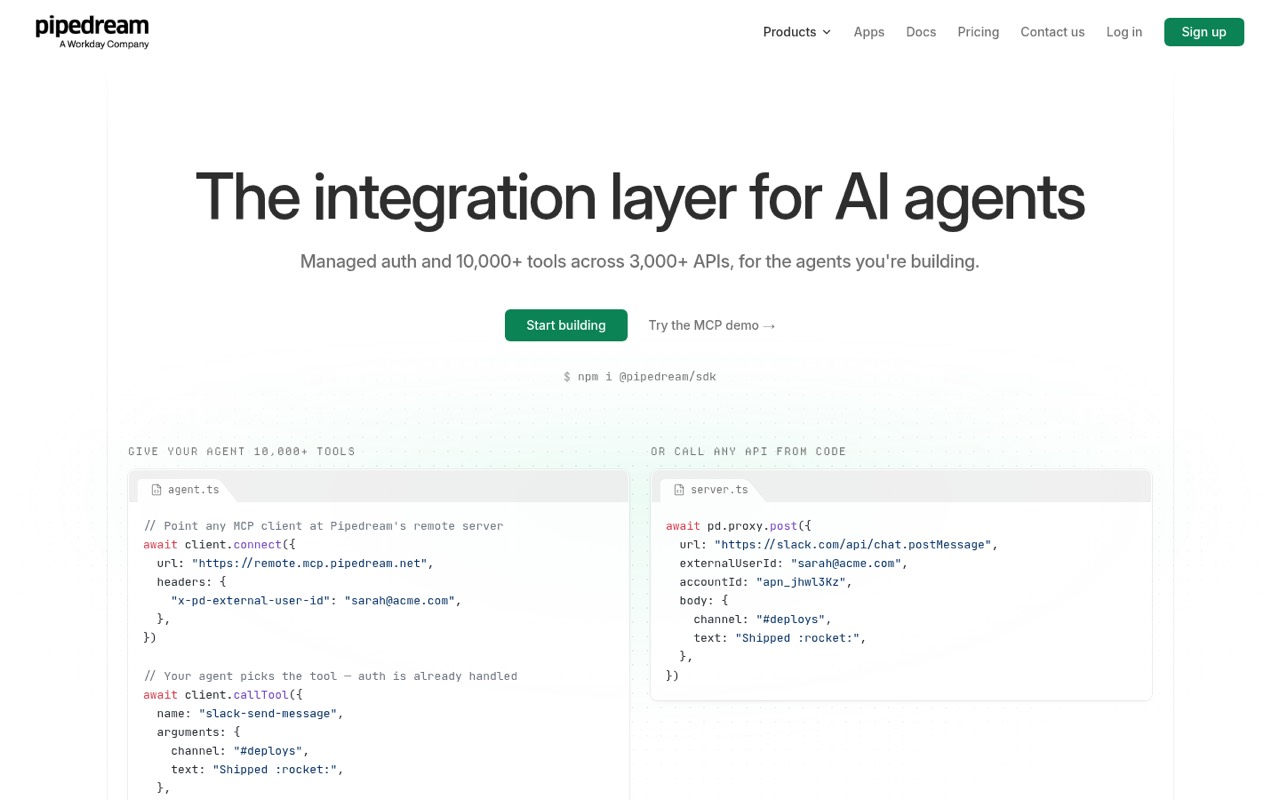
That architecture addresses the work of registering OAuth clients, maintaining token refresh, building connectors and operating the code that calls external APIs. You can use its remote MCP server to expose tools to an agent, call tools through the SDK, or send requests through the Connect proxy with a user's credentials injected. Event triggers can send app events to a webhook in real time.
The trade-off is that the integration runtime and credential path belong to a hosted service. You reduce infrastructure and connector work, but production behavior, cost and recovery depend on Pipedream's service and plan.
02Pipedream API, SDKs and docs
The homepage documents an npm package, @pipedream/sdk, and shows TypeScript examples for creating Connect Links, connecting accounts, deploying triggers and calling the proxy. The proxy accepts HTTP requests to API endpoints; the examples use pd.proxy.post with a URL, external user ID, account ID and request body. The remote MCP endpoint is https://remote.mcp.pipedream.net, and the example client supplies x-pd-external-user-id for per-user access.
Pipedream also offers hosted Connect Link flows and a browser SDK for embedded account connections. The homepage names TypeScript, Python, Java, REST and MCP as integration surfaces, and says the public registry's tools can be extended or replaced with custom tools. Triggers can deliver events to your webhook.
Before standardizing on a CLI or a language-specific SDK beyond the npm package, confirm support in Pipedream's docs. The available surfaces make integration flexible, but your team still needs to map account IDs and external user IDs to its own identity model.
03Pipedream pricing for developers
The Free plan costs $0 per month and includes development features, 3,000+ connectors, 10,000+ prebuilt tools and triggers, unlimited team members and community support. It is positioned for building and testing; the plan details do not state a free usage-credit allowance, so confirm the limit before using it for a live workload.
Startup is for production: $150 per month billed monthly or $99 per month billed annually. It includes a production environment, 100 external users and 10,000 usage credits, with unlimited team members and email support. Additional external users cost $2 per user per month, and extra usage credits cost $0.012 each; the listed rate drops at higher volume.
Business has volume pricing for users and usage, SSO, SCIM, HIPAA, dedicated static egress IPs, SLAs and dedicated Slack support. It uses an annual contract, but the price is not published. Model costs against connected external users and usage credits, not just the number of developers on the team.
04Pipedream: open source, self-hosting and lock-in
Pipedream is presented as a managed service: integration requests run in its runtime, and the vendor describes hosted OAuth, token storage and a remote MCP server. The public registry of tools is on GitHub and can be extended, but that does not establish that the core service is open source. The vendor does not publish a core-platform licence or a self-hosting path.
Ask Pipedream about data export, credential portability and what happens to connected-account data when a project closes. Credentials and token refresh are part of the service, so moving away means replacing those flows as well as rewriting or porting tool and trigger logic. Calls made through the proxy can be redirected to another API client, but your team would need to supply its own authentication and runtime. Keep integration logic and identity mappings in forms your application can export, and avoid treating the hosted account store as your only record of user connections.
05Pipedream in production
Pipedream says credentials are encrypted at rest and scoped per project. Startup includes a production environment; Business adds SSO, SCIM, HIPAA, dedicated static egress IPs and SLAs. Those are useful controls, but confirm the specific compliance scope, rate limits, usage accounting, retry policy and event-recovery guarantees with the vendor before depending on them. The vendor does not publish rate-limit figures in the product details presented here.
One Reddit user testing free-tier workflows reports that, after credits ran out, the webhook continued returning success while incoming events were discarded. The same user said those events did not appear after credits reset. This is an individual report, not a documented platform guarantee, but it highlights a failure mode worth testing: a successful response from the front door may not prove downstream work completed.
For production, track expected events through to their destination, alert on missing runs and use idempotency keys before replaying side-effecting actions. Check how usage exhaustion affects live webhooks and whether you can recover missed events.
From the threadsWhat users say
The available Reddit discussion is sharply critical of one free-tier failure case: a user reports successful webhook responses alongside dropped events. Commenters emphasize end-to-end monitoring and careful replay to avoid duplicate side effects.
When the free credits ran out, the webhook kept answering with success and discarded what came in behind it
the 200 or accepted webhook response only proves the front door was open, not that the downstream step ran
Pipedream: lost, not held
monitoring for missing runs is just as important as monitoring errors
Questions people ask
What does Pipedream do?
Pipedream provides a hosted integration runtime for apps and AI agents. It manages user authorization and credentials, then lets your code call prebuilt tools, send API requests through a proxy, expose tools over MCP or receive events through triggers.
Can I connect an AI agent to Pipedream with MCP?
Yes. Pipedream offers a remote MCP server for tool discovery and per-user authentication. Its example connects an MCP client to https://remote.mcp.pipedream.net and passes an external user ID in the request headers.
Does Pipedream handle OAuth tokens?
Pipedream says it hosts OAuth flows, stores credentials and refreshes tokens. You can use a hosted Connect Link or bring your own OAuth clients. Its Connect proxy can inject connected users' credentials into API requests.
Is Pipedream secure for production?
Pipedream says credentials are encrypted at rest and scoped per project. Business includes SSO, SCIM, HIPAA, dedicated static egress IPs and SLAs. Confirm the compliance scope, data handling, rate limits and recovery guarantees that apply to your workload before launch.
Can I self-host Pipedream?
Pipedream describes a managed runtime where integration requests run on its infrastructure. Its public tools registry is on GitHub, but the vendor does not publish a self-hosting path for the core platform. Ask about data export and migration before making it a dependency.