
We may earn a commission if you buy through links on this page. It never changes a score or a ranking. How we make money
The bottom line
One API for many models and providers; pay for the flexibility and check routing before production.
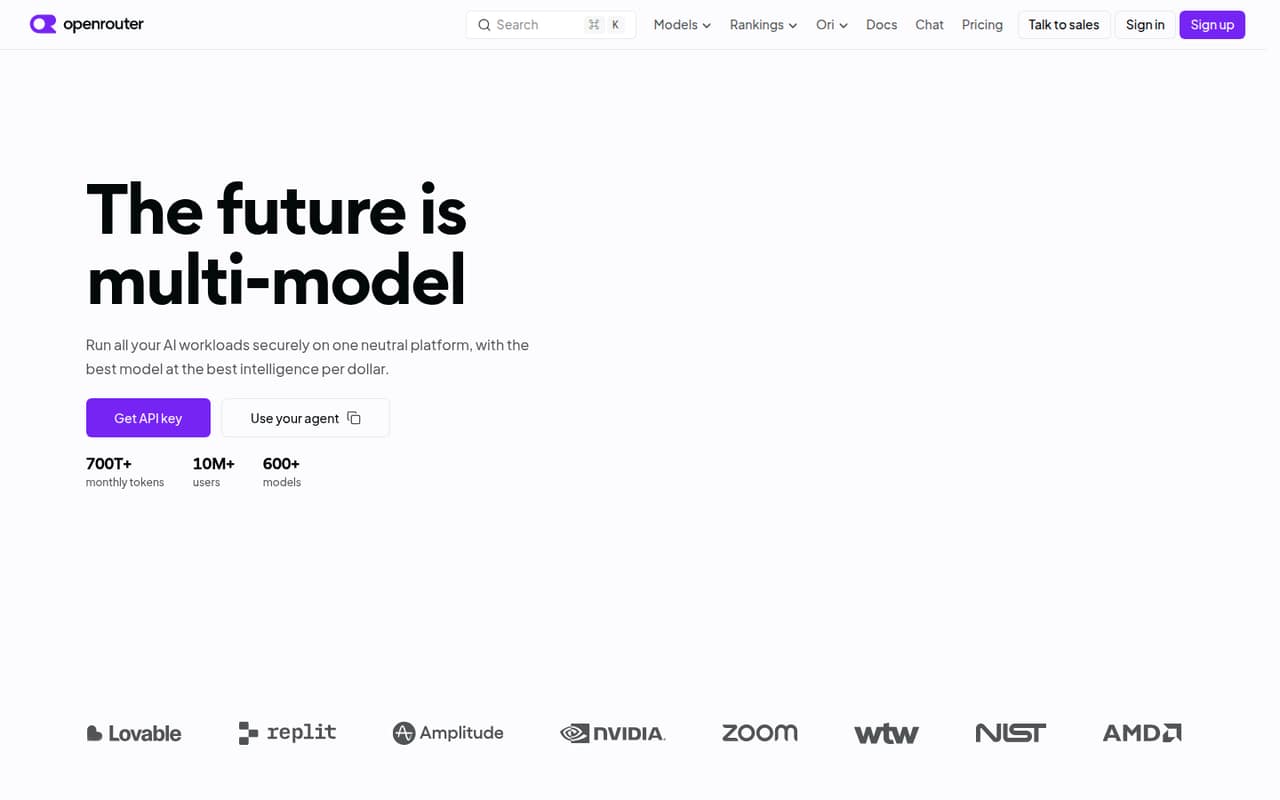
OpenRouter is a hosted API gateway for using 600+ models from 80+ providers through one interface. It adds automatic routing, default failover, provider-key support and team usage controls, so it can reduce the work of integrating multiple model vendors.
The trade-offs are credit-purchase fees on paid plans and less control over which provider serves a request unless you set provider rules. Reddit users report differences in provider speed, reliability and caching. OpenRouter fits model exploration and multi-provider workloads; teams with a single provider or strict latency requirements should compare direct APIs.
Good fit if
- Teams evaluating models across providers
- Apps needing provider failover
- Developers consolidating model billing
Skip it if
- Teams requiring self-hosted gateways
- Workloads tied to one provider
- Latency-sensitive flows without routing control
ScoresHow it rates
What works
- One API reaches 600+ models from 80+ providers
- Automatic routing uses live marketplace data
- Failover is on by default
- Bring your own provider keys
- Team dashboard tracks requests, models and spend
What doesn't
- Standard and Business charge fees on credit purchases
- Free plan is limited to 50 requests per day
- Provider speed and caching can vary
- OpenRouter is hosted, not self-hostable
- Paid-plan throughput limits need confirmation
01What OpenRouter is, technically
OpenRouter is a hosted API gateway and SaaS dashboard, not a model, SDK or server you install in your application. Your application sends requests to OpenRouter, which provides access to 600+ models from 80+ providers through one API. The service sits between your code and model providers, handling model selection, provider routing, failover and usage tracking.
That abstraction addresses the operational work of maintaining separate provider integrations, credentials and billing. OpenRouter can choose a model and provider using live marketplace data, or you can set provider rules and use your own provider keys. The dashboard brings requests, models and spend together for a team. The homepage also lists controls for provider access, data retention and processing region.
This layer adds a dependency: requests rely on OpenRouter as well as the selected provider. If your workload depends on a particular provider’s latency, caching or behavior, verify that the routing rules can meet those requirements before treating the gateway as transparent.
02OpenRouter API, SDKs and docs
You integrate by creating an OpenRouter API key and sending model requests through its API. The homepage promotes access through an API key and says developers can use their agent; it does not name a required language or CLI. Before selecting a client library, confirm current SDK and language support in OpenRouter’s docs. The published integration surface is the API, rather than a named language-specific SDK.
The unified interface means an application can select from the catalog without separately wiring each provider. OpenRouter also offers an automatic model option, provider selection and failover, plus the option to bring provider keys for additional capacity or existing deals. The dashboard provides team-level visibility into requests, models and spend, with workspace budgets and alerts listed among the controls.
Keep provider selection explicit where reproducibility, prompt caching or latency matters. Developers on Reddit report that routing the same model across providers can change speed, price and caching behavior. Test the model-and-provider combination your application will actually use, and check the docs for the request format and current integration guidance.
03OpenRouter pricing for developers
OpenRouter has a Free plan with 25+ free models across four free providers, 50 requests per day and five workspaces. It includes chat and API access with community support. That is enough to explore the gateway, but the daily request cap makes it a limited production option.
Standard and Business have no listed monthly subscription price. You pay model list prices plus a credit-purchase fee: Standard lists 5.5%, while Business lists 8%. Standard includes five workspaces; Business includes 1,000 and EU and US in-region routing. Both include $25,000 per month of BYOK inference without fees, then charge a 5% fee above that allowance. The model provider’s inference cost still applies.
Enterprise uses custom contract pricing based on volume, prepaid credits and annual commitments; fee discounts are available. SSO/SAML, managed policy enforcement, contractual SLAs and dedicated support are listed for the plan. Enterprise private endpoints cost extra, with the price not published. Budget against model usage and credit fees, rather than expecting a flat monthly bill.
04OpenRouter: open source, self-hosting and lock-in
OpenRouter is a hosted service, not an open-source gateway you can run in your own environment. The vendor doesn't publish a server licence or self-hosting path. Enterprise private endpoints are an add-on, but they are not the same as operating the gateway yourself.
The vendor doesn't publish a data-export process. Before adopting it for a long-lived application, ask what usage and audit data can be exported and in which format. Model calls are less difficult to move than routing policy: you can change the API integration, but you will need to replace credentials and review model identifiers, provider selection, failover behavior and data controls. Those settings may not map directly to another gateway or a provider’s own API. Keep the model interface in your code modular and avoid relying on OpenRouter-specific routing defaults if you expect to migrate.
05OpenRouter in production
OpenRouter says failover is on by default and failed requests are not charged. Its dashboard includes usage visibility, budgets and alerts; the homepage also lists zero data retention, provider policies, EU and US in-region routing, audit logs and uptime SLAs. Check which controls apply to your plan and selected provider. The Free plan has a 50-request daily limit; confirm paid-plan rate limits and failover behavior with the vendor before setting throughput targets.
Provider choice can affect production behavior. Reddit users report variation in speed, reliability, pricing and prompt caching when requests for a model go to different providers. One commenter described the gateway as adding latency, while another noted that models with few providers may be less resilient. Treat model and provider selection as operational configuration: monitor errors, latency and spend, and pin providers where consistency matters. Enterprise lists contractual SLAs; ask about the specific coverage your service needs.
From the threadsWhat users say
Reddit discussion is mixed. Users value the model selection and centralized credits, while raising concerns about fees, provider variation, latency and the risk of runaway usage when budgets are moved.
Huge selection
When you top up they take a % off the top
they're just adding latency between you and the provider
I had spend caps on but kept moving the goal because had to get the project completed
Questions people ask
What is OpenRouter used for?
OpenRouter provides one API for accessing models from multiple providers. Developers can use it to try different models, route requests across providers, configure failover and view team usage in one dashboard. It is a hosted gateway between your application and model providers, not a model that runs inside your stack.
Does OpenRouter charge for failed requests?
OpenRouter’s homepage says failover is on by default and failed requests are not charged. Failover is intended to keep requests moving when a provider has an outage or rate limit. Confirm how errors and billing work for your specific routing configuration before relying on it for a production availability target.
Can I use my own provider API keys with OpenRouter?
Yes. OpenRouter supports bringing your own provider keys, which can provide extra capacity and let you use existing negotiated deals. Standard and Business list $25,000 per month of BYOK inference without fees; a 5% fee applies above that allowance. The underlying provider’s inference charges still apply.
Can I control where OpenRouter processes requests?
OpenRouter lists provider, data-retention and processing-region rules for requests. The homepage names EU and US in-region routing as a Business feature and lists zero data retention among its controls. Check that the plan, provider and model you choose support the policies your application requires.
Can I self-host OpenRouter?
No self-hosted OpenRouter server is listed; OpenRouter is offered as a hosted service. If you need to run a gateway in your own environment, you will need a different product. Before adopting OpenRouter, ask about exporting usage and audit data and plan how you would replace its routing rules.
Sources
- OpenRouter homepage
- OpenRouter pricing page
- Reddit: Made entirely with Opus 5.5 + $3.21 of OpenRouter API usage
- Reddit: Do you use OpenRouter? What are the pros and cons? Is there a good open source replacement?
- Reddit: Moving from OpenRouter to OpenAI cut my AI costs by 80% and made the same workload faster.. HOW???
- Reddit: I spent $100+ in 3 weeks on OpenRouter (vs. $33/month for Claude)