
We may earn a commission if you buy through links on this page. It never changes a score or a ranking. How we make money
The bottom line
A managed agent platform for operations teams, with enterprise pricing and limited public developer detail.
Mindflow is a managed platform for building AI agents and repeatable workflows, with human approval steps and execution visibility. It targets operations work such as security alert investigation and response, and advertises more than 4,000 native integrations.
The trade-off is cost and integration uncertainty. AWS Marketplace lists 12-month contracts starting at $30,000, with no free plan, while the homepage does not name an API, SDK, programming language or CLI. This fits teams buying an operations platform more than developers seeking a programmable automation library.
Good fit if
- Enterprise security operations teams
- Teams automating approval-based incident response
- Operations groups needing managed workflows
Skip it if
- Developers seeking a public SDK
- Small teams needing free automation
- Organizations requiring self-hosted software
ScoresHow it rates
What works
- Plain-English agent builder
- Repeatable no-code workflows
- Human approval steps for response actions
- More than 4,000 native integrations
- Execution visibility and granular permissions
What doesn't
- Startup contract costs $30,000 annually
- No free plan or trial is listed
- AI credits are an extra-cost add-on
- API, SDK and CLI support are unclear
- Self-hosting and data export need confirmation
01What Mindflow is, technically
Mindflow is a managed enterprise platform for building and running AI agents and workflows. It is best understood as a hosted operations application, rather than a client library, CLI or self-hosted automation server. The platform combines a visual, no-code workflow builder with agents that users can describe in plain English, plus human approval steps and execution visibility.
In a stack, Mindflow sits between operations staff and the systems they investigate or change. Its advertised 4,000+ native integrations connect workflows to existing tools; agents can enrich alerts, collect context and recommend next steps. Human approval gates are intended to separate investigation from consequential response actions. The homepage presents security, IT and cloud operations as target areas, including a SOC Starter bundle for alert enrichment, investigation and response. This makes Mindflow relevant when a team wants managed orchestration around operational tools, not when it needs a general-purpose agent runtime embedded directly in application code.
02Mindflow API, SDKs and docs
The documented entry point on the homepage is Mindflow's platform: its Agentic Platform, Orchestration, Integrations, MCP Gateway and MCP Servers. It also links to Documentation and describes native integrations, but does not name a REST API, webhook interface, SDK, programming language or CLI. The vendor does not publish those developer surfaces on the homepage; confirm SDK and API support in its documentation or with sales before planning a code-level integration.
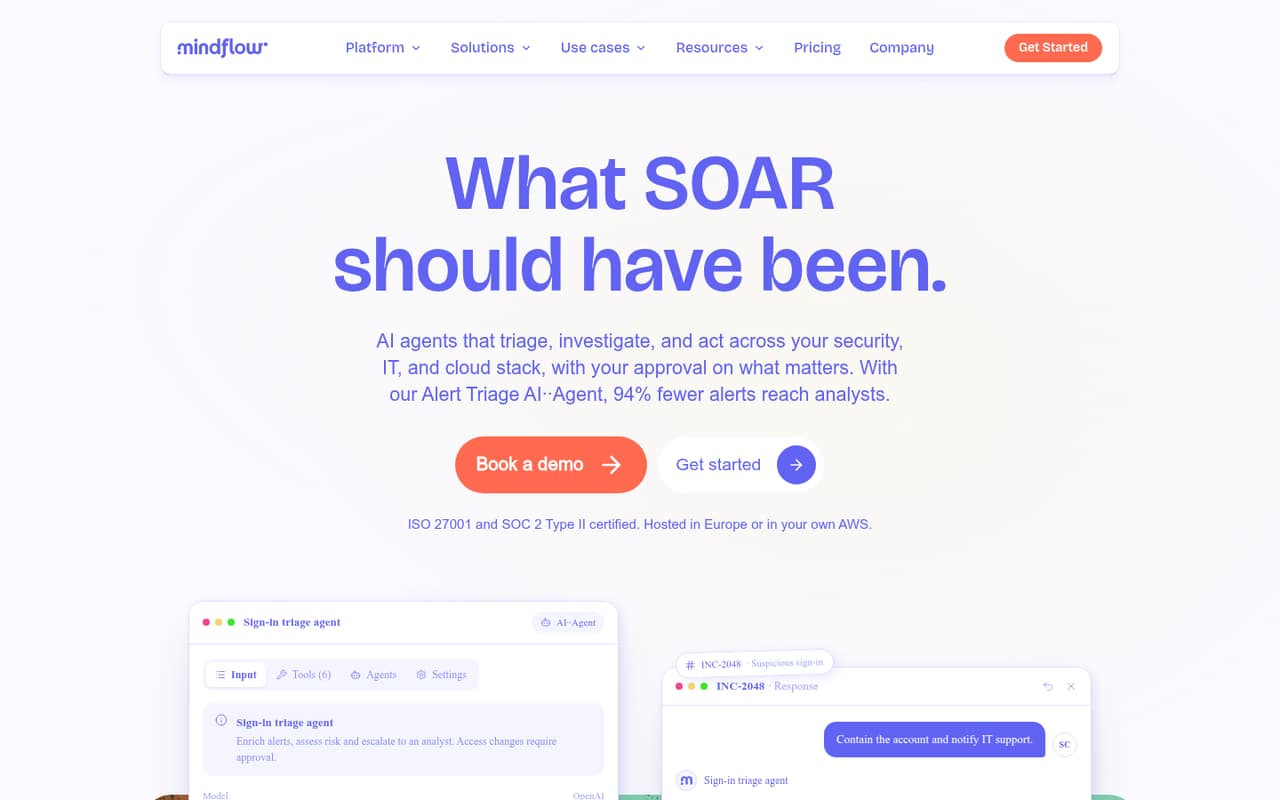
The advertised workflow is primarily configuration-led: describe an agent, give it repeatable flows, connect integrations and set permissions or approval steps. A showcased sign-in triage agent uses a Mistral model and illustrates alert enrichment, evidence gathering, incident creation and approval before account or device changes. That example shows the intended operations pattern, not a general API contract. Mindflow advertises more than 4,000 native integrations, but teams should verify that their exact tools, authentication methods and required actions are supported. MCP Gateway and MCP Servers are named product surfaces; check the docs for their protocols, deployment model and limits before depending on them.
03Mindflow pricing for developers
Mindflow has no listed free plan or free trial. The AWS Marketplace listing shows a Startup Plan at $30,000 for a 12-month contract, equivalent to $2,500 per month when divided across the term. It includes one team workspace and up to five workflows. The Team Plan is $50,000 per 12-month contract, or about $4,166.67 per month equivalent, with one workspace and up to 20 workflows. These are contract totals; monthly billing prices are not published.
The Custom Enterprise Plan is listed at $200,000 for 12 months, equivalent to $16,666.67 per month, with configurable workspaces and workflows. The website directs buyers to custom pricing. AI Credits are an add-on for AI agents, but the price is not published. The Team Plan's additional features and overage costs are also not published. The known pricing model is therefore contract-based, with workflow allowances and separately priced AI credits—not a transparent per-request or per-seat rate. Get the expected credit consumption, overage terms and renewal costs in writing before sizing a production deployment.
04Mindflow: open source, self-hosting and lock-in
Mindflow presents its platform as running on managed infrastructure. Its homepage does not identify an open-source license or offer a self-hosted deployment, so teams should treat it as a hosted commercial service unless the vendor confirms otherwise. Ask whether customer-managed infrastructure is available and what security or data-residency controls apply to it.
The homepage also does not describe data export or a migration path. Before committing workflows to the platform, ask for export formats for agent instructions, workflow definitions, execution logs and configuration, along with any restrictions on integration credentials or generated data. The more logic lives in Mindflow's visual flows and proprietary integration actions, the more work a move could require. An integration count alone does not establish portability: verify whether workflows can be represented outside Mindflow and whether connected systems can be reconfigured without rebuilding each process.
05Mindflow in production
Mindflow advertises managed infrastructure, granular permissions, execution visibility and human approvals. Those are relevant controls for workflows that investigate incidents or take response actions, but teams should validate how permissions map to individual integrations and whether approval rules can enforce the exact target and action. The showcased sign-in agent requests approval before suspending an account, revoking sessions or isolating a device, illustrating the kind of boundary to confirm in a real deployment.
The published plan limits are workflow counts: up to five on Startup and up to 20 on Team. The vendor does not publish request, concurrency, execution-time or rate limits on its homepage; ask about these alongside service-level commitments, retry behavior and failure handling. Also confirm AI Credit consumption, overage costs, audit-log retention, data handling and recovery procedures. Those details affect both production capacity and cost. The platform's execution visibility may help operators inspect runs, but it does not replace testing integration permissions or defining a manual fallback for failed or uncertain actions.
Questions people ask
What is Mindflow AI?
Mindflow is a managed enterprise platform for building AI agents and no-code workflows. It focuses on operations work such as alert enrichment, investigation and response, with human approvals and execution visibility. The vendor advertises more than 4,000 native integrations and positions the product for security, IT and cloud operations teams.
How much does Mindflow cost?
The AWS Marketplace listing shows a Startup Plan at $30,000 for a 12-month contract, a Team Plan at $50,000, and a Custom Enterprise Plan at $200,000. Monthly billing prices are not published. AI Credits, Team Plan additional features and overage costs are also not published, so confirm the complete contract cost with Mindflow.
Can I use Mindflow for free?
Mindflow has no free plan or free trial listed in its pricing information. Its listed Startup Plan requires a $30,000 12-month contract and includes one team workspace with up to five workflows. Contact the vendor to ask whether it offers a separate evaluation or proof-of-concept arrangement.
Does Mindflow provide an API or SDK?
Mindflow's homepage names its Agentic Platform, MCP Gateway, MCP Servers, native integrations and documentation. It does not name a REST API, SDK, programming language or CLI. Confirm the supported integration methods and SDK availability in Mindflow's documentation or with its sales team before designing a code-level dependency.
Can Mindflow require human approval before an agent acts?
Yes. Mindflow describes human approval steps, and its showcased sign-in triage agent requests analyst approval before actions such as suspending an account, revoking sessions or isolating a device. Confirm how approval rules, permissions and audit records work with the integrations and response actions your team intends to use.