
We may earn a commission if you buy through links on this page. It never changes a score or a ranking. How we make money
The bottom line
Matia consolidates data operations, but its price and integration details need scrutiny.
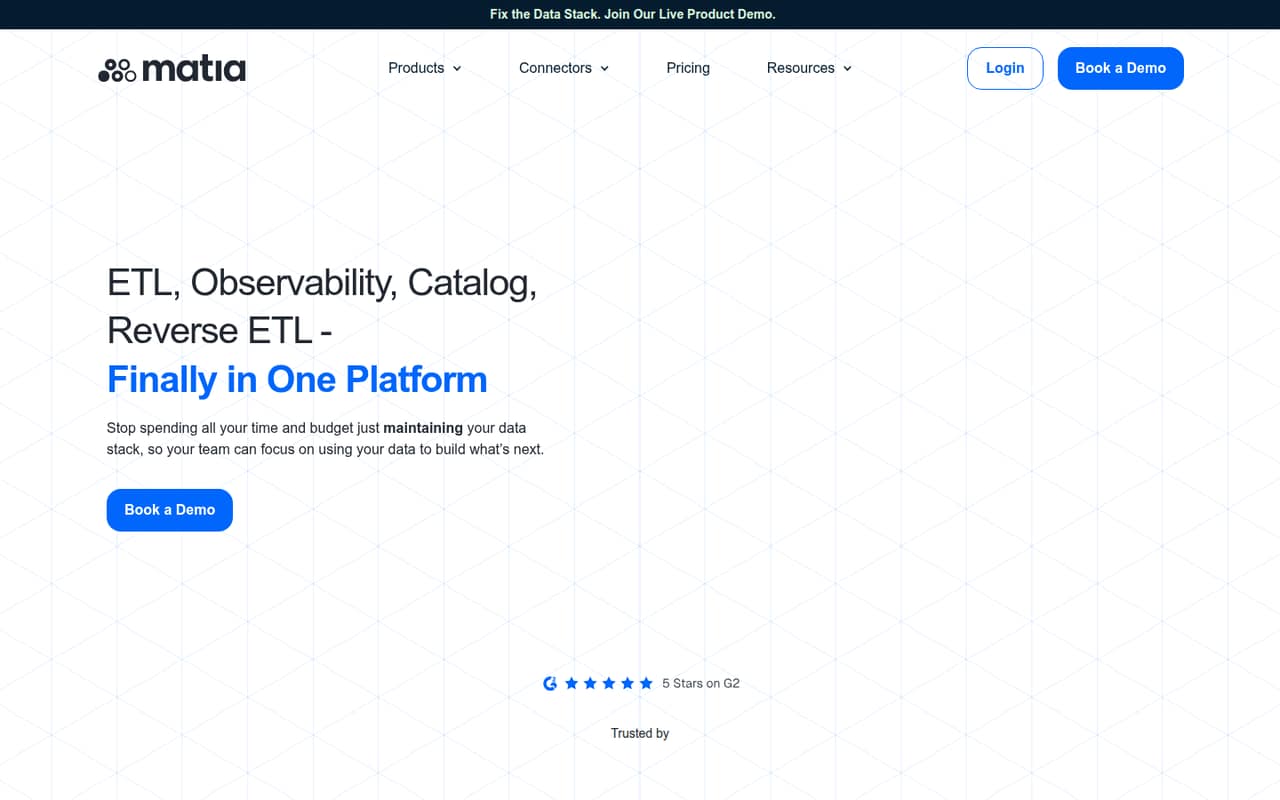
Matia is a unified DataOps platform for moving data into warehouses and back to operational tools, while adding observability, lineage and catalog features. Its connector-based approach and combined feature set may reduce tool sprawl for teams that want these functions together.
Starter begins at $1,250 per month and there is no free plan. Sync frequency, destinations and monitoring capacity vary by tier; Standard and Enterprise pricing is not published. Confirm API and SDK support, deployment options and production limits with Matia before committing.
Good fit if
- Teams consolidating data operations tools
- Warehouse teams needing reverse ETL
- Data teams tracking lineage and quality
Skip it if
- Projects needing a free tier
- Teams requiring self-hosted software
- Builders relying on documented SDKs
ScoresHow it rates
What works
- Combines ETL, reverse ETL, observability and cataloging
- Lists more than 100 data sources
- Offers column-level lineage
- Flags schema changes and anomalies
- Higher tiers increase sync frequency and capacity
What doesn't
- Starter costs $1,250 per month
- No free plan
- Standard and Enterprise prices are not published
- Homepage does not document API or SDK details
- Open-source licence and self-hosting options are not published
01What Matia is, technically
Matia is a managed DataOps platform presented as a unified product, not a library or standalone CLI. It sits between data sources, warehouses and operational destinations: ingestion moves data into a warehouse, while reverse ETL sends modeled warehouse data back to tools. The same platform adds pipeline monitoring, a data catalog and lineage.
That architecture targets teams running separate tools for data movement and oversight. Matia says it monitors for issues such as schema changes and anomalies, and traces transformations from source to AI model with column-level granularity. The catalog is intended to organize data assets and show ownership; its AI context capabilities use metadata, a semantic layer and data quality. The homepage presents a product with login and demo access, but teams should confirm deployment and data-residency details with Matia. The main fit question is whether consolidating these jobs outweighs adopting one platform for several parts of the stack.
02Matia API, SDKs and docs
The homepage describes a connector-based integration surface: Matia says it supports more than 100 sources, including Zendesk, Snowflake, SFTP, AWS Redshift, MySQL, MongoDB, HubSpot and Google Ads. It lists AWS S3 and AWS Redshift as popular destinations. The product also connects warehouse data to operational tools through reverse ETL.
The homepage links to Matia Docs, but its product copy does not describe an API style, SDKs, supported programming languages, a CLI or webhooks. Do not assume a particular programmatic control plane from the connector list. Before building automation or an application dependency, confirm API availability, authentication, SDK language support, versioning and rate limits in Matia Docs or with the vendor. The stated integration model is pipeline configuration across sources, warehouses and destinations; the copy does not establish how those connections are created or managed in code. That makes a technical fit check important for teams that need infrastructure-as-code or scripted deployment.
03Matia pricing for developers
The pricing page lists Starter at $1,250 per month. There is no free plan; the listed free trial is about two weeks. Starter includes 10 users, seven-day audit logs, hourly ETL syncs, one reverse ETL destination with eight-hour syncs, 100 monitored tables, five custom monitors and 75 dbt tests.
Standard has unlimited users and dbt tests, 30-day audit logs, 15-minute ETL syncs, two reverse ETL destinations with four-hour syncs, 300 monitored tables and 25 custom monitors. Its price is not published. Enterprise has 60-day audit logs, ETL syncs as frequent as every five minutes, unlimited reverse ETL destinations with hourly syncs, unlimited monitored tables and custom monitors, and unlimited dbt tests; its price is also not published.
The listed tiers scale by sync frequency, users, destinations and monitoring capacity. The pricing material lists no usage-metered rate, overage price, add-on or annual discount. Ask how additional capacity is billed and get a quote for the planned workload before production.
04Matia: open source, self-hosting and lock-in
Matia presents its product as a platform accessed through its product and documentation. Its homepage publishes no open-source licence, source-code repository or self-host deployment option. Teams that require an open-source stack or control over the runtime should ask Matia directly whether either is available for their contract.
The product moves data between sources, warehouses and destinations, so migration may involve recreating connectors, sync schedules, reverse ETL mappings, monitors and catalog context in another system. The homepage does not describe export formats or a migration path. Before signing, ask how to export pipeline configuration, lineage, catalog metadata and audit logs, and whether data can be extracted in standard formats. Also confirm how Matia handles credentials and what happens to stored metadata when a contract ends. Without those answers, the cost of leaving is difficult to estimate.
05Matia in production
The listed plan limits affect pipeline design: Starter ETL syncs run hourly, its reverse ETL destination syncs every eight hours, and it includes 100 monitored tables and five custom monitors. Higher tiers offer faster syncs and more capacity, but Standard and Enterprise prices are not published. Confirm that the available cadence and destination count meet each workflow’s freshness requirements.
Matia says it monitors at the source for schema changes and anomalies and provides end-to-end lineage. The homepage does not publish service-level objectives, rate limits, connector-specific quotas, data residency, compliance certifications or detailed recovery guarantees. Ask for those details, plus behavior during source outages, backfills, schema drift and failed syncs. Check whether audit-log retention—seven days on Starter, 30 on Standard and 60 on Enterprise—meets internal requirements. For production approval, validate support response commitments, security controls and export procedures in writing rather than treating general reliability claims as a service guarantee.
Questions people ask
What does Matia do?
Matia combines data ingestion, reverse ETL, observability and catalog features in one platform. It moves data from sources into warehouses, sends warehouse data to operational destinations, monitors pipelines, and provides lineage and data context. Teams should confirm that its connectors and sync schedules cover their specific workflows.
How much does Matia cost?
Starter is listed at $1,250 per month. Standard and Enterprise prices are not published. Starter includes hourly ETL syncs and one reverse ETL destination with eight-hour syncs; higher tiers offer faster syncs and greater capacity. Ask Matia for a quote and any overage terms before estimating total cost.
Does Matia have a free plan or trial?
The pricing material lists no free plan and describes a trial of about two weeks. Confirm trial eligibility, feature access, usage limits and what happens to connected pipelines when the trial ends. Starter is listed at $1,250 per month.
Does Matia provide an API or SDKs?
Matia’s homepage describes connectors and links to Matia Docs, but does not document API style, SDKs, supported languages or a CLI. If your deployment needs programmatic configuration, ask the vendor to confirm API availability, authentication, supported SDKs, rate limits and versioning before building around it.
Can Matia be self-hosted, and can I export my data?
Matia’s homepage publishes no self-host deployment option, open-source licence or data-export details. Ask the vendor about deployment choices and export formats for pipeline configuration, lineage, catalog metadata and audit logs. Include exit procedures and data handling after contract termination in the evaluation.