We may earn a commission if you buy through links on this page. It never changes a score or a ranking. How we make money
The bottom line
A free, self-hostable database server with a named Node.js connector and paid Cloud options.
MariaDB Server is an open-source database server you can install on your own infrastructure or use through MariaDB Cloud. Community Server has a $0 price; Cloud Foundation is also listed at $0 per month, while paid Cloud plans start at $0.16/hour.
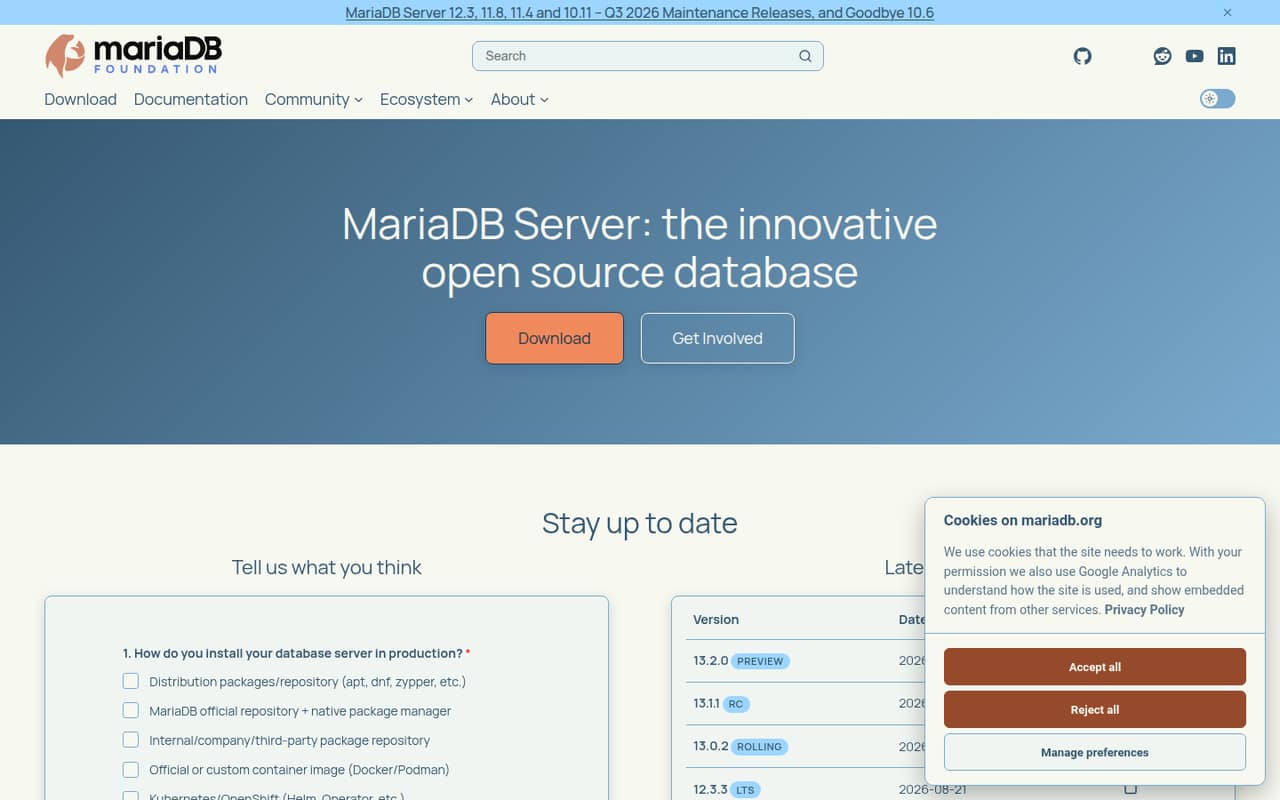
The homepage lists packages, containers, Kubernetes, source builds, Windows installs and brew on macOS, plus LTS and other release channels. It also highlights a Node.js connector and a Plugin API. Check connector support, operational requirements and Cloud billing details against your application before committing.
Good fit if
- Teams wanting a self-hosted database
- Projects already using Node.js
- Operators choosing among installation methods
Skip it if
- Teams requiring published compliance details
- Projects needing a documented REST API
- Buyers needing predictable Cloud monthly totals
ScoresHow it rates
What works
- Community Server is listed at no cost
- Supports packages, containers and Kubernetes installs
- LTS, Rolling, RC and Preview releases
- MariaDB Connector/Node.js releases are announced
- Plugin API has Doxygen documentation
What doesn't
- Cloud paid plans are billed hourly
- Cloud plan limits are not stated
- Enterprise Platform pricing requires a quote
- Homepage names Node.js, not a broader SDK set
- License details are not named on the homepage
01What MariaDB is, technically
MariaDB Server is a database server that sits in the persistence layer of an application stack. It stores and serves application data; it is not a hosted API or an application framework. Teams can run Community Server on their own infrastructure, or consider MariaDB Cloud, which has Foundation, Power and PowerPlus plans. The homepage also distinguishes Community Server from Enterprise Server, described as a hardened, production-grade edition of Community Server.
The install choices cover distribution packages and repositories, containers, Kubernetes or OpenShift, source builds, Windows installs, brew on macOS, and managed database services. That gives operators several ways to fit the server into an existing deployment model, from manually managed hosts to container platforms. The release list separates LTS releases from Rolling, RC and Preview builds. Teams should select a release channel deliberately: an LTS version is the listed long-term-support option, while Preview and RC are not the same channel.
02MariaDB API, SDKs and docs
MariaDB is a server-side database, so application integration centers on connecting an application to the database rather than calling a hosted REST API. The homepage specifically announces MariaDB Connector/Node.js releases, including versions 3.5.5, 3.4.8, 3.3.5 and 3.2.6, all described as GA releases. Node.js is the named language integration; confirm connector and SDK support for your other languages in MariaDB’s documentation before choosing a stack.
For extension work, the homepage links to Doxygen-generated documentation for the MariaDB Server Plugin API. That gives developers a documented plugin surface for extending server capabilities. Installation paths include packages, containers, Kubernetes or OpenShift, source builds, Windows and brew on macOS, so deployment can follow the tools an operations team already uses. The homepage does not identify a CLI or a REST interface; check the vendor’s docs for the connection method and client tooling your application requires.
03MariaDB pricing for developers
MariaDB Community Server is listed at $0 per month, making self-managed use the no-license-price option. MariaDB Cloud’s Foundation plan is listed at $0 per month. Paid Cloud plans are hourly: Power starts at $0.16/hour and PowerPlus starts at $0.21/hour. The pricing information does not give a monthly equivalent, so the total depends on how many billable hours your deployment runs; confirm the plan’s sizing, included resources and billing rules before estimating production spend.
MariaDB Enterprise Platform plans—Platform, Platform Plus and Platform Ultimate—require a custom quote for organizations self-managing the platform. MariaDB Exa is listed as an add-on for Power, PowerPlus and all three Enterprise Platform tiers. The published pricing information does not state Cloud free-tier limits, paid-plan caps, overage rates or Exa pricing. Ask for those figures, plus any backup, storage and support charges, before comparing a Cloud bill with the cost of operating Community Server yourself.
04MariaDB: open source, self-hosting and lock-in
MariaDB Server is described as open source and built by a global community. The homepage does not name a specific licence, so check the licence terms for the exact server version and any components you plan to distribute. Self-hosting is supported by the listed installation options, including packages, containers, Kubernetes, source builds, Windows installs and brew on macOS.
Running the server yourself avoids requiring MariaDB Cloud, but it also leaves deployment and operations with your team. The homepage does not describe a data-export or migration workflow. Before adopting MariaDB Cloud or Enterprise Server, identify how you will export data and validate a move to another database or hosting provider. The practical lock-in risk will depend on the database features, connectors and operational services your application uses, so test the exit path with your own schema and workload.
05MariaDB in production
MariaDB offers LTS releases alongside Rolling, RC and Preview versions. For production, choose a release channel that matches your upgrade policy and confirm the maintenance period for the exact version you deploy. The homepage calls Enterprise Server a hardened, production-grade edition of Community Server, but does not give specific security controls, compliance certifications, rate limits or service-level commitments. Confirm those requirements with the vendor or your infrastructure provider before relying on them.
Reddit reports are mixed and anecdotal. Some commenters describe long-term satisfaction with MariaDB; others report more intervention work or prefer another database for large datasets. Those accounts are not comparable benchmarks and do not establish a general scaling limit. Production planning should include representative load tests, backup and restore checks, monitoring, upgrade rehearsals and an incident process. If using Cloud, confirm the plan’s resource limits and billing behavior; if self-hosting, budget for your team to operate the server.
From the threadsWhat users say
Reddit sentiment is mixed: commenters praise MariaDB’s familiarity and ease of use, while others report operational problems or favor competing databases. These are individual experiences, not evidence of comparative performance.
It's simple, well supported and it just works (tm)
The feature set is simpler and the product is easy to get up and running with little fuss
At least once a week at least one of them needs some intervention work
In my experience, mariadb is great for small datasets (up to a few GB of data)
Questions people ask
Is MariaDB still around?
Yes. MariaDB’s homepage lists active releases, including LTS, Rolling, RC and Preview versions, and announced MariaDB Connector/Node.js releases. It also lists Community Server and Enterprise Server. The release page and the support terms for the version you plan to deploy are the right places to check current maintenance status.
What is MariaDB used for?
MariaDB Server is a database server used as an application’s data-storage layer. You can install it on your own infrastructure using packages, containers, Kubernetes, source builds, Windows installs or brew on macOS. MariaDB also offers MariaDB Cloud plans for teams that want a managed service.
Is MariaDB free?
MariaDB Community Server is listed at $0 per month, and the MariaDB Cloud Foundation plan is also listed at $0 per month. Cloud paid plans start at $0.16/hour for Power and $0.21/hour for PowerPlus. Enterprise Platform plans require a custom quote. Check plan limits and billing terms before estimating total cost.
Does MariaDB have a Node.js connector?
Yes. MariaDB announces MariaDB Connector/Node.js releases, including versions 3.5.5, 3.4.8, 3.3.5 and 3.2.6, described as GA releases. The homepage also links to Doxygen documentation for the MariaDB Server Plugin API. Check MariaDB’s connector documentation for current compatibility and setup details.
Can I self-host MariaDB?
Yes. MariaDB Server’s listed installation options include distribution packages and repositories, containers, Kubernetes or OpenShift, source builds, manual Windows installs and brew on macOS. Self-hosting means your team is responsible for operating the server. MariaDB Cloud is an alternative for teams seeking a managed database service.