
We may earn a commission if you buy through links on this page. It never changes a score or a ranking. How we make money
The bottom line
Useful backlink data and distinctive metrics, with API access gated behind higher-priced plans.
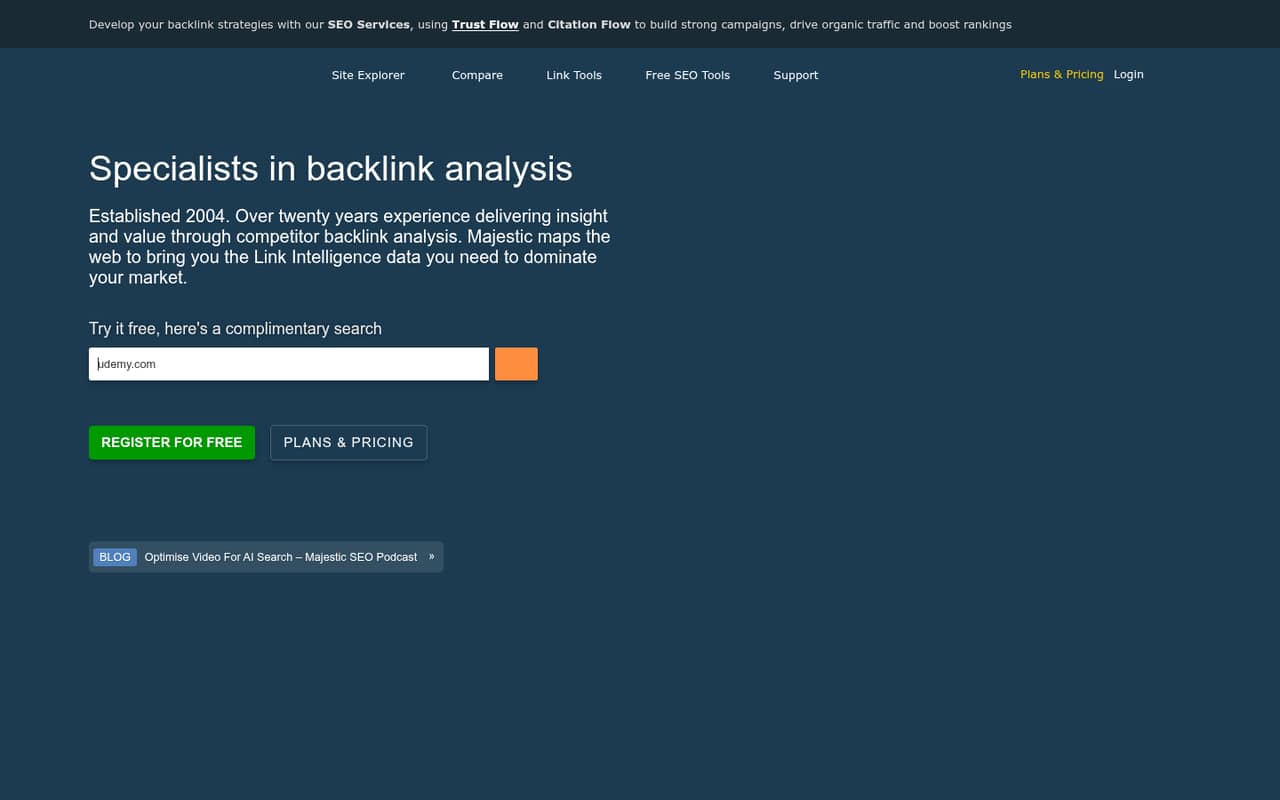
Majestic is a hosted backlink analysis service with a web app and paid API plans. Trust Flow, Citation Flow, Topical Trust Flow, and Fresh and Historic indexes give SEO teams ways to investigate link profiles and competitors.
For developers, the API is the main integration path, but Lite and Pro do not include full API access. Majestic publishes API keys and an API Reference Guide; confirm language-specific SDK support and operational limits before committing.
Good fit if
- SEO teams focused on link profiles
- API users needing backlink data
- Competitor backlink research
Skip it if
- Projects needing a free API tier
- Teams requiring self-hosted data
- Developers needing named SDKs
ScoresHow it rates
What works
- Trust Flow and Citation Flow provide distinct link metrics
- Topical Trust Flow covers more than 800 categories
- Historic Index records backlinks back to 2006
- API plans include monthly analysis-unit allowances
- Web app includes backlink research and comparison tools
What doesn't
- Full API access starts with the API — 100 million plan
- Lite and Pro have no full API access
- API rate limits are not published
- Usage does not roll over between billing cycles
- A Reddit commenter calls the interface mediocre
01What Majestic is, technically
Majestic is a hosted web application for backlink analysis, with a paid API for applications that need its link data. It sits alongside a site's analytics and SEO tooling: teams can use the web app for research, or query backlink data from a custom application through the API. It is not a library, command-line tool, or self-hosted server.
The service maps backlinks and provides tools for examining referring domains, anchor text, pages, related sites, and competitors. Trust Flow measures backlink quality, while Citation Flow measures link quantity. Topical Trust Flow evaluates relevance across more than 800 categories. The Fresh Index covers backlinks discovered in the past 120 days; the Historic Index reaches back to 2006. Those indexes and metrics make Majestic a specialist data source for link research, not a general-purpose SEO platform. The web app also includes comparison, bulk backlink, author, and reporting tools.
02Majestic API, SDKs and docs
The integration surface is the Majestic API, with API key management under API Keys and developer documentation in the API Reference Guide. The homepage also presents the API as a way to use backlink data in bespoke applications. Majestic does not name an API protocol, SDK, programming language, or CLI in its homepage materials; confirm language-specific SDK support and request and response details in the vendor's API documentation before choosing an implementation.
The browser application covers research workflows including Site Explorer, Bulk Backlinks, Compare, and Custom Reports. Majestic also lists Google Sheets and browser plugins among its free SEO tools, but those are separate from full API access. Lite and Pro do not include full API access; the API — 100 million plan is the first listed plan with it. The API plans are priced by monthly analysis units, so estimate the calls and data operations your integration needs before selecting a tier. Check the API reference for authentication, endpoint coverage, pagination, and rate limits.
03Majestic pricing for developers
Majestic has no free plan. The homepage offers a complimentary search and free SEO tools, but they are not a free API allowance. Lite costs $49.99 monthly or $41.67 per month billed annually, with 1 million analysis units per month and no full API access. Pro is $99.99 monthly or $83.33 per month billed annually, with 20 million units and no full API access.
Full API access starts at API — 100 million: $399.99 monthly or $333.33 per month billed annually, with 100 million analysis units and up to 5 users. API — 300 million costs $799.99 monthly or $666.66 annually per month; API — 1,000 million costs $1,599.99 monthly or $1,333.33 annually per month. The vendor lists Enterprise as custom-priced. Lite and Pro include 1 user; their Site Explorer limits are 5,000 and 30,000 rows per search, respectively. API — 100 million includes 50,000 rows per search. Usage does not roll over, and overage costs are not published: upgrade or wait for the next billing cycle. Annual prices are monthly equivalents billed every 12 months.
04Majestic: open source, self-hosting and lock-in
Majestic is sold as a hosted service. The vendor doesn't publish an open-source licence or self-hosting option, so teams should treat its index and metrics as an external dependency rather than data they can run on their own infrastructure.
The app lists Custom Reports and PDF Report tools, but those features alone do not establish a complete, portable export path for API data or saved research. Ask the vendor what data can be exported, in what formats, and whether API access supports the fields your team needs to retain. Moving away means replacing queries and workflows that depend on Majestic's backlink index and metrics; other link datasets may not reproduce the same coverage or scores. Keep your own records of any data your application needs to preserve, subject to the service's terms.
05Majestic in production
Plan around the monthly analysis-unit allowance and each plan's Site Explorer rows per search. Usage does not roll over, and Majestic does not publish overage costs in the published pricing details. The vendor doesn't publish API rate limits there either; ask about request quotas, throttling behavior, uptime commitments, and how usage is counted before relying on the service in a production pipeline. Confirm how the Fresh and Historic indexes fit your freshness requirements: Fresh covers the past 120 days, while Historic reaches back to 2006.
Treat the API key as a production credential and check the API reference for access controls and key management. Ask the vendor about security, compliance, and support commitments that apply to your plan. Reddit feedback is positive about the link metrics and forensic use, but one commenter describes the interface as “pretty mediocre user interface.” Another calls the tool frustrating despite praising its algorithm. Those reports are opinions, not service-level guarantees; evaluate the workflows your team will depend on.
From the threadsWhat users say
Reddit sentiment is mostly positive about Majestic's backlink data and metrics, especially for SEO forensics. Comments also raise concerns about the interface, with one user calling it frustrating.
Majestic is a must for any serious SEO because of Trust Flow and Citation Flow metrics
pretty mediocre user interface
Yep, it's still solid
Majestic is amazing for SEO Forensics
Questions people ask
Does Majestic have a free plan?
No free plan is listed. The homepage offers a complimentary search and links to free SEO tools, including a Backlink Checker and Majestic Million. Those offers are separate from a recurring plan and do not provide a full API allowance.
Which Majestic plan includes full API access?
The API — 100 million plan is the first listed tier with full API access. It includes 100 million analysis units per month, up to 5 users, and 50,000 Site Explorer rows per search. Lite and Pro do not include full API access.
What is the difference between Fresh and Historic indexes?
The Fresh Index covers backlinks discovered in the past 120 days. The Historic Index records backlinks going back to 2006. Lite includes Fresh only; Pro and the listed API plans include Fresh and Historic indexes.
What do Trust Flow and Citation Flow measure?
Trust Flow measures the quality of backlinks to URLs and websites. Citation Flow measures the quantity of links pointing to a website and does not distinguish high-quality from low-quality links. They are separate metrics for assessing a link profile.
Do Majestic's unused analysis units roll over?
No. The pricing terms state that usage does not roll over. If an allowance runs out, the listed options are to upgrade or wait for the next billing cycle. The vendor does not publish overage costs in the published pricing details.