
We may earn a commission if you buy through links on this page. It never changes a score or a ranking. How we make money
The bottom line
A convenient hosted scraper catalog; credit costs and platform dependency need careful review.
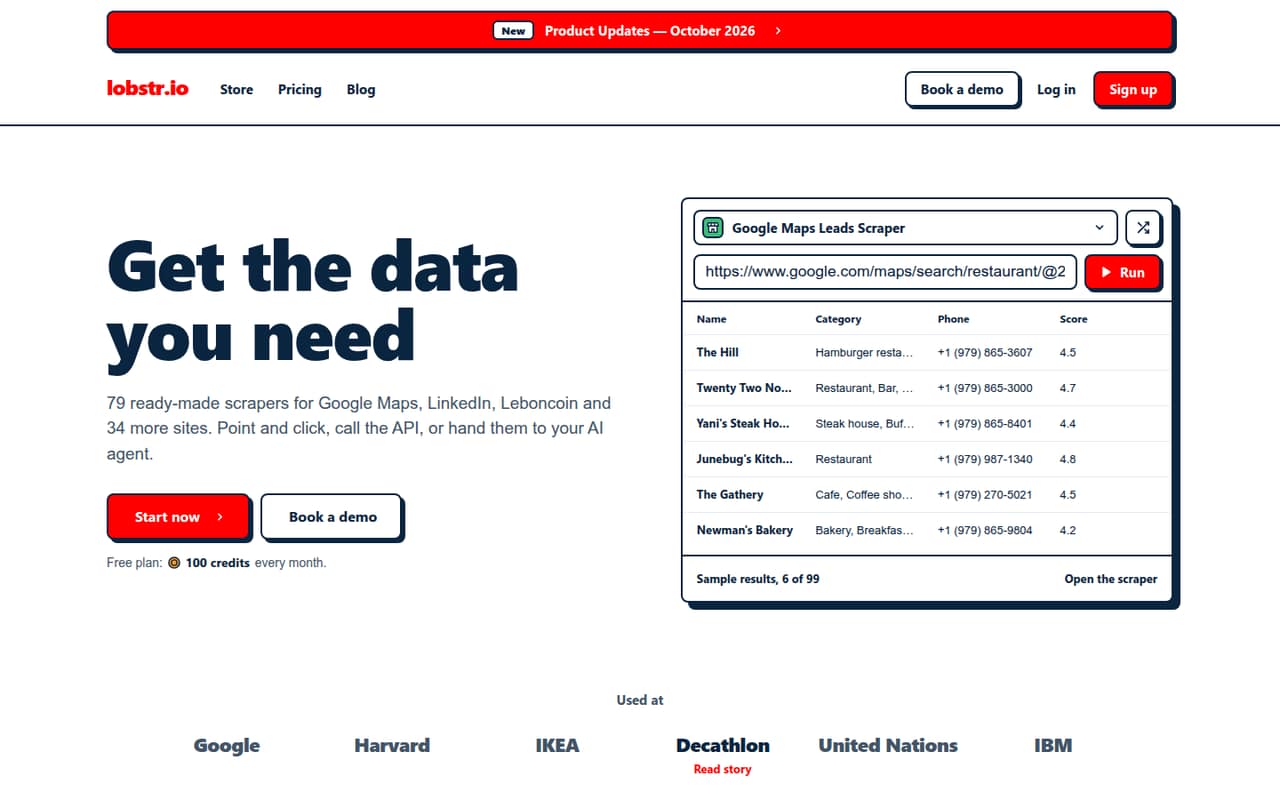
Lobstr.io is a hosted web-scraping platform, not a library or self-hosted scraper. It provides 79 ready-made scrapers across 37 sites, with runs launched from a dashboard, API or MCP client. Results can go to exports and connected destinations such as Google Sheets, Amazon S3, webhooks and email.
The free plan includes 100 credits per month, one concurrent run and seven-day result retention, but no schedules. Paid plans start at $16 per month with annual billing. Lobstr.io suits teams that want managed scrapers without operating proxies or servers; teams needing self-hosting, published SDKs or predictable per-result costs should check those details before committing.
Good fit if
- Teams needing managed website data collection
- No-code users who want ready-made scrapers
- AI-agent workflows using MCP
Skip it if
- Teams requiring self-hosted scraping infrastructure
- Developers needing documented SDKs in a specific language
- Workloads needing unmetered, predictable collection costs
ScoresHow it rates
What works
- 79 ready-made scrapers cover 37 sites
- Runs execute on Lobstr.io servers
- Dashboard, API and MCP access
- Free plan includes 100 monthly credits
- Unlimited exports on listed plans
What doesn't
- Usage consumes credits, including optional extras
- Free plan excludes scheduled runs
- Concurrent-run limits vary by plan
- Vendor does not publish a self-hosting option
- SDK languages and rate limits are not published
01What Lobstr.io is, technically
Lobstr.io is a hosted web-scraping SaaS: its scrapers run on the vendor’s servers, rather than inside your application or on infrastructure you manage. The platform combines a no-code dashboard with an API and an MCP server. It is not presented as a scraping library, command-line tool or self-hosted server.
The service handles the operational work behind its ready-made scrapers, including servers and proxies. You provide links, keywords, cities or CSV inputs; Lobstr.io runs the selected scraper and returns collected rows. Its catalog lists 79 scrapers across 37 sites, including Google Maps, LinkedIn, Vinted and Reddit. Optional extras can add emails, phone numbers and profile details.
In a stack, Lobstr.io sits between websites and the systems that consume their data. The vendor lists exports and destinations including Google Sheets, Amazon S3, webhooks and email. Teams can launch jobs through the dashboard, API or an MCP client such as Claude, ChatGPT or Cursor.
02Lobstr.io API, SDKs and docs
Lobstr.io offers an API for running scrapers and an MCP server at https://mcp.lobstr.io/mcp. The vendor describes 22 MCP tools for discovering scrapers, checking inputs and prices, building runs, starting them with approval, tracking progress and reading results. Its homepage says users can authenticate to MCP with their Lobstr.io account, without copying an API key.
The dashboard supports scraper selection, inputs such as links and keywords, CSV uploads, schedules and run monitoring. The vendor also lists Google Sheets, Amazon S3, webhooks and email as result destinations. Scrapers that need a login can use the customer’s account, synced through a Chrome extension.
The homepage names no programming languages, SDK packages, CLI or API protocol. Confirm SDK support and API authentication, request formats, pagination and error handling in the vendor’s documentation before designing an integration. The available integration surfaces are the API, MCP, dashboard and listed result destinations; do not assume a particular language binding or REST interface.
03Lobstr.io pricing for developers
The pricing page lists a Free plan at $0 with 100 credits per month, one concurrent run, seven-day result retention and unlimited exports. It includes most scrapers but no schedules. Starter costs $20 monthly or $16 per month with annual billing; it includes 10,000 credits, two concurrent runs and every scraper, including schedules. Pro is $100 monthly or $80 annually per month for 100,000 credits and 10 concurrent runs. Team is $500 monthly or $400 annually per month for 1,000,000 credits and 50 concurrent runs. Annual billing is billed once a year and takes 20% off.
All paid tiers list 45-day result retention except Team, which lists 90 days. Custom plans cover more than 1,000,000 credits and offer volume pricing, with no price listed. Optional emails, phone numbers and other scraper extras add credits per result; the pricing page lists no fixed add-on prices.
The platform meters usage in credits, so workload cost depends on scraper runs and selected extras. When credits run out, the homepage says a run pauses and resumes after a top-up or at the next cycle. Check a scraper’s credit estimate and any enrichment cost before budgeting recurring production jobs.
04Lobstr.io: open source, self-hosting and lock-in
Lobstr.io is presented as a cloud service, with scraper runs handled on its servers. The vendor does not publish a source-code license or a self-hosting option, so teams should treat it as a hosted dependency unless the vendor confirms otherwise. There is no basis to plan on deploying its scraper catalog inside your own environment.
The platform lists unlimited exports on every priced plan and names Google Sheets, Amazon S3, webhooks and email as destinations. That gives teams ways to move collected results into other systems. The vendor does not publish an export format or an API-based bulk migration path here, so confirm those details and test a representative export before building a long-term data pipeline.
Migration effort also depends on how much logic lives in Lobstr.io’s scraper definitions and how your workflows use its credits, schedules and MCP tools. Keep downstream processing independent where possible, and ask the vendor about data portability and account closure before committing.
05Lobstr.io in production
The main published capacity controls are monthly credits and concurrent runs: from one slot on Free to 50 on Team. The vendor says runs pause when credits run out and resume after a top-up or at the next billing cycle. Results are retained for seven days on Free, 45 days on Starter and Pro, and 90 days on Team. Plan exports or downstream storage around those windows.
The homepage describes hourly, daily and custom schedules on paid plans, along with CSV inputs and runs across thousands of inputs. It does not publish API rate limits, uptime commitments, service-level agreements or detailed retry behavior. Ask the vendor about these limits, scraper change handling and support response targets for workloads with delivery deadlines.
Scrapers that need accounts use customer logins synced through a Chrome extension. Before connecting production accounts, review the vendor’s security and data-handling terms, access controls and compliance documentation. The homepage does not state specific compliance certifications or security guarantees. Validate whether the service’s account access and retention model fits your data and contractual requirements.
Questions people ask
What does Lobstr.io do?
Lobstr.io runs ready-made web scrapers on its cloud platform and returns collected website data. The vendor lists 79 scrapers across 37 sites, including Google Maps, LinkedIn, Vinted and Reddit. You can launch runs from its dashboard, API or MCP server, then export results or send them to listed destinations.
Does Lobstr.io have an API or SDKs?
Lobstr.io offers an API and an MCP server, and its homepage describes 22 MCP tools for finding scrapers, preparing runs and retrieving results. The homepage does not name programming languages or SDK packages. Check the vendor’s documentation for current SDK support, API authentication details and request limits before implementation.
How much does Lobstr.io cost?
The Free plan costs $0 and includes 100 credits per month. Paid plans start at $20 monthly, or $16 per month with annual billing. Higher tiers cost $100 or $500 monthly, with annual-billing rates of $80 and $400 per month. Optional scraper extras consume additional credits per result.
Can Lobstr.io run scrapers on a schedule?
Yes. The pricing page says schedules are available on paid plans, while the Free plan has no schedules. The homepage describes hourly, daily and custom schedules. Check the selected scraper’s options and credit estimate before setting up recurring collection, since usage consumes the plan’s monthly credit allowance.
Can I self-host Lobstr.io or export my data?
Lobstr.io presents itself as a cloud service, with scrapers running on its servers; the vendor does not publish a self-hosting option or source-code license. All listed plans include unlimited exports, and the vendor names destinations such as Google Sheets, Amazon S3, webhooks and email. Confirm export formats and migration details with the vendor.