
We may earn a commission if you buy through links on this page. It never changes a score or a ranking. How we make money
The bottom line
A capable, free gateway; pin releases and assess supply-chain risk before it holds production credentials.
LiteLLM is a self-hosted gateway that puts models, agents and MCP servers behind an OpenAI-compatible API. Its routing, virtual keys, budgets and spend tracking suit platform teams that need shared controls across providers.
The free Open Source plan makes it easy to evaluate, but production teams should account for self-hosting and model-provider costs. Reddit users reported serious supply-chain incidents involving LiteLLM packages and images, so release controls and credential handling belong in the adoption decision.
Good fit if
- Platform teams managing multiple model providers
- Self-hosters needing shared access controls
- Teams routing requests across models
Skip it if
- Teams unwilling to operate a gateway
- Environments with weak release controls
- Buyers needing published enterprise pricing
ScoresHow it rates
What works
- One OpenAI-compatible API for 140+ providers
- Routes requests without app-code model changes
- Tracks spend across keys, teams and agents
- Free, self-hosted Open Source plan
- Supports budgets, rate limits and SSO
What doesn't
- Self-hosting adds infrastructure and operations work
- Enterprise pricing is custom and annual
- Numerical gateway limits are not published
- Repository licence needs verification before adoption
- Reddit users report package and image compromises
01What LiteLLM is, technically
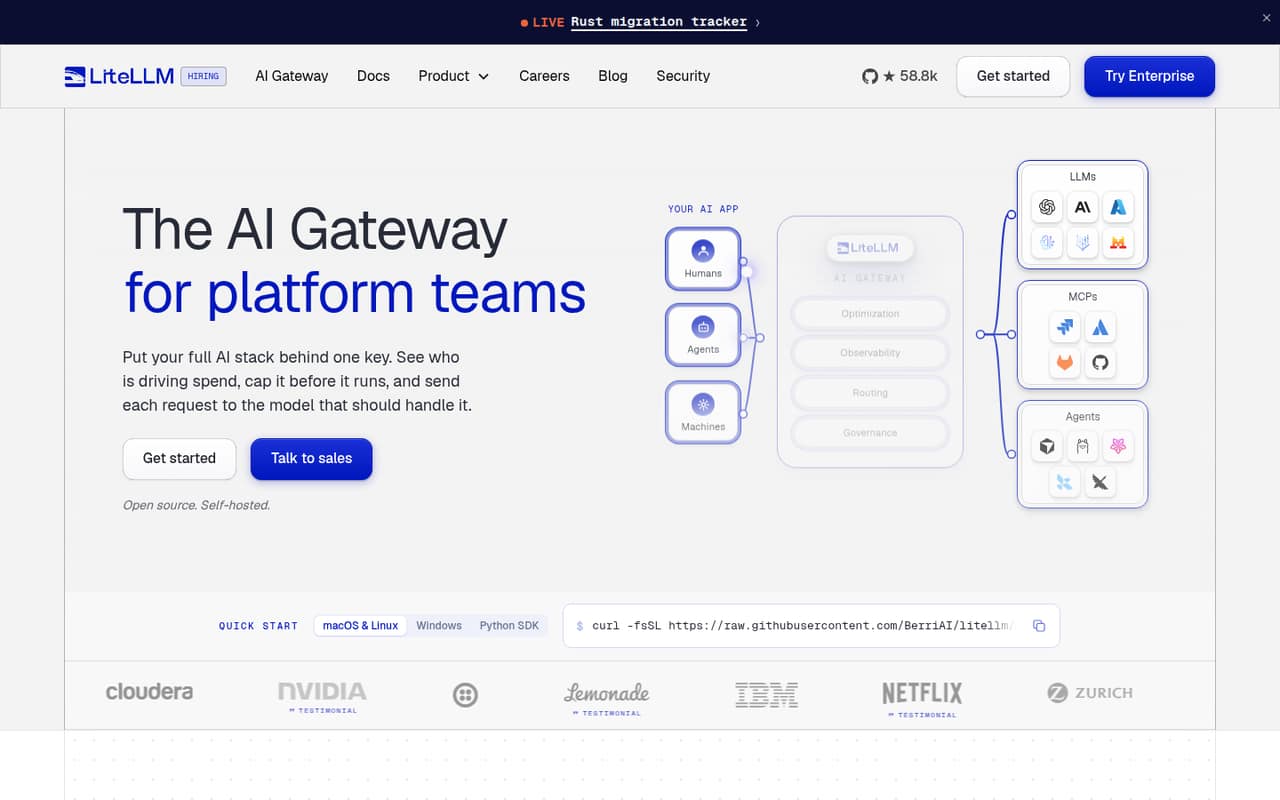
LiteLLM is a self-hosted AI gateway, not just a hosted API or a model provider. It sits between your applications and model, agent and MCP endpoints, giving clients one OpenAI-compatible API and key to use across providers. Its job is to route requests, control access, and collect usage and spend data.
For a platform team, that puts LiteLLM in the same operational path as an API gateway or internal service proxy. The homepage says teams can use it with internal, fine-tuned and self-hosted models, as well as external providers. It also describes routing, governance, observability and optimization as gateway functions. Teams can scope access by team, project or app, and set budgets and rate limits; requests stop when caps are reached, according to the product facts.
The trade-off is operational ownership: self-hosting means your team runs the gateway and manages its deployment. LiteLLM says it supports 140+ providers and 1,800+ models.
02LiteLLM API, SDKs and docs
The main integration surface is an OpenAI-compatible API. The vendor says it covers 140+ providers and 1,800+ models, with model swaps handled in gateway configuration rather than app code. That makes it a fit for applications already using an OpenAI-style request pattern, though provider-specific features and behavior still need validation against the docs.
LiteLLM names a Python SDK for calling 100+ LLMs in the OpenAI format. It also offers a liteagents SDK, described as an agent SDK that routes each turn to an appropriate model across providers. The homepage links to AI Gateway docs and provides a quick-start installation option for macOS, Linux and Windows; its shell command downloads and runs a script. Confirm current installation steps and SDK support in the vendor's docs before standardizing on them.
The gateway also exposes spend tracking, key management and access controls through its product interface. The homepage does not name SDKs for other languages, so teams using another language should verify their client approach and supported API behavior in the docs.
03LiteLLM pricing for developers
The Open Source plan costs $0 per month and is listed as free forever. It includes one OpenAI API for 100+ providers, virtual keys, users and teams, spend tracking, budgets, rate limits, fallbacks, request logging and Prometheus metrics. That is a useful starting point for teams willing to host and operate the gateway themselves.
Enterprise is quoted annually. The pricing details say the quote depends on gateway request capacity, deployment architecture and support needs. Its listed features include SSO, SCIM, OIDC/JWT authentication, audit logs, secret managers, a multi-region control plane, and optional 24/7 support and SLAs. Air-gapped deployment is also available. A 30-day free trial is listed, but confirm which plan it applies to before budgeting around it.
The vendor doesn't publish a numerical request allowance, overage price or rate-limit tier for these plans. Open Source has no listed LiteLLM subscription fee, but self-hosting requires infrastructure and model providers may charge separately for inference. Ask Enterprise sales how capacity is measured and what happens when it is exceeded.
04LiteLLM: open source, self-hosting and lock-in
LiteLLM describes itself as open source and self-hosted, and its quick-start command points to a public GitHub repository. The homepage does not identify the repository's licence; check the licence text and distribution terms before embedding it in a commercial product or modifying it for internal use.
The vendor's main lock-in reduction is the OpenAI-compatible API and the ability to swap models through gateway configuration without changing app code. That can reduce application-level migration work, but it does not guarantee that provider-specific parameters, tool calls or response behavior will transfer unchanged. A commenter on r/Python also noted that provider edge cases matter regardless of which abstraction layer a team uses.
The homepage interface shows an Export control, but it does not establish which data that exports. Before adoption, confirm how to export spend records, configuration and logs, and test a route that bypasses the gateway. That gives you a practical exit path if you later replace the proxy.
05LiteLLM in production
LiteLLM offers production controls such as budgets, rate limits, SSO, audit logs and secret-manager integration, with some governance features listed under Enterprise. The vendor doesn't publish numerical gateway request limits or capacity tiers, so ask about throughput, scaling behavior and overages before sizing a deployment. Also confirm how caps behave during provider failures and how logs handle sensitive prompts and credentials.
Release security deserves specific review. Reddit users reported that LiteLLM 1.107.0 on PyPI and official Docker images carried credential-stealing malware and a backdoor; another thread reported compromised 1.82.7 and 1.82.8 packages. These are user reports, not a substitute for a vendor incident statement, but they describe a material risk for a gateway that holds provider credentials. Pin exact versions, verify package and image provenance, and define a credential-rotation process.
A Reddit commenter recommended pinning versions and checking hashes in CI. Treat upgrades as controlled production changes rather than allowing floating image tags to update automatically.
From the threadsWhat users say
Reddit sentiment is sharply negative around reported security incidents, with some users arguing the gateway remains useful and migration depends on workload. The most consistent concern is trust in package releases and the blast radius of credentials held by a proxy.
LiteLLM again....!
pin to 1.106.2
Migration from litellm only requires a one-line base URL change
fwiw using any of these as a proxy layer will isolate you more from attacks vs running it locally as an SDK
Questions people ask
Is LiteLLM free?
Yes. The Open Source plan is listed at $0 per month and as free forever. It includes the gateway, virtual keys, users and teams, spend tracking, budgets, rate limits, fallbacks, request logging and Prometheus metrics. You still need to provide the infrastructure to run a self-hosted deployment and account for model-provider charges.
How do I install LiteLLM on Windows?
The LiteLLM homepage provides a Windows quick-start option alongside macOS, Linux and Python SDK options. It shows a shell installation command for the quick start. Check the current vendor docs for Windows-specific prerequisites, deployment steps and supported installation paths before using it in a production environment.
How much latency does LiteLLM add?
The vendor does not publish a latency figure on the vendor's site. The gateway adds a service hop between your application and model provider, but the actual effect depends on deployment location, request path and provider response time. Measure it with your own routes, payloads and failure conditions before setting production latency budgets.
Does LiteLLM work with existing OpenAI API code?
LiteLLM describes its gateway API as OpenAI-compatible and says teams can swap models without changing app code. Compatibility does not guarantee that every provider-specific option behaves identically. Validate the request and response features your application depends on, especially tools, streaming and provider-specific parameters, against the vendor docs.
Is LiteLLM safe to run in production?
LiteLLM lists production controls including budgets, rate limits, access management and secret-manager integration. Reddit users also reported compromised LiteLLM package and Docker image releases. Treat the gateway as a sensitive credential boundary: pin versions, verify artifacts, control updates and prepare to rotate provider keys if an environment is affected.
Sources
- LiteLLM homepage
- LiteLLM pricing page
- Reddit: Heads up if you self-host LiteLLM: the 1.107.0 Docker image (and the latest/main-latest/main-stable tags) shipped a credential stealer
- Reddit: litellm 1.107.0 on PyPI is compromised
- Reddit: Alert! LiteLLM 1.107.0 was compromised today
- Reddit: After the supply chain attack, here are some litellm alternatives