
We may earn a commission if you buy through links on this page. It never changes a score or a ranking. How we make money
The bottom line
A spec-first AI coding assistant with useful workflow controls and a credit meter to watch.
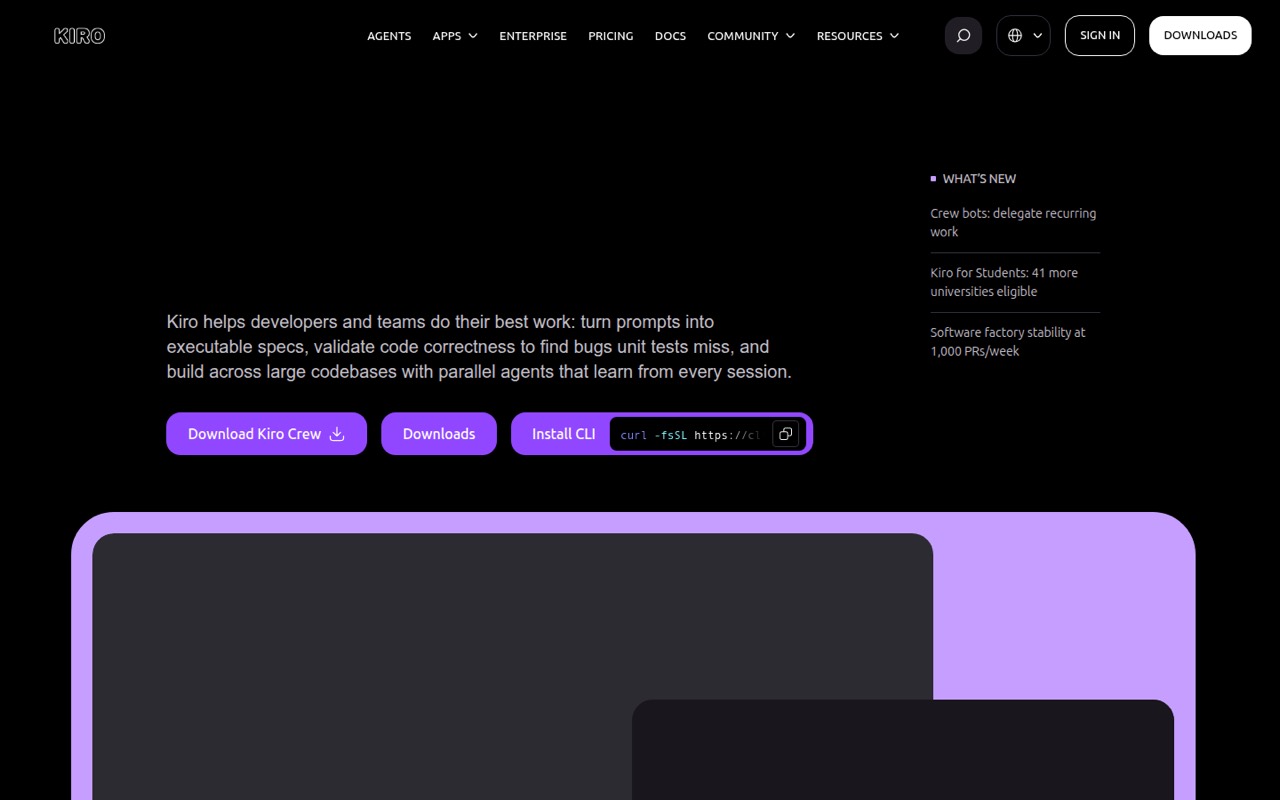
Kiro is an AWS-built AI coding assistant that turns prompts into requirements, architecture and sequenced tasks, then implements them with parallel agents. Its strongest differentiator is the spec-and-test workflow: it checks requirements for gaps and contradictions, then uses property-based tests to check rules across inputs.
It fits developers who want a more structured agent workflow and a choice of models. Kiro also has a CLI for CI/CD, but the vendor does not publish a public API or SDK surface. Reddit sentiment is mixed: some users value its speed and CLI, while others report bugs, clunky IDE workflows and model-integration concerns.
Good fit if
- Developers who work from written specs
- Teams automating PR review in CI/CD
- Engineers who want model choice
Skip it if
- Teams requiring a public coding API
- Developers who need self-hosted software
- Users who want predictable task costs
ScoresHow it rates
What works
- Turns prompts into requirements, designs and sequenced tasks
- Runs parallel agents locally or in the cloud
- Checks requirements for contradictions before coding
- Property-based tests check rules across inputs
- CLI can review PRs and fix bugs in CI/CD
What doesn't
- No published public API or SDK surface
- Credits vary in cost by selected model
- No self-hosted Kiro server option is documented
- Reddit users report IDE and agent bugs
- Data export and migration paths are not published
01What Kiro is, technically
Kiro is an AWS-built AI coding assistant delivered through an IDE and a CLI. It sits alongside a developer’s editor, repository and CI/CD workflow; it is not a library or a documented hosted API that an application calls at runtime. Its core workflow turns a prompt into requirements, an architectural design and sequenced tasks before agents implement the work.
Kiro’s agent can run on a local machine or in the cloud, with multiple agents working in parallel. Before code is written, automated reasoning checks requirements for contradictions and gaps. Property-based tests then check whether rules hold across inputs, rather than only checking a few examples. The idea is to add a planning and verification layer between a request and code changes. Kiro can also pull context from tools such as Figma or Terraform, and its headless CLI can run in CI/CD to review pull requests and fix bugs. That puts it in the developer workflow, not the deployed application stack.
02Kiro API, SDKs and docs
Kiro’s documented integration surface is its IDE, CLI and agent compatibility, rather than a public application API. The vendor does not publish a public API or SDK for embedding Kiro in an application; confirm SDK support in Kiro’s docs before designing around one. Its headless CLI is intended for CI/CD and can review pull requests and fix bugs without opening an editor.
The Kiro agent supports Agent Client Protocol (ACP), AGENTS.md, Skills.md and MCP. The IDE supports Open VSX extensions, themes and VS Code settings. The CLI works with bash, zsh, fish and over 500 popular CLIs. Kiro can also pull context from tools such as Figma or Terraform. The product offers a model picker with Claude, GPT, DeepSeek, Qwen or Auto; Auto selects a model based on task complexity, quality, latency and cost. The vendor describes the workflow, but teams should validate how these integration points fit their existing editor, agent and CI conventions.
03Kiro pricing for developers
Kiro Free costs $0 and includes 50 credits per month, access to open-weight models and Claude Sonnet 4.5. Paid individual plans start at Kiro Pro for $20 per user per month, with 1,000 credits and premium models. Kiro Pro+ is $40 for 2,000 credits; Pro Max is $100 for 5,000; and Power is $200 for 10,000. Each paid tier lists add-on credits at $0.04 per credit.
Teams / Enterprise (Credit Pooling) costs $20 per seat per month and pools 500 included monthly credits per seat across the team. Additional pooled credits cost $0.04 each. Credit packs range from $5 for 125 credits to $100 and expire 12 months after purchase. Model choice changes consumption: Kiro lists some models at a fraction of Auto’s credit cost and others at multiple times the cost. The vendor says there are no daily or weekly rate limits, but credits still cap included usage. Subscriptions bill monthly; upgrades are prorated to the second, with subscriptions processing on the first of each month. GovCloud is approximately 20% higher and has no Free tier.
04Kiro: open source, self-hosting and lock-in
Kiro is an AWS-built commercial product. The vendor does not publish an open-source license for Kiro itself; access to open-weight models does not make the IDE or agent open source. Kiro agents can run locally or in the cloud, but that is not the same as self-hosting the Kiro service. There is no self-hosted server option documented.
The vendor does not publish a data-export or migration path. Specs and code changes are part of a workflow built around Kiro’s agent harness, so teams should check what artifacts they can retain and use outside Kiro before adopting it across a codebase. Reddit users have described the subscription as locking them into the Kiro harness. Keep requirements, tests and source changes in formats your team can maintain independently, and confirm export and account-termination details with AWS if they matter to your deployment.
05Kiro in production
Kiro’s CI/CD CLI can review pull requests and fix bugs, while property-based tests are designed to check behavioral rules across inputs. Those capabilities do not remove the need to review generated changes, test them in your own pipeline and set repository permissions carefully. Kiro says its enterprise offering includes IAM and SSO authentication, usage dashboards, cost controls, governance and administration controls. It also lists IP indemnity with model exclusions. Confirm which models are covered and which controls apply to your plan.
The pricing page says Kiro has no daily or weekly rate limits, but the vendor does not publish a throughput ceiling here; ask about concurrency and service-level commitments before relying on it for critical CI. Reddit reports vary: some users praise the CLI and speed, while others describe MCP failures on long tasks, IDE clunkiness, slow execution and bugs. Treat those as individual reports, not measured reliability data. Budget credits by model and retain normal code review and rollback practices.
From the threadsWhat users say
Reddit sentiment is mixed. Some developers say Kiro works well for solo or workplace use; others report bugs, awkward IDE workflows and concerns about model availability and value.
Kiro CLI feels way better. The IDE feels unnecessarily clunky
And they stubbornly refuse to add new models
I 100% wouldn't pay for kiro as an individual user
Questions people ask
Is Kiro an IDE, an API or a coding agent?
Kiro is an AI coding assistant available through an IDE and CLI, with agents that can work locally or in the cloud. The vendor documents ACP, MCP and CLI integrations, but does not publish a public API or SDK for embedding Kiro in an application.
Can Kiro run in CI/CD?
Yes. Kiro’s headless CLI can run in CI/CD to review pull requests and fix bugs without opening an editor. Check how its permissions, credit use and concurrency fit your pipeline before making it a required production step.
Which models can I use with Kiro?
Kiro’s model picker includes Claude, GPT, DeepSeek, Qwen and Auto. Auto picks a model for a task based on complexity, quality, latency and cost. Credit consumption varies by model, so the same workflow can use different amounts depending on your selection.
Can Kiro use my existing editor settings and tools?
The Kiro IDE supports Open VSX extensions, themes and VS Code settings. The agent supports ACP, AGENTS.md, Skills.md and MCP, while the CLI works with bash, zsh, fish and over 500 popular CLIs.
Is Kiro suitable for enterprise use?
Kiro lists IAM and SSO authentication, usage dashboards, cost controls, governance and administration controls for enterprise users. It also lists IP indemnity with model exclusions. Confirm plan eligibility, model coverage and security requirements with AWS before committing.