
We may earn a commission if you buy through links on this page. It never changes a score or a ranking. How we make money
The bottom line
Jules turns GitHub tasks into reviewable pull requests, but its API and pricing details are thin.
Jules is a hosted coding agent that works from a GitHub repository and branch, runs in a cloud VM, and can prepare a pull request. Its review-and-approve workflow fits teams that want delegated coding without adding a local agent to their development environment.
The trade-off is limited published detail for developers building Jules into a wider stack: the homepage describes GitHub-based workflows, not an API, SDK or CLI. The free tier has task and concurrency caps, while paid plan prices are not published.
Good fit if
- GitHub-first development teams
- Delegating routine repository tasks
- Reviewing AI changes through pull requests
Skip it if
- Teams requiring a documented agent API
- Self-hosted coding-agent deployments
- Buyers needing predictable published pricing
ScoresHow it rates
What works
- Works from a selected GitHub repository and branch
- Can be assigned through a GitHub issue label
- Runs repository work in a cloud VM
- Shows a diff before code edits are approved
- Creates a pull request for review and merge
What doesn't
- Paid plan prices are not published
- Task and concurrency limits vary by plan
- API, SDK, language and CLI details are absent from the homepage
- No self-hosting or source-license details are published
- Data export and production service commitments need confirmation
01What Jules is, technically
Jules is a hosted AI coding agent, not a library, local CLI or self-hosted server. You select a GitHub repository and branch, write a task prompt, and Jules fetches and clones the repository to a cloud VM. It develops a plan, makes code changes, presents a diff, and can create a pull request for you to review and merge.
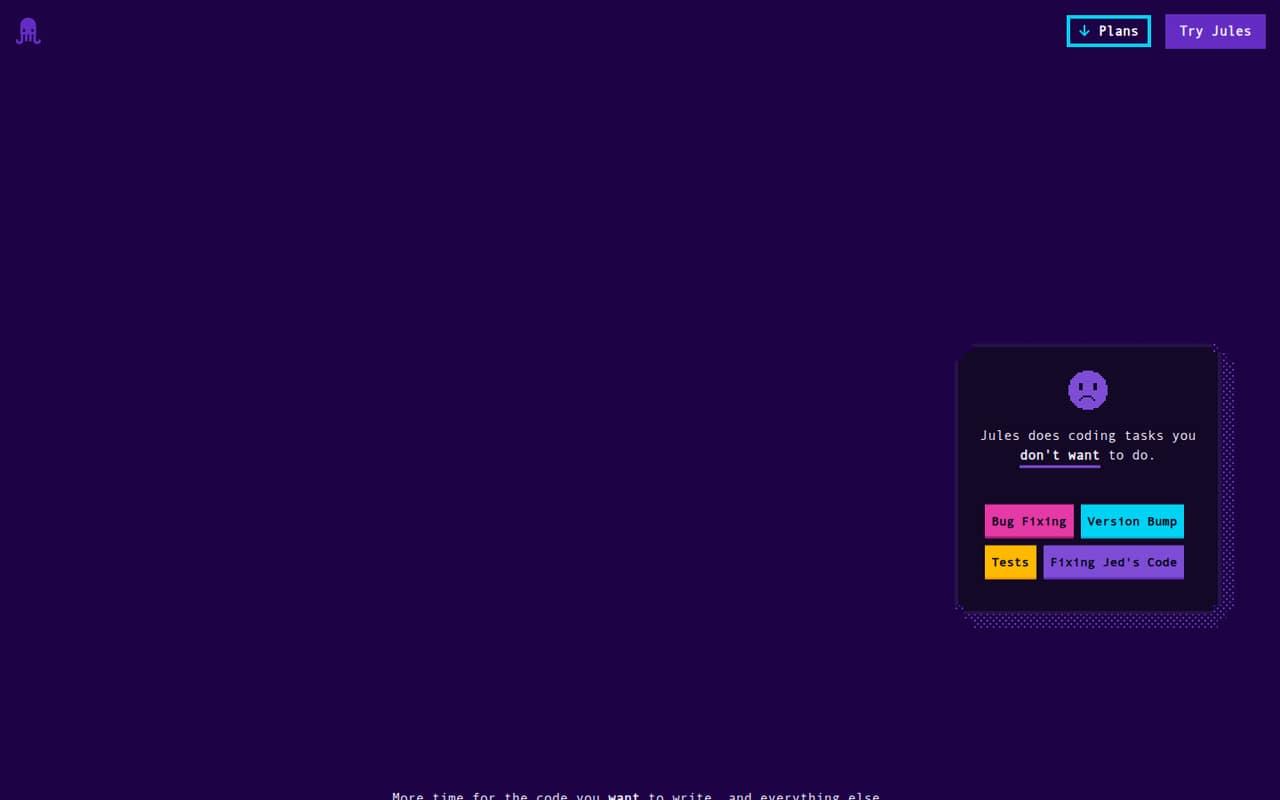
That puts Jules alongside your repository workflow rather than inside your application at runtime. It targets delegated engineering work such as bug fixes, version bumps, tests and feature building. You can also assign a task directly from GitHub by adding the “jules” label to an issue. The output is a proposed code change in the repository, not a running service or an API response for your product. The practical boundary is review: Jules prepares changes, while a developer approves edits and merges the resulting PR.
02Jules API, SDKs and docs
The homepage describes a GitHub-centered workflow: choose a repository and branch, enter a detailed prompt, or assign an issue with the “jules” label. Jules clones the repository to a cloud VM, plans the work, shows a diff, and can open a pull request. That is the documented integration surface for developers working from the published product details.
The homepage does not present a REST API, webhooks, SDKs, supported programming languages or a CLI workflow. This matters if you want to trigger coding tasks from CI, an internal developer portal or another agent orchestrator rather than through GitHub. Confirm API and SDK support, authentication, event handling and language-specific setup in the vendor’s docs before designing that integration. The GitHub issue-label route is the clearest stated path for assigning work from an existing codebase; Jules still expects a human to review and merge the proposed change.
03Jules pricing for developers
Jules has a free tier. The listed allowance is 15 tasks per rolling 24 hours and three concurrent tasks, with Gemini 2.5 Pro access. The homepage describes that allowance as 15 tasks per day. The account restriction is Individual Google Accounts only.
Jules in Pro lists 100 tasks per rolling 24 hours and 15 concurrent tasks, with access to newer models starting with Gemini 3 Pro. Jules in Ultra lists 300 tasks per rolling 24 hours and 60 concurrent tasks, plus priority access to newer models starting with Gemini 3 Pro. Both are also limited to Individual Google Accounts. Monthly and annual prices are not published; the pricing information says Pro and Ultra are included with their respective Google AI plans. No add-on or overage prices are listed, so exceeding a plan’s task allowance is a capacity question rather than a calculable usage bill from the published figures. Ask Google to confirm current plan prices, reset timing and what happens at the task cap before budgeting for a production team.
04Jules: open source, self-hosting and lock-in
The published Jules materials do not publish a source-code license or describe an open-source distribution. They also do not describe a self-hosted deployment; the workflow runs repository work on a cloud VM. Treat Jules as a hosted service unless Google confirms otherwise, and ask about data handling, retention and any available export options before sending proprietary code.
The repository itself remains on GitHub, and Jules presents changes as a diff and pull request that can be reviewed and merged there. That keeps the code change in a familiar Git workflow, but does not establish that task history, plans or other Jules data can be exported. If you later move to another agent, the repository and merged code remain usable; portability of Jules-specific records and workflows is not published. Confirm those details, along with the applicable source license, before making Jules a dependency in internal tooling.
05Jules in production
Plan around the published task and concurrency caps: the free tier lists 15 tasks per rolling 24 hours and three concurrent tasks; Pro lists 100 and 15; Ultra lists 300 and 60. The homepage frames these as daily task allowances. Confirm how tasks are counted, when limits reset and what happens when a cap is reached before using Jules for time-sensitive release work.
Jules works with a cloud VM and GitHub repository, so review repository permissions and the handling of source code before assigning sensitive work. The published materials do not state service-level commitments, security certifications, data-retention terms or an incident process; ask Google for those before making it part of a production workflow. Reddit reactions are positive but anecdotal: one r/LocalLLaMA poster said Jules handled substantial work autonomously, while a Jules community post said a new version was in development. Neither is evidence of reliability at scale. Keep human review and pull-request approval in the release path.
From the threadsWhat users say
The available Reddit discussion is enthusiastic about Jules’ ability to handle substantial coding work, but it is anecdotal. A Jules community post also signals active development, without offering production reliability evidence.
I've just been playing with Google Jules and honestly, I'm incredibly impressed by the amount of work it can handle almost autonomously
The difference might just be the model jump from flash to pro, but still amazing
Some folks on this reddit have early access!
We're pretty heads down on building a new version of Jules
Questions people ask
How does Jules work with GitHub?
You select a GitHub repository and branch, then give Jules a task prompt. You can also assign work from an issue using the “jules” label. Jules fetches and clones the repository to a cloud VM, prepares changes, shows a diff and can create a pull request for review.
Does Jules have an API, SDK or CLI?
The Jules homepage describes a web workflow and GitHub issue-label assignment. It does not name a public API, SDK, supported language or CLI. Confirm those options in the vendor’s docs before planning to trigger Jules from CI, an internal tool or another agent.
How much does Jules cost?
The free Jules plan lists 15 tasks per rolling 24 hours and three concurrent tasks. Paid prices are not published. Jules in Pro and Jules in Ultra list higher task and concurrency limits and are included with their respective Google AI plans; ask Google for current prices.
Can I self-host Jules or use it offline?
The described workflow uses a cloud VM to clone and work on a GitHub repository. The published product details do not describe self-hosting or offline use. Treat Jules as a hosted service and confirm deployment options and code-handling terms with Google before assigning private repositories.
Does Jules merge code automatically?
Jules can create a pull request, but the described workflow calls for users to review and approve the changes, merge the PR and publish it on GitHub. It also presents a diff for code review. Keep your normal review and release controls in place rather than assuming a task is production-ready.