
We may earn a commission if you buy through links on this page. It never changes a score or a ranking. How we make money
The bottom line
A focused time-series database with a free local edition and usage-priced cloud hosting.
InfluxDB is a time-series database for continuous operational data, available as self-managed software, AWS-hosted service, or InfluxData cloud plans. The homepage names Python, JavaScript, Go, C#, and Java client libraries and shows SQL queries and line-protocol writes.
The free InfluxDB 3 Core edition suits local development, but it lacks high availability and enterprise security. Cloud Serverless has a $250 free credit, then charges for writes, queries, storage, and outbound transfer; production teams can also choose custom-priced managed or self-managed plans.
Good fit if
- High-resolution operational telemetry
- Edge-to-cloud time-series pipelines
- Local development with InfluxDB 3 Core
Skip it if
- Teams needing published fixed cloud costs
- Projects requiring free high availability
- Workloads centered on relational data
ScoresHow it rates
What works
- Deploy on-premises, at the edge, or in the cloud
- Client libraries listed for five languages
- SQL query and line-protocol write examples
- Free InfluxDB 3 Core for local development
- Serverless billing separates writes, queries, storage, and transfer
What doesn't
- Core has no high availability or enterprise security
- Cloud Serverless charges across four usage dimensions
- Enterprise and Dedicated prices are custom
- Core's exact open-source license is not named on the homepage
- Reddit discussions show uncertainty around version migrations
01What InfluxDB is, technically
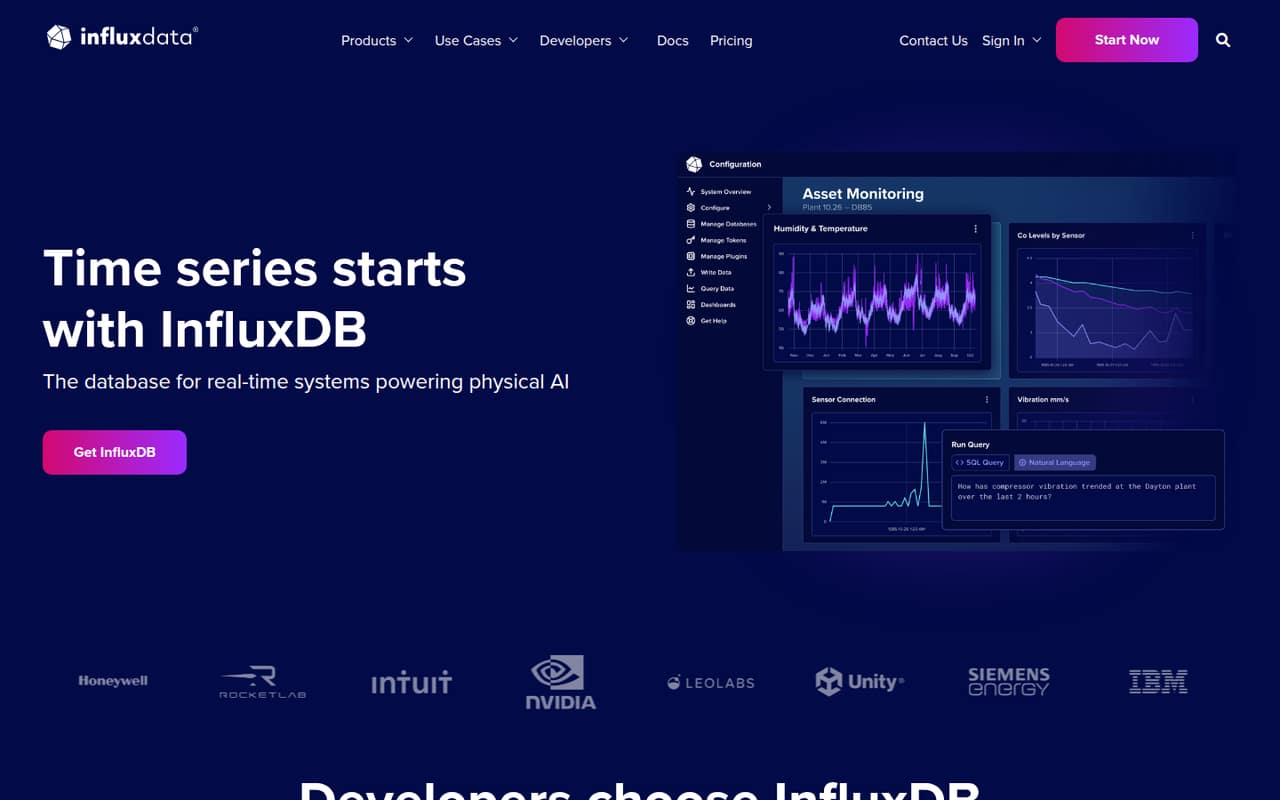
InfluxDB is a time-series database: a system of record for continuous, high-resolution operational data such as telemetry from devices, infrastructure, and industrial equipment. It sits between data producers and the systems that query, visualize, or analyze their measurements. InfluxData positions it for real-time ingest and analysis, including physical AI and edge workloads.
It is not a single deployment model. The homepage says the engine can run on-premises, at the edge, or in the cloud. The product lineup also includes InfluxDB 3 Core for Linux, Mac, and Docker; self-managed InfluxDB 3 Enterprise; Cloud Serverless and Cloud Dedicated; and Amazon Timestream for InfluxDB, billed through AWS. These options put it in a telemetry stack alongside data collectors, dashboards, and analytics or AI/ML pipelines. The homepage specifically describes Grafana monitoring and streaming cold data to lakes, warehouses, and AI/ML pipelines. Choose an edition based on whether your team wants to operate the database or pay for managed hosting.
02InfluxDB API, SDKs and docs
InfluxData’s homepage lists client libraries for Python, JavaScript, Go, C#, and Java, and links to its documentation. Its examples show Python using influxdb_client_3 and JavaScript using @influxdata/influxdb3-client. The Python example queries with SQL, including DATE_BIN, and converts results to pandas; the JavaScript example iterates over query results and uses Apache Arrow.
For writes, the Python example sends a line-protocol record through client.write(). The query examples call client.query() with SQL and a database name. These examples give developers a concrete path to writing and querying data without committing to a particular collector or dashboard. The homepage also points to integrations and describes Grafana monitoring, lakehouse destinations, and AI/ML pipelines. It does not name a command-line interface or protocol for a general-purpose HTTP API, so confirm those integration surfaces in the vendor’s docs if they are part of your deployment. The examples use host, database, and token configuration; plan how you will provision and rotate credentials.
03InfluxDB pricing for developers
InfluxDB 3 Core is free forever and open source, with Linux, Mac, and Docker options. Its stated boundaries matter: it has no high availability, no enterprise security, and community support. For a managed evaluation, Cloud Serverless includes $250 in free credit, then charges $0.0025 per MB written, $0.012 per 100 query executions, $0.002 per GB-hour stored, and $0.09 per GB transferred out.
Those four meters mean a workload’s bill depends on ingest volume, query frequency, retained data, and egress—not just database size. Cloud Serverless annual usage-commitment discounts are available by contacting sales. InfluxDB 3 Enterprise and Cloud Dedicated use custom pricing; both list no service quotas, while Enterprise includes a 30-day free trial. Enterprise also lists high availability and read replicas, SAML/SSO and OAuth, and a technical support SLA. Dedicated lists private networking and SAML/SSO as add-ons. Amazon Timestream for InfluxDB is billed to the AWS account. Telegraf Enterprise starts at $18,000 per year.
04InfluxDB: open source, self-hosting and lock-in
InfluxDB 3 Core is described as open source and runs on Linux, Mac, and Docker, giving teams a self-managed option for local use or deployment. The homepage also says InfluxDB can run on-premises or at the edge. It does not name Core’s open-source license, so check the license terms and redistribution rights before embedding it in a product.
InfluxData describes cold-data eviction that streams data to lakes, warehouses, and AI/ML pipelines, and says Parquet files store data efficiently. Those are useful parts of an export strategy, but they do not by themselves establish a complete migration path. Before adopting a managed plan, confirm what export formats and tooling are available for your edition, and test how your schema and queries translate to a replacement. Client libraries and SQL queries offer familiar integration surfaces, but edition-specific behavior can still affect migration effort.
05InfluxDB in production
InfluxData says InfluxDB can ingest millions of data points per second and is designed for high-resolution continuous data. Treat that as a product claim, not a capacity plan: benchmark with your own write shape, retention period, query mix, and deployment size. The free Core edition has no high availability or enterprise security. Enterprise and Cloud Dedicated list high availability and read replicas; their custom pricing and support terms need review before a production commitment.
The homepage does not publish a general rate-limit figure for Cloud Serverless, so confirm account-level limits and expected behavior during bursts with the vendor. Also map token handling, network boundaries, backups, and recovery ownership to your chosen deployment. Reddit discussions show that version choices and upgrades can cause operational uncertainty: a Home Assistant thread includes users weighing moves from v1 to v2 or v3, while another commenter reports switching to VictoriaMetrics because of disk use. Those are individual reports, not a universal performance comparison. Validate upgrade and retention behavior against your own workload.
From the threadsWhat users say
Reddit discussion is mixed and workload-specific. Some developers say familiar databases are adequate for modest time-series loads; others favor specialized options or raise maintenance, migration, and storage concerns.
How much will being better at querying this make your overall business?
QuestDB if you have any performance concerns whatsoever. Like Timescale, it's also simple SQL
I migrated to influxdb2 years ago. Now gotta figure out how to migrate to v3
In my experience VictoriaMetrics is far more efficient disk wise than Influx
Questions people ask
Is InfluxDB a SQL database?
The homepage’s InfluxDB 3 examples use SQL for queries, including aggregation and time bucketing with DATE_BIN. Its write example uses line protocol. The examples establish those interfaces but do not mean every InfluxDB version or edition has identical query behavior; confirm compatibility for the edition you plan to deploy.
Should I use InfluxDB 2 or 3?
Choose based on the version and integrations your stack already depends on, then verify migration requirements before switching. InfluxData’s homepage presents InfluxDB 3 Core and Enterprise, while Reddit users describe uncertainty around moving from v1 or v2 to v3. Check current vendor documentation for version support and migration steps.
Can I run InfluxDB without paying for cloud hosting?
Yes. InfluxDB 3 Core is listed as free forever and open source, with Linux, Mac, and Docker deployment. It has no high availability or enterprise security and includes community support. Teams needing those production capabilities can evaluate InfluxDB 3 Enterprise or a managed plan.
What languages have InfluxDB client libraries?
The homepage lists Python, JavaScript, Go, C#, and Java. It shows Python and JavaScript examples using the InfluxDB 3 client libraries, with SQL queries and a line-protocol write. Check InfluxData’s documentation for the current library versions and supported features for your chosen edition.
Can InfluxDB send data to other analytics systems?
InfluxData says its cold-data eviction can stream data to lakes, warehouses, and AI/ML pipelines. It also describes Parquet files and points to integrations. Confirm the supported destinations, export format, and configuration for your deployment before relying on a particular downstream system.
Sources
- InfluxDB homepage
- InfluxDB pricing page
- Reddit: should I use timescaledb, influxdb, or questdb as a time series database?
- Reddit: post-InfluxDB plans?
- Reddit: The licensing problem in small industrial automation projects — is open source (pymodbus + InfluxDB + Grafana) a viable alternative to commercial SCADA?
- Reddit: Industrial Data Logging with Node-Red, InfluxDB, and Grafana