
We may earn a commission if you buy through links on this page. It never changes a score or a ranking. How we make money
The bottom line
IFTTT is an easy hosted bridge between services, but not a self-hosted or code-first automation platform.
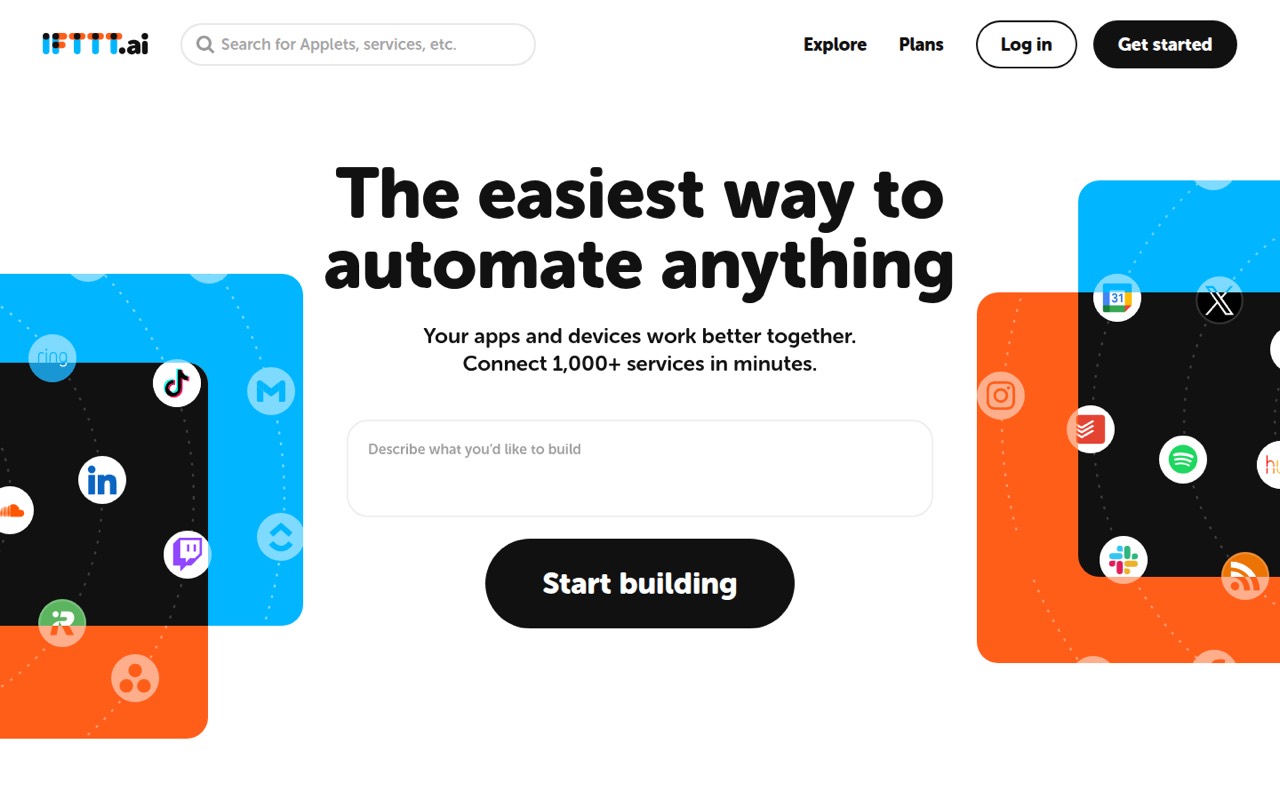
IFTTT is a hosted no-code automation service: Applets connect a trigger in one service to an action in another. Its 1,000+ integrations, AI connections and MCP server make it useful for stitching together consumer apps, devices and lightweight workflows.
The free plan includes unlimited Applets but caps use at 1,000 credits per month. Paid plans add credits, faster Applet speeds and higher support tiers. Reddit users report frustration with subscription limits, slow responses and integrations disappearing, so check the services and failure behavior your workflows depend on.
Good fit if
- Simple app-to-app automations
- Smart-home service connections
- Prompt-driven AI workflows
Skip it if
- Self-hosted workflow infrastructure
- Complex, code-first orchestration
- Workflows needing local execution
ScoresHow it rates
What works
- Connects more than 1,000 services
- Ready-made Applets reduce setup work
- Free plan includes unlimited Applets
- Connects ChatGPT, Claude and Gemini
- MCP server connects AI tools to IFTTT
What doesn't
- Free plan is capped at 1,000 credits monthly
- Paid plans are needed for higher credit allowances
- Applet speeds vary by plan
- No self-hosted deployment is presented
- Reddit users report discontinued integrations and slow responses
01What IFTTT is, technically
IFTTT is a hosted automation service, not a library, CLI or server you install in your own stack. Its core unit is an Applet: a trigger from one connected service starts an action in another. Users can enable ready-made Applets or build their own through IFTTT's app and website.
In a typical stack, IFTTT sits between SaaS apps, consumer devices and AI services. It handles the connections and runs the automation in its hosted environment; your own application does not need to run a workflow engine. The service lists more than 1,000 integrations, including Slack, Gmail and Philips Hue, and adds webpage-change triggers for things such as prices, listings and job postings.
That model suits lightweight, cross-service tasks where a visual trigger-and-action flow is enough. IFTTT also offers AI agents that query, filter and act across connected services, plus AI app connections for summarizing, translating and drafting. It is less suited to teams that need to own the runtime or build complex workflows in application code.
02IFTTT API, SDKs and docs
The integration surface IFTTT presents is its Applet builder, connected service integrations, an integration called Webhooks, and the IFTTT.ai MCP server. The homepage describes MCP as a way to connect AI tools to IFTTT services and automations. It also describes Applets as trigger-and-action workflows and says they can link two or more apps.
For AI workflows, IFTTT lists connections to ChatGPT, Claude and Gemini, as well as custom-trained agents. Agents can query, filter and take action across connected services; AI app connections can summarize, translate and draft content. These are hosted automation paths rather than a documented code-first runtime in the product overview.
Before adopting IFTTT as a code dependency, confirm supported SDKs, languages, API contracts and authentication flows in the vendor's docs. The product is easiest to integrate by selecting supported services and configuring Applets; MCP is the named protocol surface for connecting AI tools. The homepage also promotes ready-made Applets, which can reduce setup for common workflows but may not match application-specific logic.
03IFTTT pricing for developers
The Free plan costs $0 and includes 1,000 credits per month, unlimited Applets, all services and integrations, and all features unlocked. That is enough to try automations, but the credit allowance is the main usage ceiling. The pricing page does not itemize the cost of extra credits, so ask IFTTT how overages are handled before relying on a workflow at higher volume.
Starter is $2.09 per month and lists 5,000 credits, Applet speeds every 15 minutes and basic support with an 18-hour reply time; its annual total is $25.08. Pro is $5.49 per month, or $65.88 billed annually, for 20,000 credits, speeds every five minutes and prioritized support with a 12-hour reply time. Pro+ is $13.99 per month, or $167.88 billed annually, with 100,000 credits, speeds every five minutes, multiple accounts per service and dedicated support with a six-hour reply time. Enterprise has custom credits and support terms, with pricing by contacting sales. Annual billing saves about 30%, according to the pricing page.
04IFTTT: open source, self-hosting and lock-in
IFTTT is presented as a hosted service, not a self-hosted server. Its homepage does not present an open-source licence, so teams should treat it as a hosted, proprietary service unless IFTTT provides different terms. That means the automation runtime and service connections remain under the vendor's control.
The integration model also creates some lock-in: Applets depend on IFTTT's connectors and the APIs of the services they link. If a connector is changed or discontinued, a workflow may need to be redesigned around another integration path. Reddit users report that some integrations, including Alexa, have been discontinued.
Before using IFTTT for critical workflows, ask whether Applet definitions, configuration and run history can be exported, and what happens to connected-service credentials if you leave. Treat a move to another platform as a potential rebuild rather than assuming Applets can be imported. Developers who need a self-hosted runtime should evaluate that requirement before adopting IFTTT.
05IFTTT in production
The published plans set credit allowances and Applet speed tiers, but they do not establish a general API rate limit or a reliability guarantee for automation execution. Starter lists speeds every 15 minutes; Pro and Pro+ list speeds every five minutes. Those intervals matter for time-sensitive workflows, and the credit allowance matters as automation volume grows. Confirm what consumes credits and how a workflow behaves when its allowance is reached.
The service runs in IFTTT's hosted environment, so workflows also depend on IFTTT and each connected service being available. Reddit users report slow responses, discontinued integrations and a preference for local automation in Home Assistant. Those are user reports, not service-level measurements, but they flag real dependencies to test against your own requirements.
Before putting a workflow on a production path, check service permissions, handling of failed actions, retry behavior, logging, data retention and the vendor's security and compliance terms. The support reply times listed by plan are targets to consider, not a substitute for an operational fallback. Keep critical actions independently observable and avoid making IFTTT the only path for a high-impact task.
Questions people ask
What does IFTTT do?
IFTTT connects apps, devices and services through automations called Applets. You choose a trigger in one service and an action in another, then configure the workflow. It also offers AI app connections, AI agents and webpage-change triggers for workflows involving connected services.
Can I use IFTTT for free?
Yes. The Free plan costs $0 and includes 1,000 credits per month, unlimited Applets, all services and integrations, and all features unlocked. The credit allowance still limits usage, so check how your planned automations consume credits before depending on the free tier.
How do I know which IFTTT plan I need?
Compare your expected monthly credit use with each plan's allowance, then check its listed Applet speed and support terms. Free includes 1,000 credits, Starter 5,000, Pro 20,000 and Pro+ 100,000. Enterprise offers custom credits and support terms.
How often does IFTTT run Applets?
The listed Applet speeds depend on plan. Starter lists speeds every 15 minutes, while Pro and Pro+ list speeds every five minutes. The Free plan's included features do not state an Applet speed in the plan details, so confirm its expected timing for the specific service and workflow.
Does IFTTT work with AI tools?
IFTTT lists connections to ChatGPT, Claude and Gemini, plus custom-trained agents. AI app connections can summarize, translate and draft content. Its AI agents can query, filter and take action across connected services, and the IFTTT.ai MCP server connects AI tools to IFTTT services and automations.