
We may earn a commission if you buy through links on this page. It never changes a score or a ranking. How we make money
The bottom line
A capable open-source agent for developers willing to own the model, runtime and operational setup.
Hermes Agent is an open-source agent you can run on a computer or deploy to the cloud. It connects to messaging platforms and the CLI, retains conversations and skills, schedules tasks, and can delegate work to isolated subagents.
The MIT license and local runtime make it flexible to evaluate and host. The trade-off is operational ownership: pick and connect a model provider, keep long-running agents available, and tune memory and workflows as your needs grow.
Good fit if
- Developers who want self-hosting
- Messaging-based task automation
- Experimenting with agent workflows
Skip it if
- Teams needing a managed SLA
- Buyers expecting a published REST API
- Users who want zero configuration
ScoresHow it rates
What works
- MIT-licensed and free to run
- CLI, desktop and messaging integrations
- Persistent conversations, memories and skills
- Subagents have isolated conversations and terminals
- Local, Docker, SSH, Singularity and Modal sandboxes
What doesn't
- You must connect and choose a model provider
- Free Portal tier excludes hosted tools and cloud hosting
- Laptop sleep stops scheduled work
- No published request or rate-limit numbers
- Memory and profile setup may need tuning
01What Hermes Agent is, technically
Hermes Agent is an open-source agent runtime, not a hosted API or a model. You install it on a computer or deploy an agent to the cloud through Nous Portal, then connect it to a model provider. The agent sits between that provider, its tools and the interfaces where you use it: desktop, terminal, or messaging platforms such as Telegram, Discord, Slack, WhatsApp, Signal and email.
The runtime keeps conversations, memories and skills between sessions. It can schedule tasks through its gateway, browse the web, use media tools and delegate work to subagents with separate conversations and terminals. For execution isolation, it offers local, Docker, SSH, Singularity and Modal backends.
That makes Hermes an orchestration layer for persistent, tool-using workflows rather than a drop-in inference endpoint. You can run it on your own computer or choose optional cloud hosting. A local process stops when its machine stops; saved data remains, but tasks needing an active agent will not run until it is started again.
02Hermes Agent API, SDKs and docs
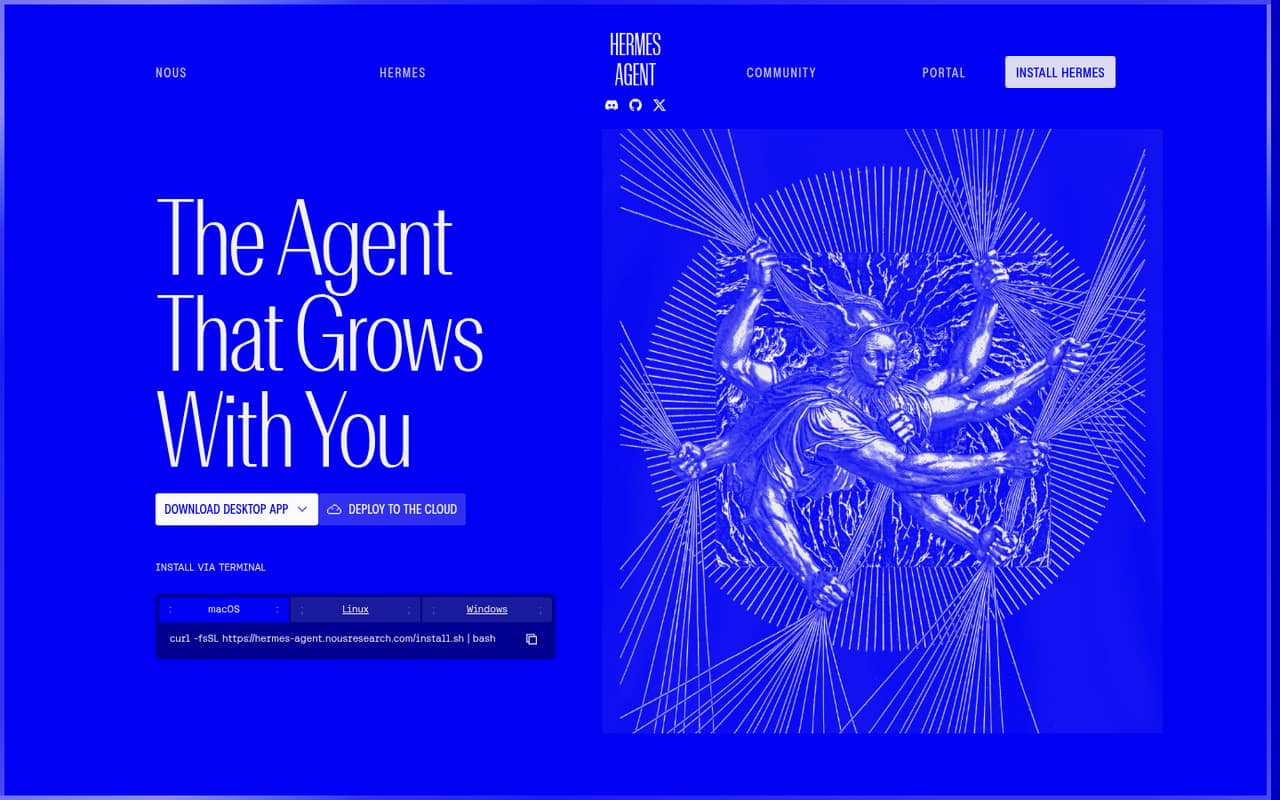
The documented integration surface is the Hermes CLI, desktop app and platform connections. The homepage provides a terminal install command for macOS, Linux and Windows, desktop downloads for macOS 12+ and Windows 10/11, and setup steps for connecting a model provider. It also points users to documentation for configuring messaging integrations.
The homepage does not name a public REST API or language-specific SDK. It does describe Python RPC scripts as an option for isolated subagents, but that is not evidence of a general-purpose Python SDK. Confirm SDK support and any programmatic API in the vendor's docs before designing an integration around them.
For developer workflows, the CLI and gateway are the clearest entry points. Supported messaging surfaces include Telegram, Discord, Slack, WhatsApp, Signal and email. The tool also includes web search, browser automation, vision, image generation and text-to-speech. Expect to configure the provider and integrations as part of setup rather than call Hermes as a hosted API.
03Hermes Agent pricing for developers
The software is free and open source under the MIT license, and Hermes can run on your own computer. The Free Nous Portal plan costs $0 per month and is for free models only; it has standard rate limits, no hosted tools and no cloud agent hosting. You can also use your own provider, which has its own pricing.
For hosted tools and a cloud agent, the pricing page lists Plus at $20 per month, Super at $100 and Ultra at $200. Each includes one cloud agent: Plus provides 4 GB RAM and 25 GB disk; Super, 4 GB RAM and 100 GB disk; Ultra, 8 GB RAM and 100 GB disk. Paid tiers include shared usage, free and paid models, and high rate limits. Super is listed at 5× Plus usage and Ultra at 10×.
Pay-as-you-go credit top-ups are available. Extra or larger cloud agents are billed daily from credits, so compute needs can add to the monthly plan. Annual prices are not published. The vendor does not publish numeric request limits, so check current Portal terms before estimating a production workload.
04Hermes Agent: open source, self-hosting and lock-in
Hermes Agent is open source under the MIT license. You can run it on your own computer, and the homepage lists local, Docker, SSH, Singularity and Modal sandbox backends. Cloud hosting through Nous Portal is optional, not a requirement for using the agent.
Hermes stores conversations, memories and skills between sessions. The vendor recommends keeping a backup of the Hermes data directory when moving to another computer. That gives you a practical migration path for saved data, though the homepage does not describe a formal export format or a one-click migration tool.
The model provider and hosted services are separate choices: the vendor says you can use your own provider or connect to Nous Portal for model and tool credits. That reduces dependence on one hosted service, but workflows may still need adjustment when you change providers, tools or runtime environments.
05Hermes Agent in production
The main production constraint is runtime availability. In a Reddit thread about hosting, a developer reports that long-running or scheduled work stops when a laptop sleeps. The vendor says tasks needing an active agent will not run while it is stopped; an always-on deployment needs a host that stays available or optional cloud hosting.
The sandbox choices include Docker, SSH and other backends, and the homepage says they include container hardening and namespace isolation. Treat that as a starting point, not a substitute for reviewing permissions, secrets handling and your own threat model. The vendor does not publish numeric rate limits or an uptime commitment on the homepage, so confirm those before planning a service around hosted tiers.
Reddit users also emphasize model selection and memory configuration. One commenter says a small default memory setup did not retain enough context for their work; others report that model fit affects agent task quality. Test your own workflows, schedule monitoring and back up the Hermes data directory.
From the threadsWhat users say
Reddit sentiment is positive about the flexibility and potential for personal workflows, but users also describe setup friction and uneven results. Comments stress that model choice, memory and workflow design shape the experience.
The simplest one: holographic memory. Why? Well, a good memory is crucial for your agent: without it, it will suffer to remind facts about your setup, what has been done, how to communicate with you, and so on
So I had to refine it with more detailed instructions and so we both learnt (me and my agent)
Without proper model, even the best memory management / provider is useless
My journey was telegram > discord > (mattermost) > matrix , I wanted more privacy
Questions people ask
Do I need to pay to use Hermes Agent?
No. Hermes Agent is free and open source under the MIT license, and you can run it on your own computer. You may still pay a model provider or optional hosted services. The Free Nous Portal tier is $0 per month but is limited to free models and excludes hosted tools and cloud agent hosting.
Can Hermes Agent use different model providers?
The vendor says you can connect your own model provider or use Nous Portal for model and tool credits. Choose a provider during setup. Reddit users report that model choice affects task quality, so evaluate the models you plan to use with your own workflows.
Can I create multiple Hermes agents?
Hermes supports isolated subagents with their own conversations, terminals and Python RPC scripts. The paid Portal tiers list one cloud agent per plan, while extra or larger cloud agents are billed daily from credits. Check current Portal terms for how additional hosted agents are provisioned.
Where can I host Hermes Agent for free?
You can run Hermes locally on your computer under the MIT license. The Free Portal plan does not include cloud agent hosting. If you need an always-on agent without using Portal hosting, you can deploy the open-source software on infrastructure you manage; that infrastructure may have its own costs.
What data does Hermes keep between sessions?
The vendor says Hermes stores conversations, memories and skills so you can return to work later. Stopping a local agent does not delete that saved data, but tasks that need an active agent will pause. Back up the Hermes data directory when moving to another computer.
Sources
- Hermes Agent homepage
- Hermes Agent pricing, compiled via web search from nousresearch.com, layer3labs.io
- Reddit: One month with Hermes Agent – what I wish I knew earlier
- Reddit: Why I switched from Telegram to Discord for my Hermes agent
- Reddit: three months with Hermes Agent: what i wish i had understood earlier
- Reddit: Where do you host your Hermes agent?