
We may earn a commission if you buy through links on this page. It never changes a score or a ranking. How we make money
The bottom line
A free, self-hostable SQL database with active drivers and developer resources.
Firebird is an open-source relational SQL database that you run in embedded or enterprise deployments. Its community site publishes reference manuals, driver updates, and developer resources, including material on materialized views and query optimization.
The Open Source option costs $0, while the listed Professional plan starts at $575 per month and bundles HQbird and related services. Firebird suits teams that want control over deployment and can verify their driver, operations, and support requirements before committing.
Good fit if
- Teams needing a self-hosted SQL database
- Projects prioritizing a $0 database option
- Developers using documented Firebird drivers
Skip it if
- Teams requiring a managed hosted database
- Projects needing published service-level guarantees
- Stacks requiring unverified driver coverage
ScoresHow it rates
What works
- Open-source option has no license fees
- No installation or activation restrictions listed
- Supports embedded and enterprise deployments
- Reference manuals and driver updates are published
- Materialized views store pre-calculated query results
What doesn't
- Paid plans start at $575 per month
- Annual-billing prices are not published
- Named driver coverage is limited to Jaybird and Node.js
- QA resources are a stated community concern
- The exact open-source license is not named
01What Firebird is, technically
Firebird is an open-source relational database server that stores data and processes SQL queries. It sits in the data layer of an application stack: application code connects through a database driver, sends SQL, and reads or changes records. The vendor’s pricing information describes both embedded and enterprise deployments, so Firebird is not limited to a hosted database service.
That makes it an option for teams that want to operate a database in their own environment, including deployments embedded in an application or run at enterprise scale. The site publishes reference manuals, release news, and resources for developers. It also highlights materialized views, which store pre-calculated query results, and publishes videos about SQL query optimization. Those features address query and data-access needs, but they do not replace the operational work of deployment, backups, monitoring, and upgrades. Teams should treat Firebird as a database component to integrate and run, not as a managed API endpoint.
02Firebird API, SDKs and docs
The integration surface is SQL through a database connection, rather than a hosted REST API. The homepage announces Jaybird driver releases and updates to a Node.js driver, and links to Firebird reference manuals. It also lists tools and IDE news, including Plamenix, BeeKeeper Studio, and RdbExpert. Confirm the supported runtimes, driver versions, connection configuration, and compatibility requirements in the vendor’s reference manuals before selecting a stack.
The site’s developer material includes videos on common SQL query optimization mistakes and a video explaining materialized views, their syntax, refresh options, and an example query. That gives developers some guidance on database behavior and query design. The homepage does not establish a particular CLI workflow or a single SDK package covering every language, so check the driver documentation for the integration path your application needs. Jaybird and Node.js are named; verify other SDK and language support in Firebird’s documentation rather than assuming it.
03Firebird pricing for developers
The Open Source plan is listed at $0 per month, with no license fees and no installation or activation restrictions. It supports embedded and enterprise deployments. The pricing page lists paid plans for teams that need HQbird and related services: Professional is $575 per month for up to 10 servers, and Enterprise is $1,450 per month for 11–100 servers. Dedicated costs $4,300 per month for unlimited servers.
The paid bundles include stated monthly allowances: Professional includes 50 migrations and 100 MQFS One queries; Enterprise includes 500 migrations and 5,000 MQFS One queries; Dedicated includes 10,000 migrations and 100,000 MQFS One queries. The page lists extra servers at $49 per month each on Professional and $10 per server per month on Enterprise. It does not publish annual-billing prices. These are not per-request database prices: the listed paid tiers scale by server count and bundle allowances. Confirm what happens when a migration or query allowance is exceeded, and whether the support and management services in a tier match your deployment.
04Firebird: open source, self-hosting and lock-in
Firebird identifies itself as open source, and its pricing information says the Open Source option has no license fees or installation restrictions. It supports embedded and enterprise deployments, so teams can run it in their own environment instead of depending on a hosted-only service. The exact open-source license is not named in the site material summarized here; check the project’s license file before distributing Firebird or building it into a product.
Firebird stores relational data and uses SQL, but the vendor does not publish a data-export or migration-away procedure in the homepage material. Ask how to export schemas, data, and database-specific features, including materialized views, before planning an exit. SQL and self-hosting may give teams more control over their stack, but application queries, drivers, and database-specific behavior can still create migration work. Validate compatibility with the target database rather than assuming a drop-in replacement.
05Firebird in production
Firebird’s embedded and enterprise deployment options give teams room to choose where the database runs, but production ownership includes installation, upgrades, backups, monitoring, and recovery planning. The homepage promotes query optimization resources and materialized views; its video describes refresh options and an example query. Test refresh behavior and query performance against your own workload before relying on pre-calculated results.
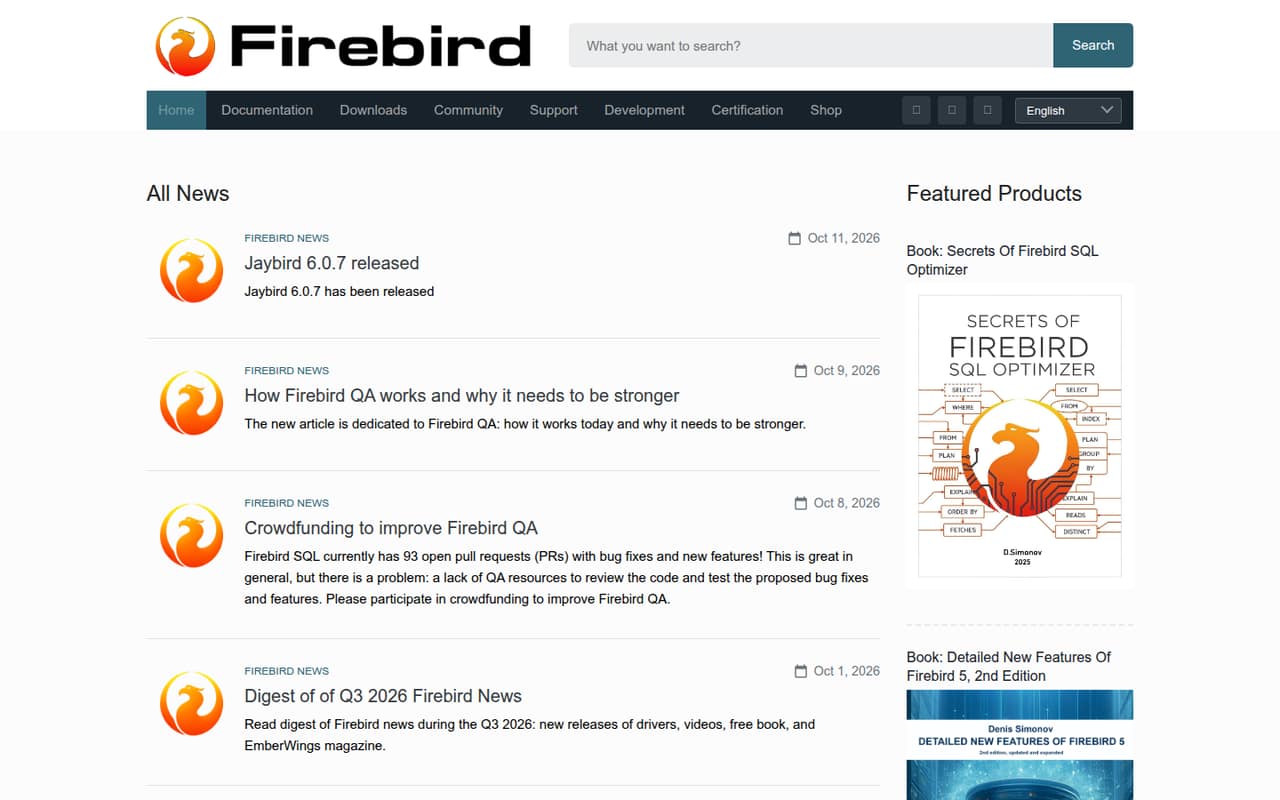
The site’s October 2026 news says Firebird had 93 open pull requests and describes a lack of QA resources to review and test proposed fixes and features. The project also published an appeal to fund stronger QA. That is a reason to review release notes, test upgrades, and assess support expectations—not evidence that a specific release is unreliable. The listed paid plans have server-count and monthly allowance boundaries, and the pricing page does not publish annual prices. Before production, confirm driver compatibility, security and compliance requirements, backup and restore procedures, support coverage, and what happens when a paid-plan allowance is exceeded.
Questions people ask
Is Firebird a hosted database service?
Firebird is a relational SQL database, not a hosted-only service. Its pricing information says the Open Source option supports embedded and enterprise deployments, with no installation restrictions. Teams should plan to run and operate the database themselves unless they arrange separate hosting or management.
Does Firebird have a free option?
Yes. The Open Source option is listed at $0 per month, with no license fees and no installation or activation restrictions. The pricing page also lists paid plans starting at $575 per month for deployments that need the bundled HQbird and related services.
Which drivers does Firebird name?
Firebird’s homepage names Jaybird and a Node.js driver in its news. It also links to reference manuals. Check those manuals and the driver projects for supported runtime versions, connection details, and compatibility with the Firebird release you plan to deploy.
What do Firebird’s paid plans cost?
The listed prices are $575 per month for Professional, $1,450 per month for Enterprise, and $4,300 per month for Dedicated. The plans cover different server counts and include stated monthly migration and MQFS One query allowances. Annual-billing prices are not published.
Does Firebird support materialized views?
Firebird’s homepage features materialized views and describes them as storing pre-calculated query results instead of running a query every time. A site video covers syntax and refresh options. Check the reference manuals for version-specific behavior and test refresh costs with your own data and workload.