
We may earn a commission if you buy through links on this page. It never changes a score or a ranking. How we make money
The bottom line
A Cypher graph database for AI workloads, with a free tier and managed plans starting at $73 per 1 GB/month.
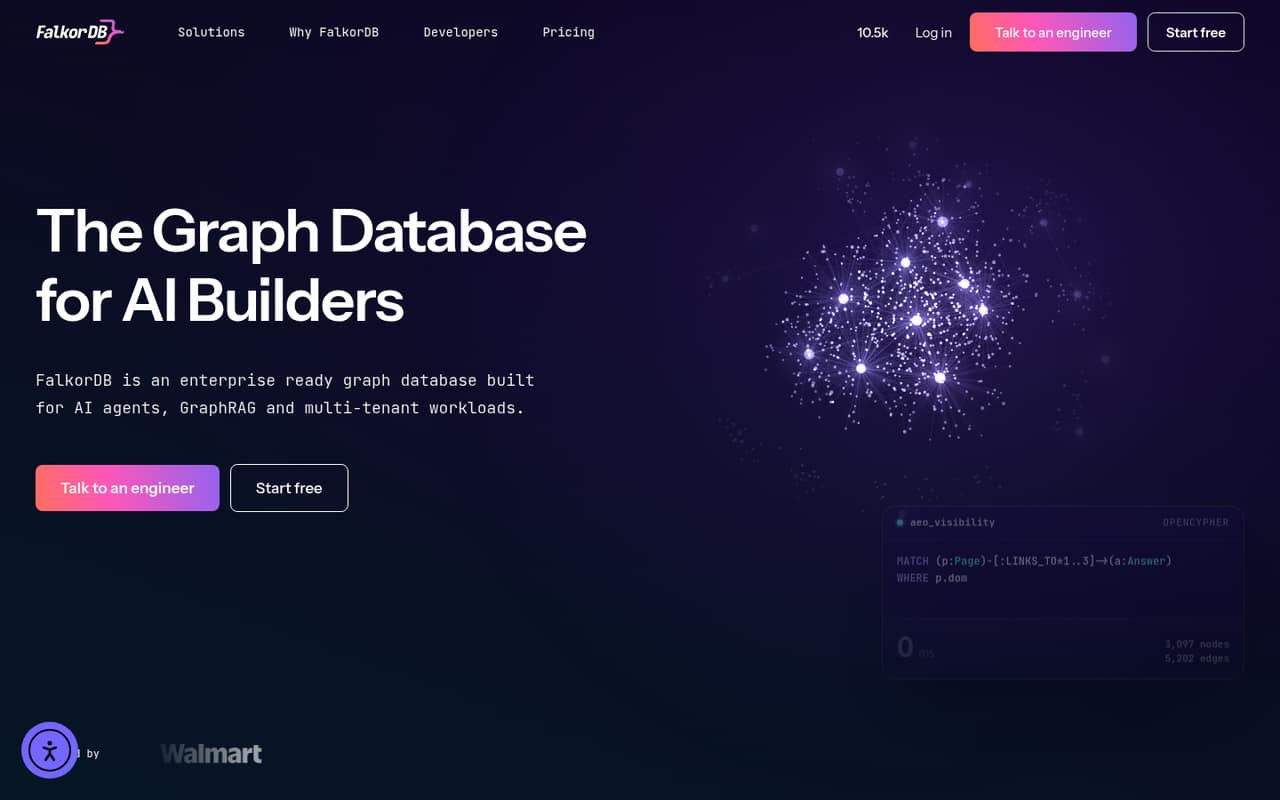
FalkorDB is a graph database server for connected-data queries, GraphRAG, agent workflows and long-term agent memory. Teams can use FalkorDB Cloud or self-host it, and the vendor names native Cypher plus integrations with LangChain, LlamaIndex, Graphiti and Mem0.
The free plan is useful for an MVP, while production cloud plans start at $73 per 1 GB/month and add capabilities such as clustering and support by tier. Before committing, confirm current license terms, client support for your stack, service limits and data-export options with the vendor.
Good fit if
- GraphRAG and connected-data applications
- Agent memory across sessions
- Isolated customer or session graphs
Skip it if
- Teams requiring a published license guarantee
- Workloads needing documented service limits
- Projects without graph-shaped data
ScoresHow it rates
What works
- Native Cypher query support
- Managed cloud and self-hosted deployment
- Free plan lists multi-graph and access control
- Integrations named for four AI frameworks
- Pro plan includes clustering and multi-zone availability
What doesn't
- SDK languages and transport details need confirmation
- Free-tier capacity limits are not published
- Overage pricing and add-ons are not listed
- Data-export options are not published
- Reddit commenters question performance claims and licensing
01What FalkorDB is, technically
FalkorDB is a graph database server, not an AI agent framework or a hosted-only SaaS app. It stores connected data and exposes Cypher queries for applications that need to traverse relationships, including GraphRAG retrieval, agent workflows and long-term memory. The vendor positions it for multi-tenant workloads, with separate graphs for customers, agents or sessions.
It sits in the data layer of an application stack: your application or AI framework writes and queries graph data, then uses the returned relationships to ground answers or choose an action. The vendor names native Cypher support and integrations with LangChain, LlamaIndex, Graphiti and Mem0. Deployment options are FalkorDB Cloud, a managed service, or self-hosting with an enterprise console. This makes it relevant when a relational or document store does not represent the connections your queries need. The homepage does not establish whether FalkorDB replaces other stores; teams should assess it as a graph component in their existing stack.
02FalkorDB API, SDKs and docs
The confirmed query surface is native Cypher. The homepage shows graph-pattern queries for connected retrieval, dependency traversal and session memory, and links to the docs and a GraphRAG-SDK on GitHub. It also names out-of-the-box integrations with LangChain, LlamaIndex, Graphiti and Mem0. Those give AI teams named integration points, but the homepage does not identify supported programming languages, client SDKs or a transport protocol.
Treat Cypher and the named framework integrations as the confirmed starting points. Check the vendor docs for client support in your language, connection setup, authentication, transaction behavior and deployment-specific configuration before choosing a stack. The homepage does not name a CLI or a REST API, so do not assume either is the intended interface. Native Cypher may reduce query-language changes for teams already using it, but compatibility details and migration work still need validation against the queries and data model in your codebase.
03FalkorDB pricing for developers
The pricing page lists a Free plan at $0 per month, with multi-graph and multi-tenancy, graph access control and community support. Its capacity and other operational limits are not published on the vendor's site, so confirm them before treating it as a production tier.
Startup starts at $73 per 1 GB/month. It includes TLS and automated backups every 12 hours, but not cluster deployment. Pro starts at $350 per 8 GB/month and adds cluster deployment, high availability, multi-zone deployment and business-hours support. Enterprise has custom pricing and lists VPC, cluster and multi-zone deployment, custom backup schedules, advanced monitoring, 24/7 enterprise support and a dedicated account manager.
The listed prices are monthly starting prices. Annual rates, overage charges, usage-based add-ons and a free-trial offer are not listed. The unit changes by plan, so do not assume the cost scales linearly between tiers; ask FalkorDB how storage growth, billing increments and capacity changes affect your bill. The free plan's support is community-based.
04FalkorDB: open source, self-hosting and lock-in
FalkorDB can be self-hosted, and the vendor also offers managed FalkorDB Cloud. Reddit discussions characterize FalkorDB as source-available rather than OSI-approved open source. That is a community description, not a substitute for checking the current license: review the license terms for the exact edition and deployment you plan to use, especially for commercial use and redistribution.
The vendor promotes native Cypher as a migration path, which may help if your existing queries and graph model fit its compatibility. It does not establish that every feature or query is portable. Data-export formats, backup export procedures and exit tooling are not published on the vendor's site. Before production adoption, ask how to export graph data and schema, whether cloud backups can be retrieved, and what migration support is available. A managed service also ties operations to its deployment and pricing model, even if the query language is familiar.
05FalkorDB in production
The Pro plan lists high availability, clustering and multi-zone deployment; Startup explicitly has no cluster deployment. Automated backups are listed every 12 hours on Startup and Pro, while Enterprise offers a custom schedule. Enterprise also lists VPC deployment, advanced monitoring and 24/7 support. The published pricing details do not state request limits, maximum graph size, service-level objectives, recovery targets or compliance certifications. Confirm these with the vendor against your workload and requirements.
The homepage claims a 496× P99 latency advantage over Neo4j on an open benchmark, but that is a vendor claim; compare the benchmark setup and workload with your own before relying on it. Reddit discussion includes a commenter questioning the latency framing, while another says an incremental Rust rewrite maintained performance in a simple rewrite. Reddit commenters also flag source-available licensing as a procurement consideration. These are useful prompts for review, not production guarantees. Check scaling behavior, backup restoration, access controls and support response terms before choosing a tier.
Questions people ask
What is FalkorDB used for?
FalkorDB is a graph database for connected-data workloads, including GraphRAG, agentic AI flows and long-term agent memory. Its vendor describes using graph relationships to ground LLM answers, give agents a queryable model of the world and recall relationships from earlier sessions. It also supports separate graphs for customer, agent or session workloads.
Does FalkorDB support Cypher?
Yes. FalkorDB describes its query support as native Cypher and uses Cypher examples for graph retrieval, dependency traversal and agent memory. If you are migrating existing queries, confirm compatibility for the specific syntax and features your application relies on; native support alone does not establish that every query or database feature is portable.
How much does FalkorDB cost?
The listed Free plan costs $0 per month. Startup starts at $73 per 1 GB/month, and Pro starts at $350 per 8 GB/month. Enterprise pricing is custom. The vendor lists monthly starting prices but does not publish annual rates, overage charges or add-on pricing in the published pricing details.
Can I self-host FalkorDB?
Yes. The vendor lists self-hosting with an enterprise console alongside managed FalkorDB Cloud. Reddit discussions describe FalkorDB as source-available rather than OSI-approved open source, so check the current license terms for your intended use. Ask the vendor which features, support options and operational tools apply to your chosen deployment.
Which SDKs and AI frameworks work with FalkorDB?
The vendor names integrations with LangChain, LlamaIndex, Graphiti and Mem0, and links to a GraphRAG-SDK on GitHub. The homepage does not identify programming-language support or client SDK details. Check the vendor docs for your language, connection method, authentication requirements and version compatibility before integrating.
Sources
- FalkorDB homepage
- FalkorDB pricing page
- Reddit: Neo4j Alternatives in 2026: A Fair Look at the Open-Source Options (including licensing)
- Reddit: Why We’re Rewriting FalkorDB in Rust – and the Journey Behind It
- Reddit: Wrote a comparison of open-source Neo4j alternatives in 2026 - the licensing landscape has changed significantly