
We may earn a commission if you buy through links on this page. It never changes a score or a ranking. How we make money
The bottom line
A hosted REST API for public social data, priced by daily units and available from $100/month.
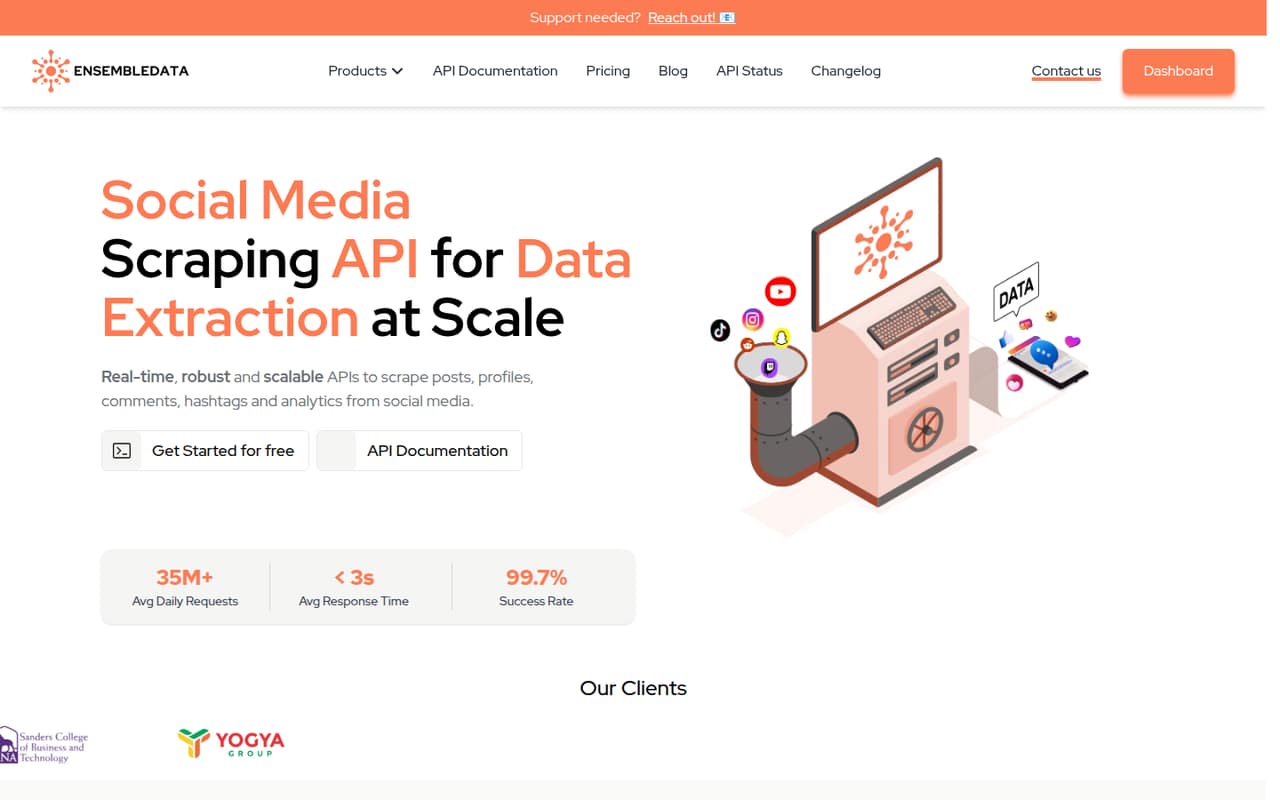
EnsembleData is a hosted REST API for collecting public social data as JSON. Its endpoint coverage spans eight social platforms, with profile, post, comment, search and analytics data for use in pipelines and research workflows.
The free plan is limited to 50 units per day. Paid plans start at $100 per month for 1,500 units per day, so check how each endpoint consumes units before sizing a production workload. The vendor lists no annual discounts.
Good fit if
- JSON-based social data pipelines
- Teams needing several platform APIs
- Evaluating social data extraction
Skip it if
- Teams requiring self-hosted scraping
- Projects needing published rate limits
- Workloads with unpredictable daily volume
ScoresHow it rates
What works
- REST endpoints return JSON for data pipelines
- Endpoint coverage spans eight social platforms
- Free plan includes 50 units per day
- Failed internal-error requests use no units
- Python client and requests examples are shown
What doesn't
- Free usage is capped at 50 units daily
- Paid plans have daily unit ceilings
- No annual billing discounts are listed
- Open-source licensing and self-hosting are unclear
- Rate limits and production service commitments need confirmation
01What EnsembleData is, technically
EnsembleData is a hosted social media scraping API: your application sends requests to vendor-operated endpoints, authenticates with a token, and receives JSON responses. It is an API service rather than a self-hosted server or a standalone data warehouse. The homepage also advertises SDK access, including a Python client example.
The service targets public-data extraction for posts, profiles, comments, hashtags and analytics. The homepage describes real-time and bulk extraction across eight social platforms, with endpoints for platform-specific searches, account information, content and engagement data. That places EnsembleData upstream of your own storage and analysis: applications or scheduled jobs can collect the responses, then pass them into ETL processes, warehouses or dashboards. The API can supply social content and metrics, but your code still needs to handle scheduling, storage, deduplication and downstream analysis.
02EnsembleData API, SDKs and docs
The integration surface is REST: the homepage shows a request to an endpoint on ensembledata.com with a token parameter, followed by JSON response handling. Its Python example imports EDClient from ensembledata.api, calls a TikTok hashtag-search method and reads the result data and units charged. A separate Python example uses requests.get, so a client library is not required for that pattern.
The homepage also shows a JavaScript-style response-handling snippet, but does not name a JavaScript SDK. The vendor advertises SDKs and documentation, with endpoint tutorials for platform operations such as profile lookup, posts, comments and search. Examples cover multiple endpoint families, but integrations such as webhooks, a CLI or specific ETL plugins are not listed on the homepage. Confirm supported SDK languages, endpoint-specific request formats and authentication guidance in the vendor's docs before choosing a client.
03EnsembleData pricing for developers
The free plan costs $0 per month and includes 50 units per day across eight social platforms. Units reset daily at 00:00 UTC, so it is useful for evaluation but not a large or continuous collection workload. The pricing page lists failed internal-error requests as using no units.
Paid plans are also priced monthly: Wood is $100 for 1,500 units per day; Bronze is $200 for 5,000; Silver is $400 for 11,000; Gold is $800 for 25,000; and Platinum is $1,400 for 50,000. Each listed plan covers eight platforms and resets units daily at 00:00 UTC. Diamond is available by contacting the company for plan details. The pricing page lists no annual billing or annual discounts, and no add-ons. It does not give a per-request overage price, so do not assume excess usage is billed rather than blocked or requiring an upgrade. Check how many units each endpoint consumes against your expected daily calls before selecting a plan.
04EnsembleData: open source, self-hosting and lock-in
EnsembleData is presented as an API hosted at ensembledata.com, not as a server you install in your own environment. The vendor doesn't publish an open-source license or a self-hosting option, so teams that require source access or deployment control should ask about those requirements before adopting it.
The API returns JSON, which gives you a portable response format for storing extracted data in your own systems. That does not remove all migration work: endpoint paths, request parameters, authentication and unit accounting are specific to EnsembleData. If you build an adapter between your internal data model and the vendor API, switching providers should be easier than embedding vendor-specific response shapes throughout your application. Confirm data retention and export terms with the vendor, especially if you plan to stop using the service.
05EnsembleData in production
The published pricing limits are daily unit allowances, not a stated requests-per-second rate limit. Units reset at 00:00 UTC, and failed internal-error requests do not use units. Before launch, confirm how each endpoint charges units, how the API responds at the daily cap, and whether your workload needs a higher plan or a Diamond quote. The vendor doesn't publish a request-rate ceiling or service-level commitment on the homepage.
Plan for upstream changes and collection gaps in any social-data pipeline: persist responses, track unit consumption and make retries bounded. The homepage describes real-time and bulk extraction, but teams should verify freshness and bulk-job behavior for the endpoints they depend on. Confirm authentication handling, retention, security controls and compliance requirements with the vendor before sending production workloads. Do not treat public availability as a substitute for checking platform terms and your own data-use obligations.
Questions people ask
Does EnsembleData have a free plan?
Yes. The Free Trial plan costs $0 per month and includes 50 units per day across eight social platforms. Units reset daily at 00:00 UTC, and the pricing page says failed internal-error requests use no units. Check endpoint unit costs to see whether the allowance fits your evaluation.
How much does EnsembleData cost?
Paid plans start with Wood at $100 per month for 1,500 units per day. Bronze is $200 for 5,000 units, Silver is $400 for 11,000, Gold is $800 for 25,000, and Platinum is $1,400 for 50,000. Diamond pricing requires contacting the company.
What programming languages can I use with EnsembleData?
The homepage shows a Python client using EDClient and a Python example using requests against a REST endpoint. It also includes a JavaScript-style response-handling snippet, but does not name a JavaScript SDK. Check the vendor's documentation for the current SDK language list and client support.
Can I self-host EnsembleData?
EnsembleData is presented as a hosted API at ensembledata.com, rather than a server to deploy in your own environment. The vendor doesn't publish a self-hosting option or an open-source license. If deployment control or source availability is a requirement, ask the company before building against the service.
What happens when I reach my daily unit limit?
The pricing page states that plan units reset daily at 00:00 UTC, but does not describe the API response or billing behavior after a plan's allowance is exhausted. Confirm whether requests are rejected, paused or handled another way, and whether higher usage requires a plan change or a Diamond quote.