
We may earn a commission if you buy through links on this page. It never changes a score or a ranking. How we make money
The bottom line
A broad hosted scraping stack with approachable integrations and monthly usage caps.
Decodo combines a hosted Web Data API with proxy products for collecting public web data. Its API covers scraping, search, site mapping and crawling, with Python and TypeScript SDKs, a CLI and integrations for MCP, LangChain, LlamaIndex, n8n and OpenClaw.
The free plan is useful for a small evaluation, and paid monthly tiers scale from $19 to $1,499. Before building around it, check the target sites, location coverage and usage limits you need: one Reddit user looking for state-level targeting said their Decodo search did not meet that requirement.
Good fit if
- AI agents that need current web data
- Scraping projects with varied targets
- Teams building RAG data pipelines
Skip it if
- Projects requiring self-hosted infrastructure
- Workloads needing unverified geo coverage
- Teams needing published overage rates
ScoresHow it rates
What works
- One API covers scrape, search, map and crawl
- Python and TypeScript SDKs are available
- CLI and MCP server support
- Markdown and JSON output for AI workflows
- Free plan includes up to 5K crawls
What doesn't
- Proxy and API usage have different pricing structures
- Annual billing is not listed
- Overage rates are not published
- Open-source licence and self-hosting are not published
- A Reddit user reports difficulty finding state-level targeting
01What Decodo is, technically
Decodo is a hosted web data platform, not a scraping library or a self-hosted server. Its Web Data API exposes four functions under one key: scrape a page, search the live web, map a site’s URLs and crawl multiple pages. The service returns web content in structured formats, including Markdown or JSON, for downstream applications such as RAG pipelines and AI agents.
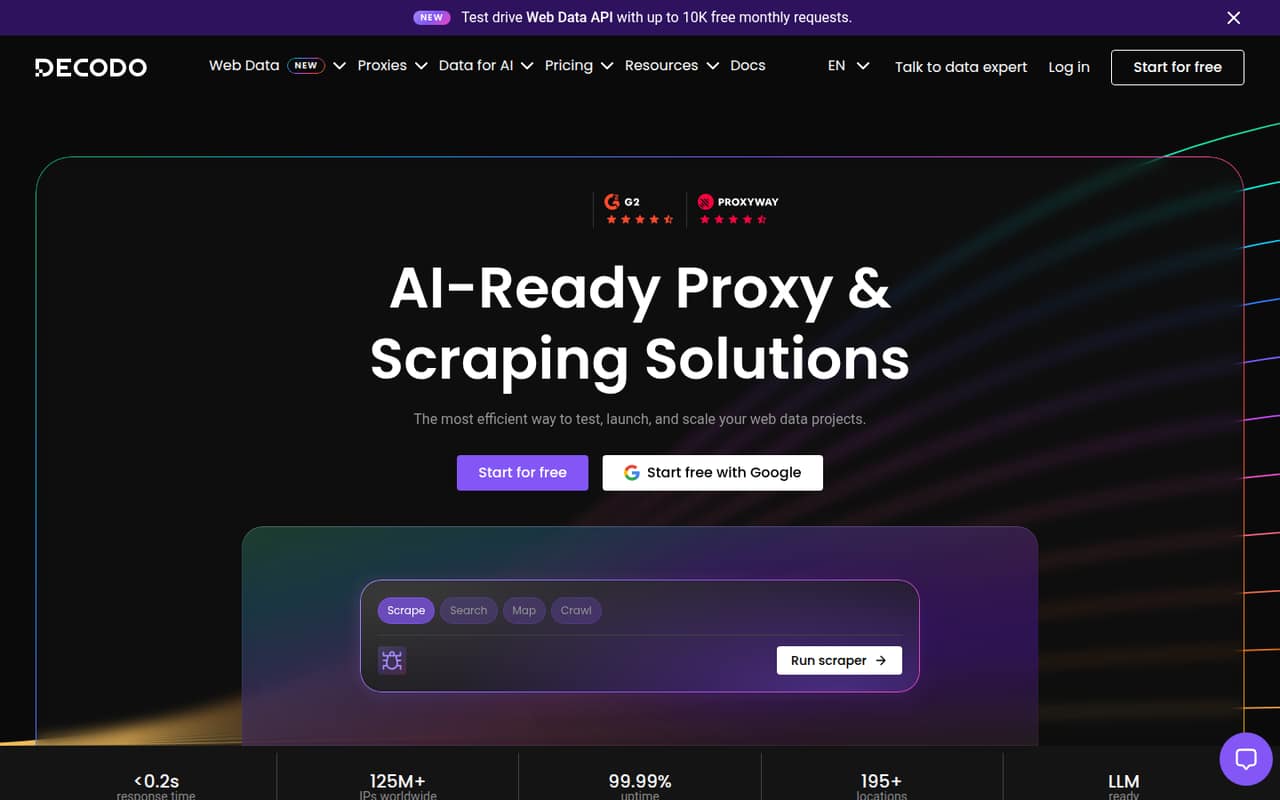
The API sits between your application and public websites. Decodo handles collection and, for crawls, automatic link following and JavaScript rendering; its proxy network provides IP access and location targeting for projects that need it. The vendor lists 125M+ IPs worldwide and coverage across 195+ locations. You can use the API as an agent tool through MCP or call it from an application using the supported SDKs. This setup avoids operating a scraper fleet yourself, but makes your collection path dependent on a hosted vendor and its access to each target.
02Decodo API, SDKs and docs
The Web Data API groups four endpoints under one key: /scrape, /search, /map and /crawl. The homepage lists HTML, JSON or Markdown for scrape results, and describes structured Markdown or JSON output for LLM workflows. Search can retrieve results from Google, Bing and other engines; crawl supports multi-page collection, automatic link following and JavaScript rendering.
Decodo lists Python and TypeScript SDKs, an official MCP server, a CLI, agent skills, and integrations for n8n, LangChain, LlamaIndex and OpenClaw. The CLI can run endpoints from a terminal or shell script, including in CI jobs. The homepage describes MCP setup through configuration and says the server is listed in GitHub’s MCP Registry. Use the vendor docs to confirm authentication, parameters, response handling and SDK coverage for your language before implementation; the homepage directs developers to its SDK and setup pages. The integration menu is broad, but teams using other languages should confirm SDK support in the vendor’s docs.
03Decodo pricing for developers
The pricing page lists a free monthly plan with 10 req/s and up to 5K crawls or 10K pages. Paid monthly plans start at $19 for Regular — 10 req/s, with up to 19K crawls or 38K pages. The other tiers are Regular — 25 req/s at $49 (65K crawls or 122K pages); Regular — 50 req/s at $99 (141K or 330K); Regular — 100 req/s at $249 (383K or 1.2M); and Regular — 150 req/s at $499 (831K or 2.7M).
Higher tiers list Regular — 200 req/s at $999, with up to 1.8M crawls or 6.2M pages, and another Regular — 200 req/s plan at $1,499, with up to 2.9M crawls or 9.9M pages. Enterprise is custom. Separately, the homepage advertises Web Data API access starting at $0.15 per 1K requests; confirm how that rate relates to the monthly plans. The pricing page lists monthly prices, with no annual billing shown. It does not list add-ons or overage rates, so confirm the cost of usage beyond plan limits before launch.
04Decodo: open source, self-hosting and lock-in
Decodo is presented as a hosted API and proxy service. The vendor doesn’t publish an open-source licence or a self-hosting option, so teams should treat the collection service as a hosted dependency unless Decodo confirms otherwise. The homepage lists an official MCP server and SDKs, but that alone does not establish that their source code is open under a particular licence.
The API returns content in formats such as Markdown and JSON, which you can store in your own systems and use to reduce dependence on Decodo’s output pipeline. The vendor doesn’t publish a data-export or migration process. A move to another provider would likely require replacing API calls, adapting request and response handling, and switching proxy settings. Keep your own copy of collected data and isolate provider-specific code behind an internal interface if portability matters.
05Decodo in production
Decodo’s homepage advertises 99.99% uptime and, separately, 99.99% success on difficult anti-bot targets. Treat these as vendor claims, not a substitute for a written SLA or measurements against your target sites. The listed plans impose both request-per-second limits and monthly crawl or page caps, so production systems need usage monitoring and backpressure. Ask the vendor how requests beyond a plan’s included capacity are handled and priced.
The proxy network lists 195+ locations and city-level targeting, while new features mention state, city and ASN targeting for datacenter and ISP proxies. Coverage can still depend on proxy type and inventory. In one Reddit thread, a user looking for a static ISP proxy said Decodo and other providers did not seem to offer the state-level targeting they needed. Verify the exact location and target combination before relying on it. The vendor also describes CAPTCHA handling and anti-bot access; test against your own targets and review applicable site terms, privacy requirements and data-handling obligations.
From the threadsWhat users say
The Reddit discussion is mostly about proxy selection rather than direct Decodo support or API use, so it offers limited evidence of broad user sentiment. The available Decodo-specific mention raises a practical concern about state-level targeting, while other commenters emphasize testing providers against the intended workflow.
none seem to even allow for state level targeting, or are out of stock
for multi-account work, prioritize stable sessions, consistent IPs and clear usage limits rather than just the cheapest proxy. test each provider with your actual workflow first
There is no silver bullet. Would suggest to use at least 2 providers with residential proxies, should be always a backup
Buy the smallest plan from your top two, run each IP through IP Quality Score before putting an account on it and check the fraud score stays low after a week of use or not
Questions people ask
What is Decodo used for?
Decodo provides a hosted Web Data API for scraping pages, searching the web, mapping site URLs and crawling multiple pages. Its proxy network offers IP access and location targeting for public web data collection. The vendor also lists integrations for AI and automation workflows.
Does Decodo have a free plan?
Yes. The pricing page lists a free monthly plan with 10 req/s and up to 5K crawls or 10K pages. That gives a project a bounded way to start, but production workloads should compare their expected traffic and page volume with the paid tiers.
Which programming languages does Decodo support?
The homepage lists Python and TypeScript SDKs. It also offers a CLI and an official MCP server, plus integrations for LangChain, LlamaIndex, n8n and OpenClaw. If your application uses another language, confirm SDK support and API implementation details in the vendor’s docs.
Can Decodo target specific locations?
The vendor lists coverage across 195+ locations and city-level targeting. Its new-features section says state, city and ASN targeting is available for datacenter and ISP proxies. Verify availability for your chosen proxy type and exact target: one Reddit user reported difficulty finding state-level targeting.
Can I self-host Decodo?
Decodo is presented as a hosted API and proxy service. The vendor doesn’t publish a self-hosting option or an open-source licence, so teams that require infrastructure they can run themselves should confirm this with Decodo before committing.