
We may earn a commission if you buy through links on this page. It never changes a score or a ranking. How we make money
The bottom line
A capable asset orchestrator with useful context, but production costs need monitoring.
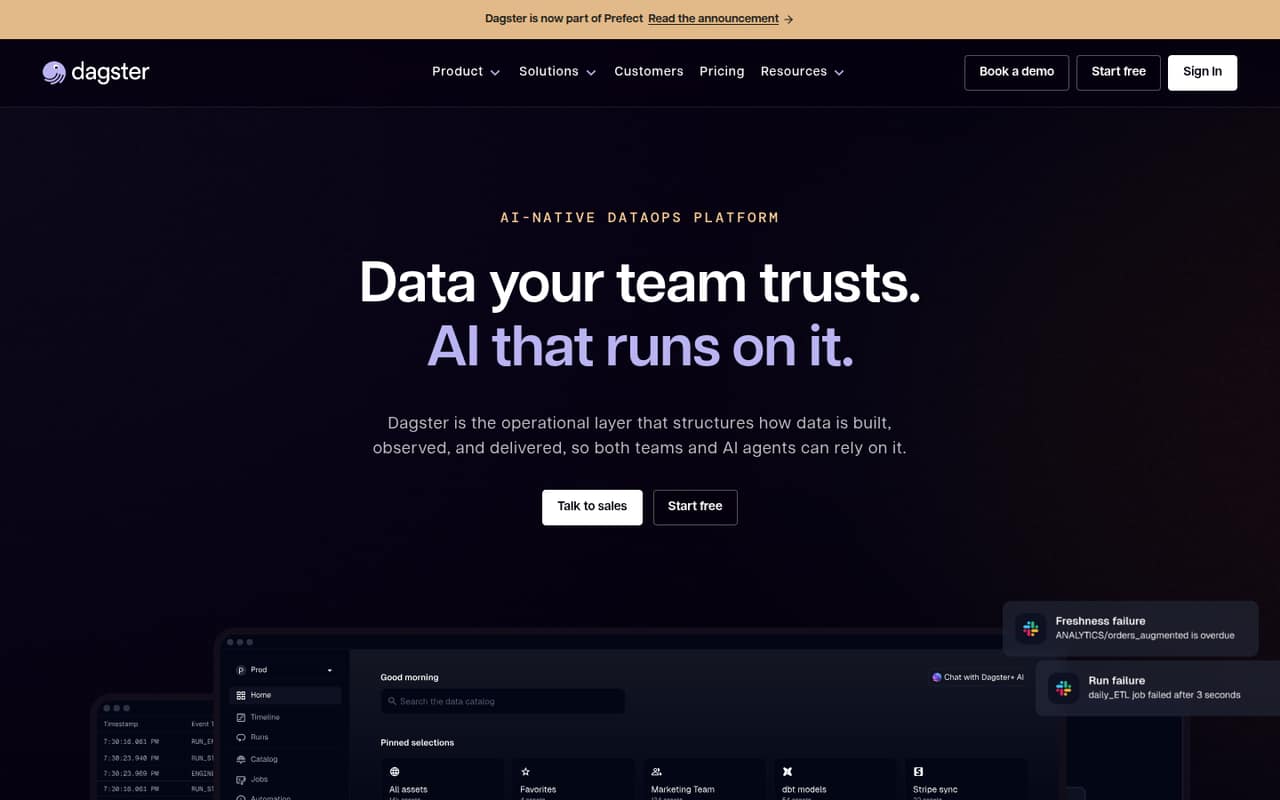
Dagster is an asset-centric DataOps platform for orchestrating and observing data workflows. It tracks assets, lineage, dependencies, health, and failures, and can run compute in your infrastructure while its control plane is managed by Dagster.
We like the model for teams that need operational context across a data stack, especially around dbt and Snowflake. The trade-off is usage-based pricing on paid plans and limited public detail about SDKs, support, and licensing. Reddit reports include sharp concerns about price changes.
Good fit if
- Teams standardizing asset-based pipelines
- Data teams using dbt and Snowflake
- Organizations needing lineage and health context
Skip it if
- Teams requiring predictable flat-rate costs
- Small teams avoiding infrastructure ownership
- Buyers needing published rate limits
ScoresHow it rates
What works
- Asset-centric orchestration links pipelines to their outputs
- Lineage and dependencies are part of the operational model
- Observability includes asset health and failure context
- Hybrid deployment keeps compute in your infrastructure
- Branch deployments validate changes before production data
What doesn't
- Solo and Starter bills combine subscription and credit usage
- No free plan; the free trial lasts 30 days
- SDK, API, and CLI details need confirmation in the docs
- The vendor does not publish Pro prices
- Reddit users report abrupt, substantial pricing changes
01What Dagster is, technically
Dagster is a DataOps platform for defining, running, and observing data assets across a stack. Rather than modeling a workflow only as a sequence of tasks, its asset-centric approach tracks the data products those tasks create, along with their lineage, dependencies, freshness, and health. That gives engineers operational context for understanding what a failure affects.
In a deployment, Dagster manages the control plane, while hybrid deployment lets compute run in your own infrastructure. The platform also offers branch deployments to validate pipeline changes in a production-like environment before they reach real data. Dagster AI uses context such as assets, runs, lineage, freshness, failures, and automation history to help diagnose issues and take action.
Dagster sits between data-producing code and the tools or systems that consume its outputs. The homepage names native integrations for dbt, Snowflake, and Fivetran. It is not just a scheduler: its focus is coordinating data assets and making their operational state visible.
02Dagster API, SDKs and docs
The homepage describes a code-native approach, local development, and integrations with dbt, Snowflake, and Fivetran. It does not name a programming language, SDK, API style, or CLI in its platform overview, so confirm the supported developer interfaces in Dagster's docs before committing to a language or deployment workflow. Do not assume a particular REST API, webhook, or command-line surface from the homepage alone.
The stated integration surface is useful for teams with existing dbt models or Snowflake assets: Dagster says these can be orchestrated, monitored, and cataloged without custom glue code. Fivetran is also listed as a native integration. Branch deployments offer a way to validate pipeline changes in a production-like environment, while reusable components and shared standards are aimed at platform teams managing multiple contributors.
The homepage links to documentation, but does not detail SDK coverage or support channels. Check the docs for current integration setup, local development requirements, testing patterns, and version compatibility before estimating implementation effort.
03Dagster pricing for developers
Dagster has no free plan; its listed Solo and Starter plans include a 30-day free trial. Solo costs $10 per month for one user, one code location, and one deployment, then $0.040 per credit. Starter costs $100 per month for up to three users, five code locations, and one deployment, then $0.035 per credit. Catalog Search is included with Starter.
Usage is billed on top of the monthly subscription, so pipeline activity affects the total. Serverless compute adds $0.010 per minute on Solo and Starter. Hybrid deployments have no compute charge, although running compute in your own infrastructure still has infrastructure and operating costs. Pro is custom-priced and includes unlimited code locations and deployments, custom serverless compute, Cost Tracking and Insights, and personalized onboarding support.
A Reddit thread reports that a previous 30,000-credit Starter allowance was removed, with one user calculating that the credits would cost $1,050 at $0.035 each. Treat that as a report about a pricing change, not a current allowance. Annual prices are not published.
04Dagster: open source, self-hosting and lock-in
Dagster's homepage describes hybrid deployment: compute can run in your infrastructure while Dagster manages the control plane. Reddit commenters also report running a self-hosted open-source version, including on AWS infrastructure. The vendor's homepage does not identify a license, so verify the applicable license and what source code is available before building a self-managed deployment around it.
The division between control plane and compute matters for portability. Workloads running in your infrastructure remain there, but the pipelines, asset definitions, and operational context are built around Dagster's model. The vendor does not describe data export or migration procedures on the homepage. Ask how to export metadata and history, and what happens to schedules, lineage, and asset definitions if you leave. Moving workloads to another orchestrator is likely to require translating those definitions and rebuilding operational workflows.
05Dagster in production
Dagster's production features include asset health dashboards, failure context, lineage, and branch deployments. Hybrid deployment lets teams keep compute in their own infrastructure, while the control plane remains managed by Dagster. That can help with infrastructure or compliance requirements, but buyers should confirm the exact deployment architecture and security controls for their environment.
The homepage does not publish rate limits or reliability targets. Before depending on the service, ask about availability commitments, incident response, access controls, audit logging, data retention, and the limits that apply to your plan. Also model credit consumption and serverless minutes with representative workloads; the pricing page lists usage charges, and Reddit users report concerns about pricing changes and short notice.
Self-hosting avoids the managed-service bill but transfers infrastructure and maintenance work to your team. Reddit users describe both relatively small self-hosted setups and the burden of managing infrastructure as a small team. The right choice depends on whether your team can own deployment, backups, upgrades, and monitoring.
From the threadsWhat users say
Discussion is split between interest in Dagster's asset-centric approach and concern about managed-service costs. Pricing changes draw particularly negative responses, while self-hosting is a practical alternative for some teams but adds operational responsibility.
will never use their service again, went from $10, $20, $50, now $500+
We relied on the 30,000 credits included with the plan to orchestrate everything, which under the new plan...is completely gone
Only paying for Fargate (serverless) and S3, so it's as cheap as it gets. Almost no infra maintenance, would never consider a paid version
Questions people ask
What is Dagster used for?
Dagster orchestrates and observes data workflows using an asset-centric model. It tracks assets, lineage, dependencies, and health, so teams can understand what data a pipeline produces and what may be affected by a failure. Dagster also offers AI features that use operational context to help diagnose issues and take action.
How is Dagster different from a task scheduler?
Dagster centers its model on the data assets pipelines produce, with lineage, dependencies, and health attached to those assets. A task scheduler focuses on running jobs or tasks. Dagster's approach is intended to show how outputs relate and what downstream data may be affected when something fails.
Can Dagster run compute in my infrastructure?
Yes. Dagster describes hybrid deployment as running compute in your infrastructure while Dagster manages the control plane. The vendor says hybrid deployments have no compute charge, but your own infrastructure still has costs. Confirm the deployment architecture and requirements for your environment with Dagster.
Does Dagster integrate with dbt and Snowflake?
Yes. Dagster describes native integrations with dbt and Snowflake, and says existing dbt models and Snowflake assets can be orchestrated, monitored, and cataloged. The homepage also names Fivetran as a native integration. Check the docs for current setup instructions and compatibility.
Does Dagster have a free plan?
No free plan is listed. Solo and Starter include a 30-day free trial, then charge a monthly subscription plus per-credit usage. Solo is listed at $10 per month and $0.040 per credit; Starter is $100 per month and $0.035 per credit.