
We may earn a commission if you buy through links on this page. It never changes a score or a ranking. How we make money
The bottom line
A practical hosted reporting pipeline, but not a developer-first API or self-hosted integration platform.
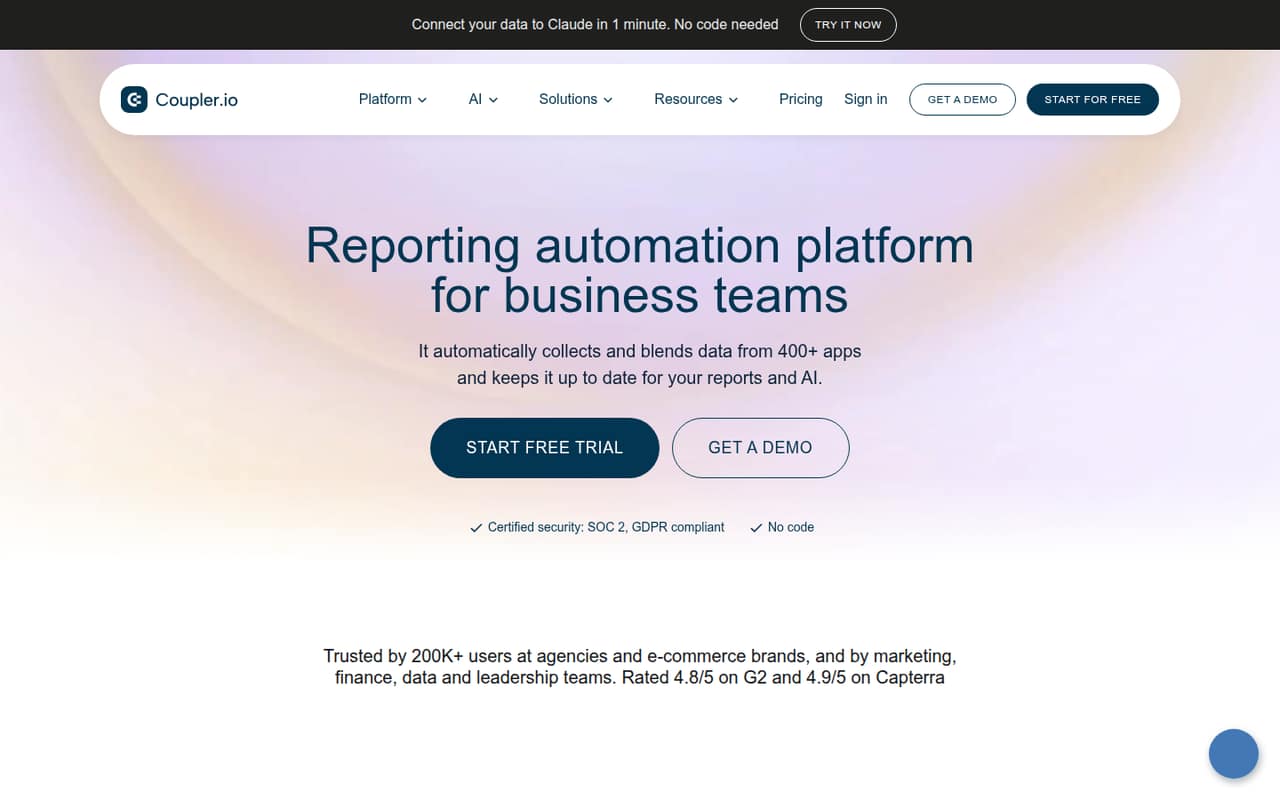
Coupler.io is a hosted reporting automation platform: it connects business apps, transforms data, and syncs it to spreadsheets, BI tools, warehouses, APIs and AI tools. Its 400+ sources and no-code workflows suit teams that need scheduled reporting without building their own extraction pipeline.
The trade-off is less clarity for software teams that need a programmable integration surface, self-hosting or published operational limits. The free plan is constrained to 100 rows per run and manual refresh; paid plans add accounts, destinations, refresh frequency and team features.
Good fit if
- Marketing teams automating recurring reports
- Analysts connecting apps to spreadsheets
- Teams sending business data to BI
Skip it if
- Teams requiring a self-hosted pipeline
- Developers needing documented SDKs
- Workloads needing published rate limits
ScoresHow it rates
What works
- Connects to more than 400 business data sources
- Blends data with formulas, filters, aggregation, append and join
- Schedules refreshes for data flows
- Supports spreadsheet, BI, warehouse, API and AI destinations
- Built-in storage keeps data, history and snapshots
What doesn't
- Free plan allows just 100 rows per run
- Free plan supports manual refresh only
- Published pricing does not list row overage rates
- Custom plan pricing is not published
- Confirm SDK, CLI and API options before building around them
01What Coupler.io is, technically
Coupler.io is a hosted, no-code reporting automation platform, not a dashboard builder or a library you install in an application. It sits between business apps and reporting destinations: connect a source, shape or combine its data, then schedule a flow to deliver it to a spreadsheet, BI tool, warehouse, API or AI tool. The homepage lists more than 400 sources and features for formulas, filters, aggregation, append and join.
That makes it an extraction and data-preparation layer for teams that would otherwise export CSVs or maintain recurring scripts. Coupler.io also describes built-in storage for data, history and snapshots, which can support reporting and analytics without requiring a separate warehouse for every workflow. If a warehouse is already in the stack, the platform can sync data there instead. Reports remain in destinations such as Google Sheets, Data Studio or Power BI; Coupler.io keeps their data refreshed.
02Coupler.io API, SDKs and docs
The integration model is primarily configured data flows: choose a business-app source, apply transformations, select a destination and set a refresh schedule. Coupler.io's homepage names 400+ sources and destinations including Google Sheets, BigQuery, Redshift, PostgreSQL, Snowflake, Data Studio, Power BI, Tableau, Claude, ChatGPT, Cursor AI, Perplexity and Slack. It also lists APIs as a destination category.
This is a different fit from writing directly to a documented ingestion API. The homepage does not present an API style or name SDKs, programming languages, a CLI, webhooks or plugins. Before designing an application around Coupler.io, confirm API access, authentication, SDK support, language coverage and operational behavior in the vendor's docs. For teams working through the interface, the no-code connection and transformation steps reduce integration work; teams needing version-controlled pipeline definitions or programmatic provisioning should verify those workflows with Coupler.io. The vendor offers demos and says its team provides support.
03Coupler.io pricing for developers
The Free plan costs $0 and includes one account, one source, one destination, manual refresh and 100 rows per run. It is enough to try a basic connection, but a recurring production flow needs a paid plan for scheduled refreshes. Starter costs $32 per month, or $24 per month with annual billing, and includes three accounts, one destination, one user, daily refresh and 5,000 rows per run.
Active is $132 monthly or $99 per month billed annually; it includes 15 accounts, three destinations, daily refresh, unlimited users and unlimited data volume. Pro is $259 monthly or $199 per month annually, with 50 accounts, unlimited destinations, hourly refresh, unlimited users and automations. The pricing page advertises 25% savings with annual billing. Extra accounts are listed at $5.99 or $4.49 per account, depending on plan; Custom account pricing is custom. Custom includes 15-minute refresh, SSO and audit logs, but its price is not published. Confirm row overages and any plan-specific account add-on price before budgeting.
04Coupler.io: open source, self-hosting and lock-in
Coupler.io is presented as a hosted platform with built-in storage. Its homepage does not establish an open-source licence or a self-hosted deployment option, so teams that require either should get a direct answer from the vendor before adopting it. Treat the service as hosted unless Coupler.io confirms otherwise.
The platform can send data to warehouses, spreadsheets, BI tools, APIs and AI tools, giving teams potential destination-side copies of synced data. It also says it stores data, history and snapshots, but confirm which of those records can be exported, in what formats, and whether exports include transformation logic and schedules. Migration effort will depend on whether those flow definitions can be recreated elsewhere. Ask about account closure, data retention and deletion as well as export options; those details matter if Coupler.io becomes part of a reporting pipeline.
05Coupler.io in production
The plan limits are the first production check: account and destination counts, refresh cadence and, on Free and Starter, rows per run. Active lists unlimited data volume, while Pro adds hourly refresh and automations; Custom lists 15-minute refresh. Ask the vendor about connector-specific quotas, API limits, retries, failure alerts and recovery behavior before making a flow a critical dependency. Those details are not part of the listed plan limits.
Coupler.io says it is SOC 2 certified and GDPR compliant. Confirm the controls, data-retention terms and contract language required for your organization rather than treating those labels as a substitute for review. Reddit discussion is mixed and limited: a user in an r/Airtable thread praised the connector's ease of use, while commenters in that thread questioned whether the post was an advertisement. In an r/PPC discussion, a commenter recommended trying free tiers to see which workflow fits. Those comments are anecdotal, not evidence of service reliability.
From the threadsWhat users say
Reddit sentiment is mixed: one user praised the Airtable connector, while other commenters questioned the post's promotional tone. Another thread offered little product experience beyond suggesting a free-tier trial.
Was completely blown away with how good the Coupler.io connector was and how easy it made it to get the data in
Please stop hiding advertisements this way, it is too obvious :)
You can test them within their free tiers and see which fits your workflow best
I'd used Coupler before as well to get data into Sheets - I just hadn't realised the Coupler Airtable connector made it that easy to work with the Airtable data in Looker Studio
Questions people ask
What is Coupler.io used for?
Coupler.io automates reporting data flows. It connects business apps, lets teams blend and transform data, then sends it to destinations such as spreadsheets, BI tools, warehouses, APIs and AI tools. Teams can schedule refreshes instead of repeatedly exporting and copying data by hand.
Is Coupler.io safe?
Coupler.io says it is SOC 2 certified and GDPR compliant, and describes built-in secure storage. For a production review, ask the vendor about its current security documentation, data retention, access controls and the terms that apply to your account and data.
Is Coupler.io free?
Yes. The Free plan costs $0 and includes one account, one source, one destination, manual refresh and 100 rows per run. Coupler.io also advertises a seven-day free trial. Check the current plan terms to confirm which paid features are available during the trial.
Can Coupler.io build dashboards?
Coupler.io says it is not a dashboard builder. It moves and prepares data for reports in destinations such as Google Sheets, Data Studio, Power BI and Tableau. It also offers dashboard templates, but teams use their chosen reporting tool to visualize the resulting data.
Can I use Coupler.io with AI tools?
Yes. Coupler.io lists AI integrations and names Claude, ChatGPT, Cursor AI, Perplexity and Slack among its destinations and tools. Its homepage also describes asking questions about business data in plain language. Confirm which connectors and plan limits apply to your intended workflow.