
We may earn a commission if you buy through links on this page. It never changes a score or a ranking. How we make money
The bottom line
A broad, hosted automation platform with quote-based pricing and production details to verify.
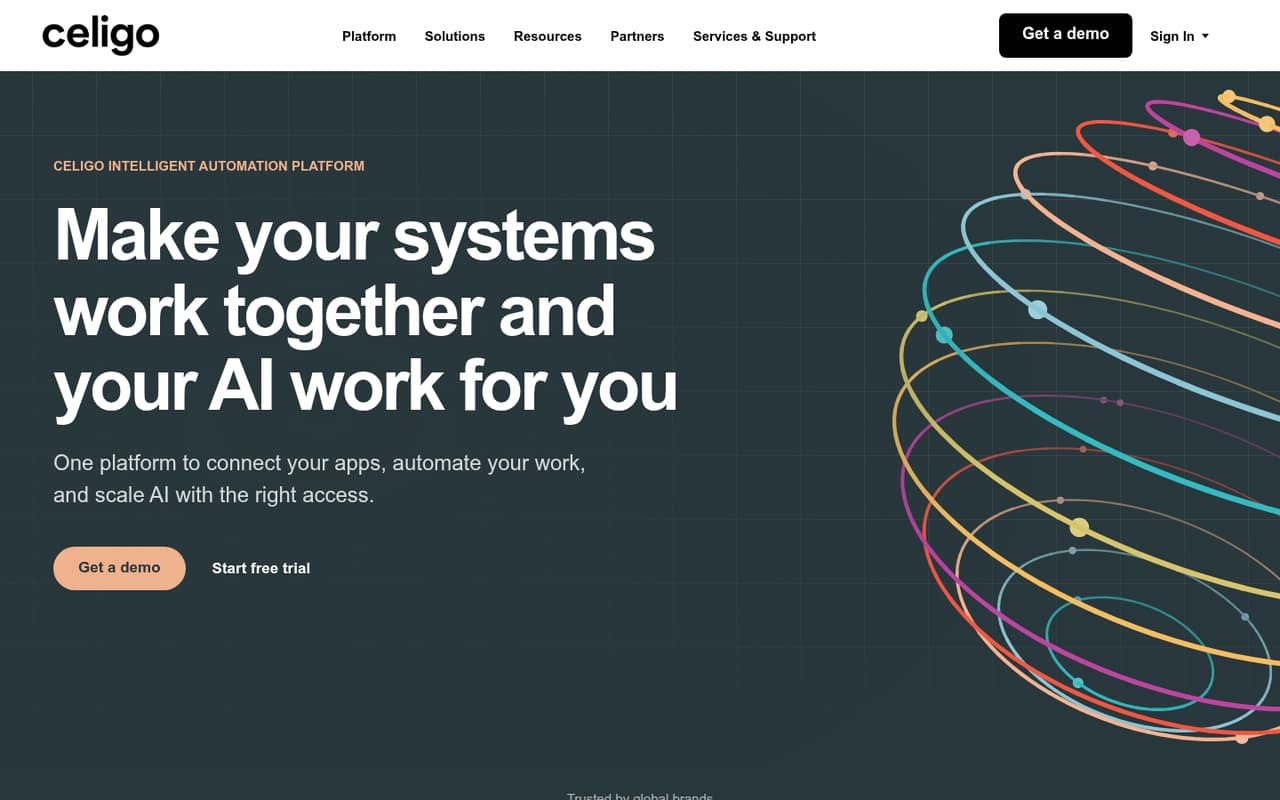
Celigo is a cloud platform for application integrations, data ingestion, API management, EDI, AI agents and MCP management. Teams build workflows from prebuilt Integration Apps, connectors and templates, then govern them alongside agents with monitoring, recovery and access controls.
The main trade-offs are commercial and operational: paid plans are quote-based on endpoints and flows, and exact API, SDK and language support needs confirmation with Celigo. Reddit users praise its integration coverage and support, while raising concerns about cost, pricing changes and visibility into successful flow runs.
Good fit if
- NetSuite-centered integration teams
- Teams consolidating automation tools
- Organizations governing AI workflows
Skip it if
- Teams requiring self-hosted software
- Projects needing published fixed pricing
- Teams requiring detailed flow tracing
ScoresHow it rates
What works
- Integrations, APIs, EDI and agents share one platform.
- Marketplace includes prebuilt connectors, apps and templates.
- Free plan includes two endpoints and one flow.
- Vendor describes monitoring, auto recovery and audit trails.
- No per-task, transaction or volume-based overages on listed plans.
What doesn't
- Paid plan prices are quote-based and unpublished.
- Professional and Standard endpoint and flow counts are quote-based.
- SDKs, languages and CLI support need confirmation.
- A Reddit user reports limited logging and network tracing.
- Additional endpoints, flows and Integration Apps have unpublished prices.
01What Celigo is, technically
Celigo is a hosted cloud platform for integration and automation, not a library or self-hosted server. It sits between business applications and data sources, where teams use it to connect systems, transform workflows and manage API, EDI and AI-agent activity. The platform combines application integrations, data ingestion, API management, B2B trading partner workflows, MCP management and AI agents under shared governance.
Teams can start from a prebuilt connector, Integration App, agent or template in the Celigo Marketplace, then customize it for their process. Celigo positions rules-based workflows and AI agents as parts of the same platform, with monitoring, auto recovery, audit trails and least-privilege access. That makes it an orchestration layer for business systems rather than a standalone API client. The vendor describes Celigo as a cloud platform; teams evaluating it should treat deployment and data movement as dependencies on a hosted service.
02Celigo API, SDKs and docs
Celigo's integration surface centers on its hosted platform, marketplace connectors, Integration Apps, templates and workflow builder. The vendor also describes API management for building and securing APIs, plus management of MCP connections. The homepage does not name an API protocol, programming language, SDK, CLI or webhook interface, so confirm those details in Celigo's developer documentation before designing a custom integration around them.
For teams that can use prebuilt assets, the Marketplace lists integrations and templates for systems including NetSuite, Salesforce, Shopify, SAP, Slack, Snowflake and Workday. It also lists MCP servers, AI agents and guided tools. This can reduce connector work, but a marketplace listing is not a substitute for checking the supported records, authentication methods, error handling and customization options for your exact workflow. Ask Celigo for API reference material, SDK availability by language, versioning policy and documented limits for the interfaces your code will call.
03Celigo pricing for developers
Celigo's Free plan costs $0 per month and includes two endpoints and one flow. The listed offer also includes a 30-day full-access trial. That is enough to evaluate a small integration, but the low endpoint and flow counts make it a narrow base for production. The vendor does not publish paid monthly or annual rates.
Standard pricing is quote-based on endpoint and flow counts. Professional adds a sandbox environment, API Builder and Lookup Cache, with endpoint and flow counts also quote-based. Enterprise includes unlimited endpoints, while flow counts remain quote-based. Standard and Enterprise list no per-task, transaction or volume-based overages; the pricing information also lists no such usage fees as add-ons. Budget instead for the negotiated endpoint and flow allocation, plus any additional endpoints, flows or prebuilt Integration Apps. Their prices are not published, so ask for a quote that models expected integrations and expansion before committing.
04Celigo: open source, self-hosting and lock-in
Celigo is presented as a cloud platform. The vendor's public positioning does not establish an open-source license or a self-hosted deployment option, so teams should plan around a hosted commercial service rather than an installable runtime. Get written confirmation from Celigo about source access, deployment choices and what happens to your workflows and data when a contract ends.
Migration effort depends on how much logic lives in Celigo flows, Integration Apps and platform-specific configuration. The vendor describes marketplace assets and a shared automation platform, but export formats and a workflow migration path are not published in the pricing information. Before rollout, test whether you can export configuration, mappings, logs and data in usable formats. Keep business rules and transformation logic documented outside the platform where practical, and include an exit plan in procurement.
05Celigo in production
Celigo describes production monitoring, auto recovery and audit trails for flows and AI agents, with least-privilege access for people and agents. Its Trust Center references SOC 2 Type II and SOC 1 Type II. These are useful controls to assess, not substitutes for reviewing the security documentation, incident process and access model for your deployment. The vendor does not publish numerical throughput or rate limits in the pricing information, so ask for limits and operational commitments that match your workload.
Reddit feedback is mixed. A commenter on r/Netsuite says Celigo support is usually good and that it has broad integration coverage. Another reports limited logging and network tracing, saying successful flows do not expose the data that moved through them. Users also discuss cost and pricing changes as reasons to compare options. Test failure recovery, payload visibility, replay behavior and peak-volume handling with your own workflows before relying on Celigo for critical operations.
From the threadsWhat users say
Reddit sentiment is mixed. Users value Celigo's integration coverage and, in one report, support, but cost and difficulty tracing successful flows are recurring concerns.
Celigo support is usually pretty good and they have almost any type of integration you might want
Celigo costs were just becoming too much after we priced all the future integrations we would need
There's very limited logging and network tracing
Celigo is more point and click
Questions people ask
What is Celigo?
Celigo is a hosted intelligent automation platform for connecting applications and automating workflows. Its capabilities include data ingestion, API management, B2B and EDI, AI agents and MCP management, with shared governance across those functions.
Does Celigo have an API?
Celigo offers API management as a platform capability for building and securing APIs. The specific API protocols, public endpoints, SDKs and language support should be confirmed in Celigo's developer documentation before you plan a custom integration.
How does Celigo work?
Teams connect applications and configure workflows in Celigo, often starting with marketplace connectors, Integration Apps or templates. The platform also supports data ingestion, API management, EDI and AI agents, with monitoring, recovery and access controls described as shared platform capabilities.
Does Celigo offer a free plan?
Yes. The Free plan is listed at $0 per month and includes two endpoints and one flow. Celigo also lists a 30-day full-access trial. The Free plan's endpoint and flow limits make it important to confirm your production requirements before building around it.
How is Celigo priced for production?
The paid Standard, Professional and Enterprise plans do not have published monthly or annual rates. Pricing is quote-based on endpoints and flows, with Enterprise listing unlimited endpoints. Ask for a quote that includes projected growth and any additional Integration Apps.
Sources
- Celigo homepage
- Celigo pricing, compiled via web search from integrate.io, latenode.com, ariox.com, erppeers.com, houseblend.io
- Reddit: Celigo Alternative
- Reddit: Exploring Alternatives to Celigo for NetSuite Integrations
- Reddit: Evaluating Celigo vs other integration platforms
- Reddit: Celigo Integrator.io Pricing Baseline