
We may earn a commission if you buy through links on this page. It never changes a score or a ranking. How we make money
The bottom line
Blitzy targets complex enterprise work, but its integration details and production costs need careful vetting.
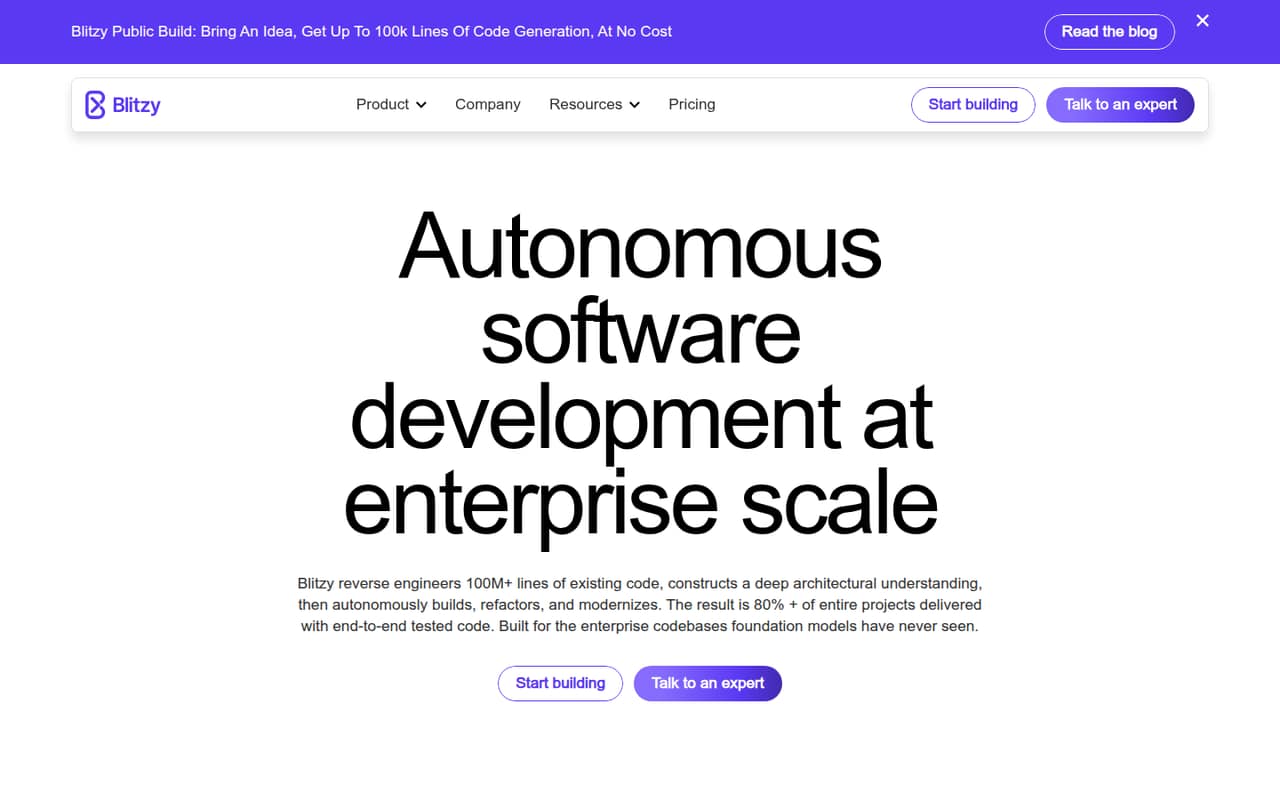
Blitzy is an agentic software development platform that maps large codebases, coordinates AI agents, and aims to take scoped work through code generation and runtime validation. Its stated fit is enterprise modernization and feature work, not lightweight code completion.
The trade-off is visibility: the vendor describes the workflow and deployment choices, but does not publish API, SDK, language, or overage details on its homepage. Public Build is free with strict code-line limits; production plans are annual enterprise engagements. Reddit reactions are mixed and include conflicting accounts.
Good fit if
- Enterprise codebase modernization
- Teams with scoped, large projects
- Organizations requiring private deployment
Skip it if
- Individual developers seeking code completion
- Teams needing a documented public API
- Startups with small software budgets
ScoresHow it rates
What works
- Maps dependencies into a dynamic codebase knowledge graph
- Coordinates more than 3,000 specialized agents
- Supports asynchronous work lasting days or weeks
- Offers customer VPC and on-premises deployment options
- Free Public Build includes 100K lines to generate
What doesn't
- Homepage does not name APIs, SDKs, languages, or CLI
- Public Build is restricted to public repositories
- Private Sandbox is limited to companies with 250+ employees
- Production plans involve substantial annual investments
- Reddit discussions include skeptical and conflicting reports
01What Blitzy is, technically
Blitzy is an agentic software development platform for existing codebases. The vendor describes it as a system that reverse engineers code, maps dependencies and architectural decisions into a dynamic knowledge graph, then uses coordinated AI agents to plan and build changes. It sits above a repository and development workflow: teams submit a specification, Blitzy works through scoping, code generation and runtime validation, and the vendor says the result can include compiled code, end-to-end tests and a precise scope of remaining work.
This is not presented as a local library, command-line tool or general-purpose hosted API. It is a platform sold for enterprise codebases, with deployment options listed as Blitzy Cloud VPC, Single Tenant, customer VPC, on-premises and black box, depending on engagement. The stated use cases include refactoring, adding features and modernizing legacy systems. The homepage claims support for codebases of 100M+ lines and says work can run uninterrupted for days or weeks; these are vendor claims, not independently established production limits.
02Blitzy API, SDKs and docs
The described workflow is specification-led: submit a spec, let Blitzy map the codebase and execute the work, then review the returned code, tests and remaining scope. The homepage says every PR arrives compiled, tested and aligned to team standards. That positions Blitzy around repository-level work and review rather than a documented function call inside an application.
The vendor homepage does not name an API style, SDK, supported programming language, CLI, webhook, plugin or repository provider. It mentions docs support for Public Build and email contact support for Private Sandbox, but does not describe the docs’ technical depth. Before adopting it, ask Blitzy for its repository connection method, supported languages and build systems, authentication model, API or automation options, and the documentation for each. Confirm SDK support in the vendor’s docs rather than assuming a conventional API integration. The homepage also does not publish details about branch policies, CI systems or how generated changes are handed off to existing review workflows.
03Blitzy pricing for developers
Public Build is free forever for public repositories, with 100K lines of codebase context and 100K lines to generate. It includes docs support and small SOTA models; the homepage says Blitzy approval is required. Private Sandbox is also listed at $0 per year for companies with 250+ employees, with 1M lines of context, 100K lines to generate, email contact support and small SOTA models.
The production options move to annual enterprise investments. Structured Pilot is listed at $250,000 per year, with 15M lines of context, 500K lines to generate and a dedicated solutions engineer. Core lists a $500K annual investment; Scale lists $1M typical annual investment; Transformation lists $10M typical annual investment. Deployment options vary by plan. The pricing page does not list monthly billing, per-seat or per-request charges, overage rates, or add-ons. The published limits are measured in lines of context and generation, not requests or compute. Ask sales what happens when a project exceeds those allowances and whether additional work changes the contract.
04Blitzy: open source, self-hosting and lock-in
Blitzy does not publish an open-source licence or source-code availability on its homepage. Its listed deployment choices include Blitzy Cloud VPC, Single Tenant, customer VPC, on-premises and black box, but a private deployment option does not by itself mean the software is self-hostable or that customers receive source code. The Transformation engagement lists customer VPC, on-premises or black box deployment; ask the vendor what those options include and who operates the infrastructure.
The homepage does not explain data export, repository disconnection, deletion, or how to retain the knowledge graph and project artifacts if a contract ends. That leaves migration effort and data portability unclear. Before a production agreement, get written terms covering source and generated-code ownership, repository and prompt retention, export formats, deletion timelines, and access to generated tests and specifications. Treat the agent workflow and its project context as a potential dependency until those terms are clear.
05Blitzy in production
Blitzy says it can run asynchronously for days or weeks and return compiled code and end-to-end tests. The homepage also lists SOC 2 Type II compliance and ISO 27001 certification, along with private deployment options. Those are useful procurement signals, but teams still need to confirm availability commitments, incident response, audit evidence, data handling, model routing, repository permissions and the actual validation gates for their stack. The vendor does not publish public rate limits, uptime figures or overage terms on its homepage.
Reddit sentiment is divided. A thread in r/ChatGPTCoding questions whether the broad codebase claims match the reliability of current models. In r/SaaS, an evaluator criticized the product, while commenters disputed the account and another commenter said their company used Blitzy across engineering teams. These are individual, conflicting reports, not verified deployment data. For a production decision, ask for a scoped evaluation against representative repositories and agree on measurable acceptance criteria before committing to an annual plan.
From the threadsWhat users say
Reddit sentiment is mixed, with skepticism about the breadth of the claims and conflicting reports from people describing evaluations or deployments. The discussion is not consistent enough to treat as a reliable measure of product quality.
It is absolutely BS
What stands out most to me is the way it actually bridges idea to execution instead of just generating isolated snippets
I logged in to the portal, there is nothing there. No tutorials, no tech documents, nothing
My company (mid-cap financial services, publicly traded) bought Blitzy and it’s used by about half of our engineering teams right now every week
Blitzy in the news
Questions people ask
What can Blitzy do?
Blitzy says it reverse engineers existing codebases, maps dependencies and architectural decisions, and coordinates AI agents to plan, build and validate changes. The vendor describes work from scoping through runtime validation, including refactoring, feature development and modernization. It says asynchronous runs can return compiled code, end-to-end tests and a summary of remaining work.
Is Blitzy any good?
It depends on your codebase and project. Blitzy describes a workflow aimed at complex enterprise systems, but the public technical details do not establish its performance for your stack. Reddit reports are mixed, including both skepticism and positive accounts of company use. Evaluate it on representative repositories and define acceptance criteria before signing a production contract.
Does Blitzy have an API or SDK?
The vendor homepage does not name an API style, SDK, supported language or CLI. It describes submitting a specification and receiving code, tests and remaining-work scope, but not the technical interface used to connect a repository or automate that flow. Ask Blitzy for current API and SDK documentation, supported languages, authentication details and automation options.
Can Blitzy run in a private environment?
The vendor lists Blitzy Cloud VPC and Single Tenant for some engagements, and customer VPC, on-premises or black box deployment for Transformation. These options are not the same as open-source self-hosting. Ask who operates each deployment, what data leaves your environment, what support is included and what controls you retain.
What does Blitzy cost for production?
The homepage lists Structured Pilot at $250,000 per year, Core at a $500K annual investment, Scale at a $1M typical annual investment and Transformation at a $10M typical annual investment. Public Build and Private Sandbox are listed at $0, subject to different eligibility and code-line limits. Ask sales about contract scope and excess usage.