
We may earn a commission if you buy through links on this page. It never changes a score or a ranking. How we make money
The bottom line
A low-friction managed runner for GitHub Actions, priced by compute minute and bundled with CI observability.
Blacksmith is a hosted replacement for GitHub Actions runners. Teams keep their GitHub Actions workflows and route jobs to Blacksmith-managed machines, with a listed 3,000 free minutes per month and per-minute rates by operating system.
The case for it is faster builds and cache downloads plus a console for finding slow jobs and searching logs. Those speed figures are Blacksmith’s claims; confirm performance with your own workflows. Check free-minute scope, data access and support terms before moving production CI.
Good fit if
- Teams already using GitHub Actions
- Repositories with long or slow CI jobs
- Teams wanting managed runner operations
Skip it if
- Teams requiring a self-hosted runner
- Projects needing published SDKs or APIs
- Organizations requiring documented data export
ScoresHow it rates
What works
- Drop-in GitHub Actions runner integration
- 3,000 free minutes per month
- Ubuntu, ARM, Windows and macOS options
- Global search across CI logs
- Inline failed-test logs on pull requests
What doesn't
- Performance multipliers are vendor claims
- Free-minute allocation scope needs confirmation
- Public API and SDK details are not established
- Source licence and self-hosting availability are unclear
- Export and standard support terms need confirmation
01What Blacksmith is, technically
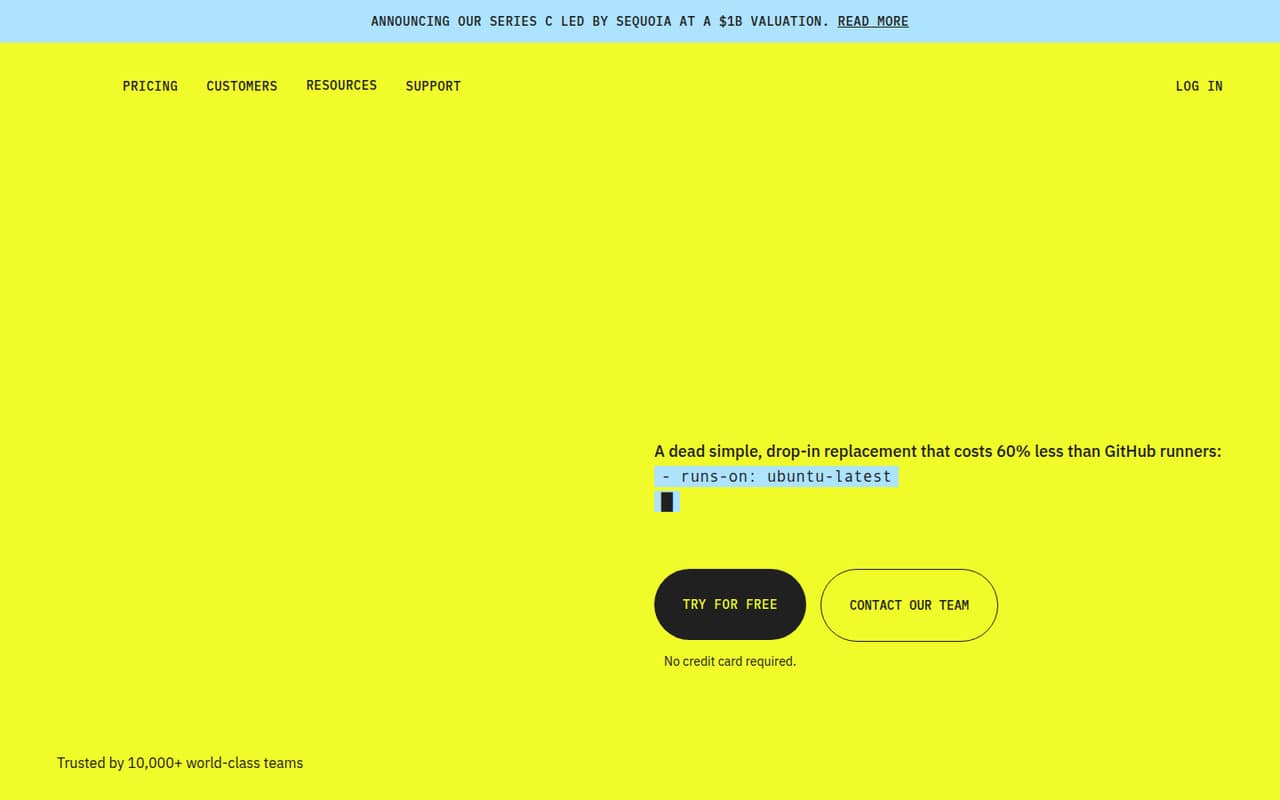
Blacksmith is a managed CI service for GitHub Actions: it supplies the runner infrastructure and a web console, rather than replacing GitHub Actions as the workflow system. Jobs still use GitHub Actions workflow configuration; Blacksmith presents itself as a drop-in runner replacement and shows runs-on: ubuntu-latest in its setup example. It sits between your repository and CI compute, running jobs on its hardware and providing a separate view into job performance and logs.
The product addresses two parts of CI operations: compute speed and troubleshooting. Blacksmith says its bare-metal gaming CPUs deliver 2x faster hardware, co-located cache artifacts make downloads 4x faster, and persisted Docker layers make Docker builds 40x faster. These are vendor claims, not guarantees for every repository. Its console is intended to surface slow or failing jobs, performance regressions, searchable CI logs and failed-test logs on pull requests. Teams retain GitHub Actions as the orchestration layer while outsourcing runner management.
02Blacksmith API, SDKs and docs
The primary integration surface is GitHub Actions workflow configuration, not a language-specific SDK. Blacksmith calls the service a drop-in replacement and shows runs-on: ubuntu-latest; teams should review its documentation for the exact runner labels and migration steps before changing workflows. This approach can avoid rewriting job logic, while keeping the existing GitHub Actions workflow as the source of CI configuration.
The homepage links to product documentation, but names no REST API, SDK, CLI, programming language package or webhook integration. The console is the named surface for CI observability, including job inspection, global log search and inline failed-test logs posted as a GitHub comment. Confirm in the vendor docs whether any API or SDK supports your desired automation, and check how log access is scoped. The integration described publicly is GitHub Actions, so teams running other CI orchestrators should confirm compatibility rather than assume runner portability.
03Blacksmith pricing for developers
Blacksmith lists 3,000 free minutes per month, then per-minute compute rates by runner type: Ubuntu x64 at $0.004/min, Ubuntu ARM at $0.0025/min, Windows x64 at $0.008/min and macOS M4 at $0.08/min. The pricing page does not publish monthly or annual subscription terms. Before budgeting, ask whether the free minutes apply per organization, account or runner type, and how unused minutes are treated.
The listed add-ons can change the bill. Docker layer caching and sticky disks each cost $0.50/GB/month on Ubuntu plans; static IPs cost $100/IP/month on Ubuntu and Windows plans. Enterprise pricing is custom and includes a 99.9% SLA, 24/7 priority support, a dedicated Slack channel and white-glove onboarding. The homepage says Blacksmith costs 60% less than GitHub runners, but that is a vendor comparison; model your own job duration, operating-system mix and add-on use. Compute charges are usage-based, not a published flat subscription.
04Blacksmith: open source, self-hosting and lock-in
Blacksmith is presented as a managed service for GitHub Actions. The vendor links to a self-hosting resource titled “When to move to managed CI,” but that does not establish that Blacksmith itself can be self-hosted. Its software licence and source availability are not published on the homepage. Teams that require an open-source or on-premises runner should confirm both points with Blacksmith before adopting it.
The workflow integration is built around GitHub Actions, which gives teams a familiar configuration layer, but the service still creates dependency on Blacksmith’s runner capacity and observability console. The homepage does not describe a data-export format or process for logs, metrics or job history. Ask whether these records can be exported and how long they remain available. If leaving, teams should plan to redirect workflows to another GitHub Actions runner and verify that any needed history or debugging data has been retained.
05Blacksmith in production
Blacksmith’s homepage lists unlimited concurrency in its comparison table, but does not provide a numeric rate limit or explain how concurrency is governed by plan. Confirm queueing behavior, usage caps and any operating-system-specific constraints before relying on that claim for release pipelines. The pricing page lists a 99.9% SLA for Enterprise; teams on other plans should ask what reliability commitments and support response times apply.
For security and compliance review, check the vendor’s security documentation for runner isolation, secrets handling, network controls, data retention and available compliance attestations. The homepage links to a security page but does not state those details. Also confirm how the service handles failed jobs and whether logs can be exported for incident response. Blacksmith claims faster hardware, cache downloads and Docker builds, but real results depend on your workload and cache behavior. Benchmark representative workflows before shifting critical deployment jobs, and validate the bill with your expected minutes and any paid caching or IP add-ons.
Questions people ask
Does Blacksmith replace GitHub Actions?
No. Blacksmith positions itself as a managed runner replacement for GitHub Actions. Workflows continue to use GitHub Actions configuration, while Blacksmith supplies the runner infrastructure and a separate console for CI observability.
How do I connect a GitHub Actions workflow to Blacksmith?
The homepage describes a drop-in integration and shows runs-on: ubuntu-latest. Check Blacksmith’s documentation for the current runner labels, setup process and any workflow changes required for your repository.
Does Blacksmith offer a public API or SDK?
The homepage names GitHub Actions workflow configuration and the observability console as integration surfaces, but does not name an API, SDK or CLI. Confirm API and SDK availability in Blacksmith’s documentation before planning programmatic control.
Can I use Blacksmith for Windows and macOS CI?
Yes. The listed runner options include Windows x64 at $0.008 per minute and macOS M4 at $0.08 per minute. Blacksmith also lists Ubuntu x64 and Ubuntu ARM options; each has 3,000 free minutes per month.
Can I self-host Blacksmith or export my CI logs?
Blacksmith is presented as a managed service. Its homepage links to a self-hosting resource, but does not establish a self-hosted Blacksmith edition, software licence or log-export process. Ask the vendor about deployment options and data export before adopting it.