
We may earn a commission if you buy through links on this page. It never changes a score or a ranking. How we make money
The bottom line
Useful for routine Azure workflows, but validate developer tooling and connector costs before scaling.
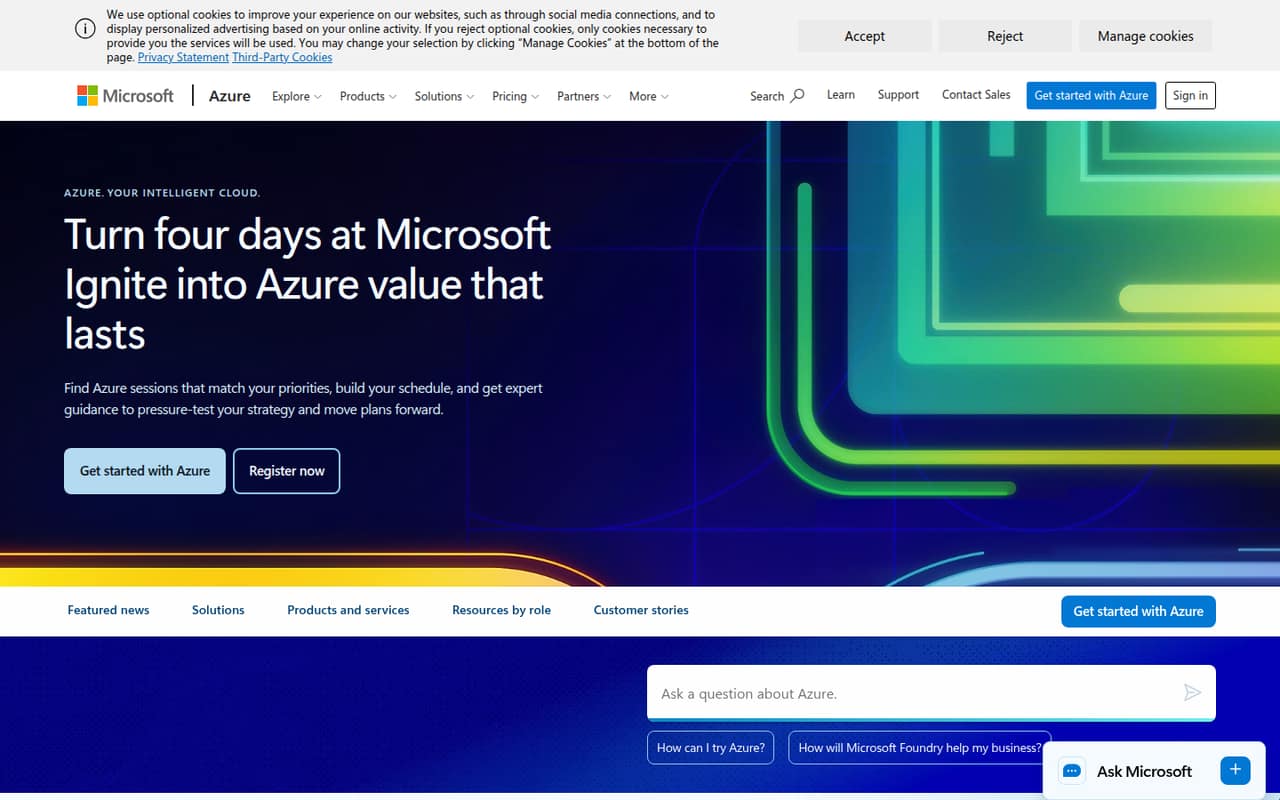
Azure Logic Apps is a hosted Azure service for building workflows, with an option billed per action and Standard plans billed for provisioned compute. The homepage promotes AI and native Azure integration, but gives little detail about workflow capabilities or developer interfaces.
The Consumption Plan includes 4,000 actions per month free per Azure subscription, then charges per action. Standard plans add fixed compute costs, and connector calls can add to the bill. Reddit users describe low-code workflows as useful for routine automation, while raising concerns about debugging and source control.
Good fit if
- Routine Azure workflow automation
- Variable workloads billed per action
- Teams using Azure services
Skip it if
- Teams needing a self-hosted runtime
- Code-first workflows requiring deep debugging
- Projects needing predictable connector costs
ScoresHow it rates
What works
- Consumption plan has 4,000 free monthly actions
- No per-seat licensing on Consumption
- Standard plans include built-in operations within provisioned capacity
- Native Azure integration is a stated focus
- Provisioned plans offer three listed compute sizes
What doesn't
- Standard and Enterprise Connectors cost extra
- Homepage gives little detail on workflow capabilities
- API, SDK and language support need verification
- Reddit users raise debugging and source-control concerns
- No self-hosted runtime or open-source license is listed
01What Azure Logic Apps is, technically
Azure Logic Apps is a hosted Azure service for building and running workflows. It sits between events or business processes and the systems a workflow needs to coordinate; it is not presented on the homepage as a library, CLI or self-hosted server. The homepage describes it broadly as a way to build workflows faster, with AI and native Azure integration.
The pricing options show two deployment and billing models: a multi-tenant Consumption Plan billed by action, and Standard plans that provision compute capacity. Integration Accounts are separately priced for partner-integration artifacts. That makes Logic Apps a managed workflow layer in an Azure stack, rather than application code you package and run yourself. The homepage does not spell out specific triggers, connectors or workflow limits, so check the current product documentation against the events, systems and execution requirements in your design.
02Azure Logic Apps API, SDKs and docs
The homepage positions Logic Apps around workflow building, AI and native Azure integration. It links to Azure documentation, the Azure portal and quickstart templates, but does not name a REST API, SDK, programming language, CLI or plugin interface. Treat workflow authoring as the integration surface established by the product description, and confirm API, SDK and automation support in the vendor's current documentation before choosing a build and deployment process.
A Reddit thread describes a portal-based, drag-and-drop workflow that reacts to a Salesforce object change and replicates its details to other systems. That is a user example, not a guarantee of a specific connector or trigger. In another thread, developers raised concerns about debugging, source control and moving changes between environments in low-code tools. Confirm how Logic Apps handles workflow definitions, reviewable diffs, local development, testing and promotion across environments before making it part of a critical release pipeline.
03Azure Logic Apps pricing for developers
The Consumption Plan (Multi-tenant) has no per-seat charge and includes the first 4,000 actions per month free per Azure subscription. After that, actions cost $0.000025 each. Standard Connectors add $0.000125 per call; Enterprise Connectors add $0.001 per call. Consumption data-retention storage is $0.12 per GB per month.
Standard Plan – WS1, WS2 and WS3 are listed at estimated monthly totals of $175.16, $350.33 and $700.65. They provide 1, 2 and 4 vCPUs respectively; built-in workflow operations are included within provisioned capacity. Those totals are estimates based on hourly rates, not annual prices. Standard-plan data-retention and state storage are billed at Azure Storage rates.
Integration Accounts have a free tier with limited artifacts and no SLA, plus Basic and Standard tiers listed at $306.60 and $1,000.10 per month. Account for connector calls, storage and partner-integration needs when estimating production cost.
04Azure Logic Apps: open source, self-hosting and lock-in
Logic Apps is presented as an Azure service, not software to install on your own servers. The vendor's homepage does not publish a self-hosted runtime or open-source license, so teams needing either should confirm availability and terms with Microsoft before adopting it. Treat the service as hosted and Azure-dependent when assessing portability.
The homepage also does not describe workflow-definition export or a migration path to another engine. Before committing, verify how definitions, configuration, secrets and execution data can be exported, and what can be reused outside Azure. A Reddit thread reports that developers have worried about local development, source control and moving changes across environments; those are practical areas to validate with current documentation and a representative workflow. Connector choices and Azure-specific integrations may also increase the work needed to move.
05Azure Logic Apps in production
The homepage does not publish workflow limits, rate limits or reliability targets. The pricing details establish different cost models, but they do not by themselves define throughput or scaling behavior. Confirm current limits, retry and failure handling, monitoring, security controls and compliance commitments with Microsoft for the region and plan you intend to use. The Integration Account Free Tier explicitly has no SLA; do not assume that condition applies to other tiers or plans.
Production cost can rise with action volume, paid connector calls and retained data. For Standard plans, built-in operations fit within provisioned capacity, while state and retention storage are billed at Azure Storage rates. Reddit users describe low-code tools as useful for routine or peripheral automation, but some warn that debugging and version comparison can be difficult. Keep workflows small and reviewable, and test recovery and deployment procedures before putting business-critical processes behind them.
From the threadsWhat users say
Reddit sentiment is mixed: some developers find low-code useful for routine automation, while others object to limited control and difficulty debugging or comparing versions. One thread describes a concrete Salesforce-triggered workflow; another raises concerns about Logic Apps development and deployment practices.
They’re quite useful and productive for work like that
if you ever need anything custom or slightly different than the general use case, you'll end up spending more in consultants than you would have on some in house devs
Debugging it is almost impossible
there was no local dev environment, no reasonable way to store them in source control, and moving changes across environments was so clunky
Questions people ask
What is Azure Logic Apps used for?
Azure Logic Apps is a hosted Azure service for building workflows. Microsoft describes it as helping users build workflows faster, with AI and native Azure integration. The homepage does not detail specific triggers, connectors or workflow limits, so check the product documentation for the requirements of a particular integration.
Does Azure Logic Apps have a free tier?
The Consumption Plan (Multi-tenant) includes the first 4,000 actions per month free per Azure subscription. The Integration Account – Free Tier is also listed at $0 per month, but has limited partner-integration artifacts and no SLA. Those are separate offers with different purposes.
Does Azure Logic Apps support APIs and SDKs?
The Azure homepage links to documentation, the Azure portal and quickstart templates, but does not name a Logic Apps API, SDK, programming language or CLI. Confirm the current supported interfaces in Microsoft's documentation before selecting an automation or deployment approach.
Can Azure Logic Apps run outside Azure?
Logic Apps is presented as an Azure-hosted service. The vendor's homepage does not publish a self-hosted runtime or open-source license. If running workflows outside Azure is a requirement, confirm the available deployment options and licensing directly with Microsoft before designing around the service.
What should I check before using Logic Apps in production?
Check execution and connector limits, retries, monitoring, security and compliance commitments, plus how workflow definitions and data can be exported. The homepage does not publish workflow or rate limits. The Integration Account – Free Tier explicitly has no SLA; verify the applicable terms for any other plan.