
We may earn a commission if you buy through links on this page. It never changes a score or a ranking. How we make money
The bottom line
Managed Airflow with strong deployment tools, billed by the hour and scaled for production.
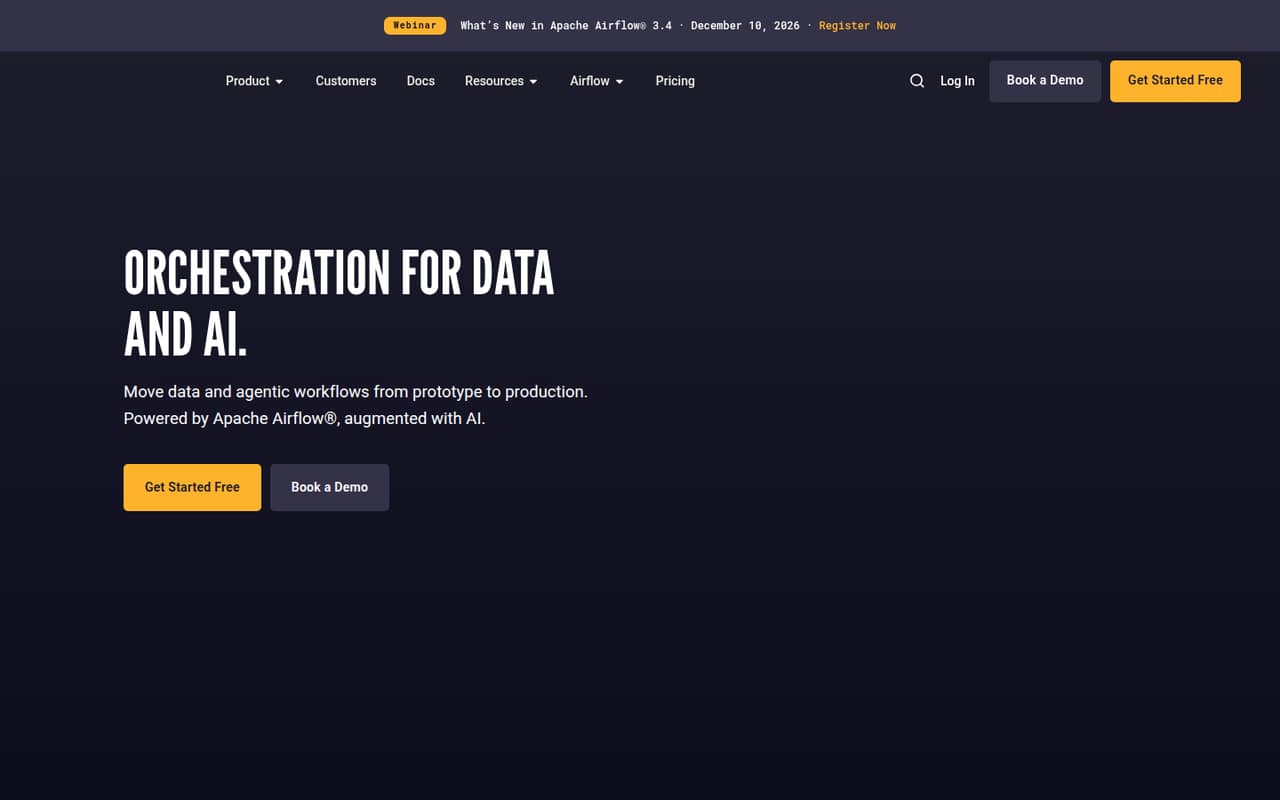
Astro is Astronomer’s orchestration platform, built around Apache Airflow and a re-engineered runtime. It combines hosted deployments with a CLI, browser IDE, API and Terraform support, plus event scheduling and Otto, an AI agent for DAG work and troubleshooting.
The main trade-off is operational convenience versus metered cost. Developer deployments start at $0.35 per hour, while workers, dedicated clusters, Astro Observe, AI tokens and cloud networking can add charges. Ask for a usage estimate and confirm any quoted-plan terms before moving production workloads.
Good fit if
- Teams already building with Airflow
- Data platforms needing managed operations
- Event-driven data and AI workflows
Skip it if
- Small projects needing a free hosted tier
- Teams avoiding vendor-managed infrastructure
- Workloads requiring published fixed pricing
ScoresHow it rates
What works
- DAGs stay compatible with the Airflow model
- CLI and browser IDE support local development
- Configuration can be managed with Terraform
- Hourly entry pricing is published for two plans
- Higher tiers add support and enterprise controls
What doesn't
- No free plan or free trial is listed in pricing
- Worker and dedicated-cluster costs are extra
- AI token rates are not published
- Business and higher tiers require a quote
- Astro platform license and export paths need confirmation
01What Astro is, technically
Astro is Astronomer’s managed orchestration platform for data and AI workflows, built on Apache Airflow. It is not a new DAG framework or a standalone library: teams write Airflow DAGs, then use Astro to develop, deploy, operate and observe them. The hosted service runs Astro Runtime, Astronomer’s re-engineered Airflow runtime, while the Astro CLI supports local development and deployment workflows.
In a typical stack, Astro sits between workflow code and the infrastructure that schedules and executes it. It provides deployments, scheduling, scaling, observability and platform controls; your DAGs define the work and connect to the systems those workflows use. The homepage says DAGs stay the same while Astro changes the scheduler, executor, runtime and infrastructure. Astro also offers Astro Private Cloud for teams running Airflow in their own environment. That makes it relevant to Airflow teams wanting managed operations, but the service is most useful when Airflow is already a fit for the codebase.
02Astro API, SDKs and docs
The named integration surfaces are the Astro CLI, browser-based Astro IDE, API and Terraform. The homepage shows CLI commands for initializing a project from a template, starting Airflow locally, testing an upgrade and deploying. It also says configuration can live in Git and move through pull-request review. The API can be used to manage deployments, but the homepage does not name its protocol or supported SDK languages. Confirm API details and SDK support in Astronomer’s docs before designing an integration around them.
Astro is built around Apache Airflow DAGs, and the vendor says existing DAGs stay the same on Astro Runtime. That gives Airflow users a familiar workflow-code layer, with local development intended to match production behavior. Terraform is the named infrastructure-as-code integration; no other provider integrations or language-specific SDKs are identified in the homepage text. The vendor also describes Otto as an agent that can run in a terminal or in Astro, using deployment and team context for DAG authoring, failure investigation and upgrade planning.
03Astro pricing for developers
The pricing page lists no free plan or free trial. The homepage has a “Get Started Free” call to action, so confirm what access it covers; Apache Airflow itself is open source, but that does not make Astro’s hosted service free. Developer deployments start at $0.35 per deployment per hour. Team starts at $0.42 per deployment per hour and adds dedicated clusters, high availability, observability, data quality, seven-day audit-log retention and 24x5 support.
The bill grows with running time and extra compute. Workers start at $0.13 per hour, and dedicated clusters start at $2.40 per hour. Astro Observe is priced as a percentage of deployment and worker compute. AI token usage has additional costs, but rates are not published; cloud-provider networking costs are passed through. Team (quote), Business, Enterprise and Enterprise Business Critical use quote-based usage pricing. Astro Private Cloud has custom pricing. The pricing page offers monthly and annual views but publishes no annual equivalents. Ask for a workload estimate that includes workers, observability, AI use and networking.
04Astro: open source, self-hosting and lock-in
Apache Airflow is open source, and Astro is built on it. The Astro platform’s own source availability and license are not published on the vendor's site; ask Astronomer whether any platform components can be inspected or run independently. Astro Private Cloud is an option for running Airflow in your environment, with multi-cluster and multi-region management, air-gapped deployment support, enterprise SSO and deployment isolation. It has custom pricing.
Astro says DAGs stay the same on Astro Runtime, and it supports Git-managed configuration, which can reduce dependence on the hosted control plane. Still, runtime, observability, Otto, deployment metadata and platform configuration may need replacement when leaving. The vendor's site does not describe a complete data-export process or migration tooling. Before adopting it, ask which data and deployment records can be exported, in what formats, and what happens to Astro-specific configuration after a move to plain Airflow or another provider.
05Astro in production
Astro is designed for production workloads, with dedicated clusters and high availability on Team, and stronger support and access controls on higher tiers. The homepage claims the runtime handles 500,000 sustained concurrent tasks, reports 228 ms p95 task-start latency in its stated scenario, and lists cross-region recovery with an RPO under 15 minutes and RTO under one hour. Treat those as vendor claims, and check how they apply to your deployment size and architecture.
Production costs depend on deployment hours, workers, dedicated clusters and add-ons. Ask how autoscaling, hibernation and scale-to-zero affect your workload’s actual bill, and confirm limits for replicas, workers and task concurrency. Security and support vary by plan: Business adds SSO, CI/CD enforcement, 90-day audit logging and 24x7 support with a one-hour SLA; Enterprise Business Critical adds cross-region disaster recovery and a 30-minute SLA. Confirm compliance coverage, data residency, incident response and networking costs before relying on it for sensitive pipelines.
Questions people ask
Is Astro the same thing as Apache Airflow?
No. Astro is Astronomer’s orchestration platform, powered by Apache Airflow and its Astro Runtime. Teams write Airflow DAGs, while Astro supplies deployment, scheduling, operations and observability features. Astronomer says DAGs stay the same on Astro Runtime, but the platform adds its own runtime and management capabilities.
Can I develop Astro workflows locally?
Yes. The vendor says developers can run Airflow locally with the Astro CLI or develop in a browser with Astro IDE. The homepage also shows CLI commands for starting a local project and testing upgrades. Astro says local and production behavior use the same code, but confirm any environment-specific settings for your deployment.
Does Astro support Terraform?
Yes. Astronomer lists Terraform as an option for managing Airflow infrastructure, alongside Git, the CLI and API. The homepage does not identify Terraform provider versions or resource coverage, so check the vendor’s documentation for support details before building an infrastructure workflow around it.
Does Astro offer a free plan?
The pricing information lists no free plan or free trial, although the homepage has a “Get Started Free” call to action. Ask Astronomer what that access includes and whether it has usage or duration limits. Apache Airflow is open source, but Astro’s hosted service has hourly deployment pricing.
Can I move my Astro DAGs to another Airflow environment?
Astronomer says DAGs stay the same on Astro Runtime, which can help with portability. Astro-specific configuration, runtime behavior, deployment history and observability features may need separate work. The vendor's site does not describe a complete export process, so ask Astronomer which records and settings you can export before adopting the service.