
We may earn a commission if you buy through links on this page. It never changes a score or a ranking. How we make money
The bottom line
Managed CDC with a useful free tier; confirm usage rates, source access and migration terms before committing.
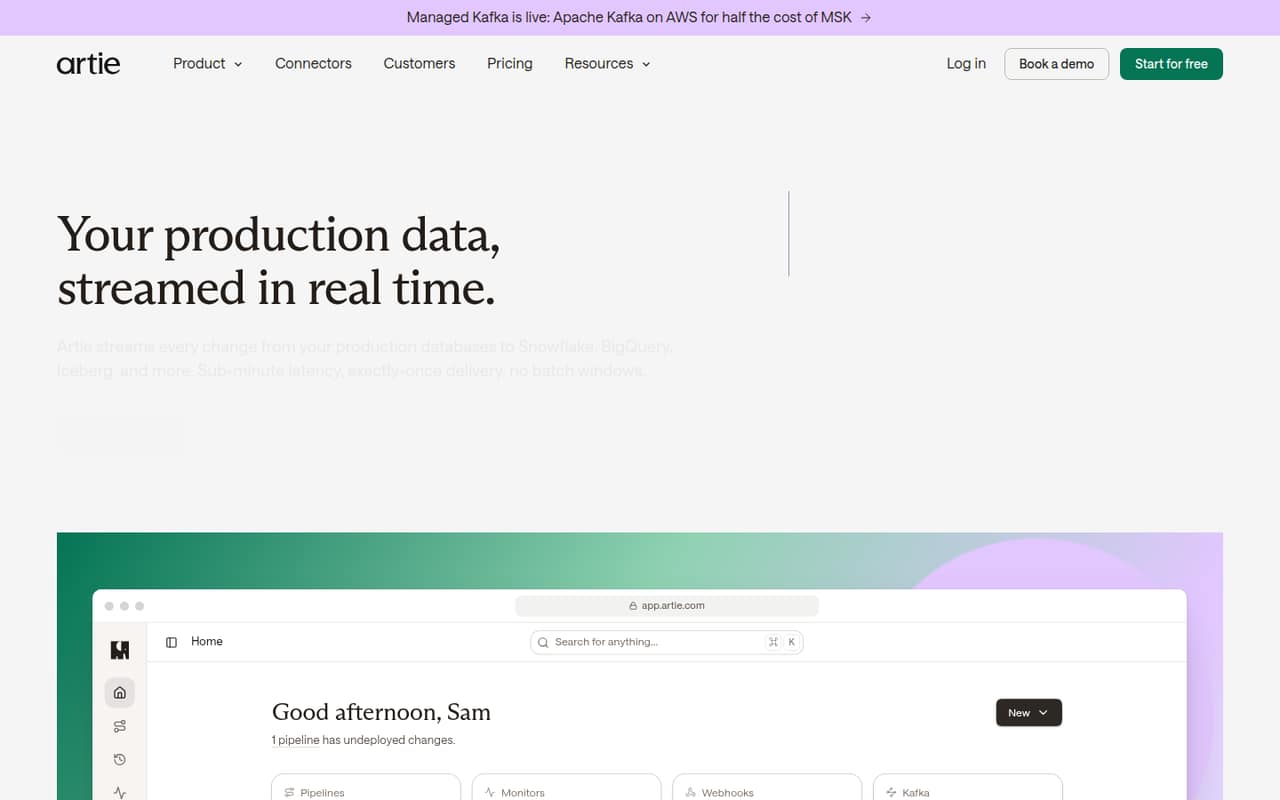
Artie is a managed data integration service that streams database changes to warehouses and lakehouses, plus managed Kafka on AWS. The vendor says CDC changes arrive within a minute, with exactly-once delivery, automatic schema evolution and backfills that do not count toward billable rows.
The Free plan covers up to 1 million billable rows and two active pipelines. Growth starts at $500 per month with annual billing, but usage rates beyond committed volume are not published. Enterprise adds BYOC and on-premise deployments at custom pricing. Artie is worth considering for teams that want managed operations, but confirm costs and exit terms before production rollout.
Good fit if
- Teams moving database changes to analytics
- Small pipelines testing CDC at no cost
- Companies wanting managed Kafka on AWS
Skip it if
- Teams requiring a published usage rate
- Teams committed to open-source infrastructure
- Projects needing a documented migration path
ScoresHow it rates
What works
- Streams inserts, updates and deletes from production databases
- Vendor says changes land within a minute
- Exactly-once delivery and automatic schema evolution
- Backfills are included and excluded from billable rows
- Enterprise offers BYOC and on-premise deployments
What doesn't
- Growth overage rates are not published
- Enterprise pricing is custom
- No published source license or open-source commitment
- Data-export and migration procedures are not published
- Confirm SDK support before planning code-first automation
01What Artie is, technically
Artie is a managed data integration service for change data capture (CDC), with managed Kafka on AWS as a separate product. It sits between production databases and analytics destinations: it reads database changes and streams inserts, updates and deletes to Snowflake, BigQuery, Databricks, Iceberg and other destinations. The vendor says changes arrive within a minute of commit, with exactly-once delivery.
This is a hosted service, not a database library or a self-managed CDC server. Teams connect a source, choose tables and columns, then deploy a pipeline through Artie's product. Artie says it reads transaction logs rather than source tables and that backfills do not block writes. Enterprise customers can run the data plane in their own cloud or private network; the Enterprise plan also lists on-premise deployments. The managed Kafka offer runs on AWS, with Artie handling broker failures, disk growth and upgrades. This puts Artie in the data movement layer, before a warehouse or lakehouse, rather than inside application request paths.
02Artie API, SDKs and docs
The integration flow Artie describes is pipeline-oriented: connect a database, select tables and columns, optionally mask sensitive fields or keep SCD Type 2 history, then deploy. The homepage lists Postgres, MySQL, MongoDB and DynamoDB as sources, and Snowflake, BigQuery, Databricks, Iceberg and ClickHouse among destinations. The vendor also says it supports additional databases and analytics destinations.
Artie's materials describe a managed product rather than a language-specific library. They do not establish a REST API, SDK languages, CLI or automation interface, so confirm those details in Artie's documentation before designing infrastructure-as-code or code-first pipeline management. The homepage shows webhooks in its product interface, but gives no protocol or configuration detail to rely on. For Kafka, the described workflow is to create topics and ship code while Artie manages AWS brokers. Check the connector list and operational documentation for your exact database version, destination, authentication method and recovery requirements before rollout.
03Artie pricing for developers
Artie has an ongoing Free plan at $0 per month. It includes up to 1 million billable rows per month and up to two active pipelines, with backfills always included. Free also lists SOC 2 Type II and Slack Community support. The stated 14-day free trial is separate from the ongoing Free plan.
Growth costs $500 per month when billed annually or $600 month-to-month. It includes unlimited active pipelines, usage-based billing by billable rows, proactive monitoring, SSO, RBAC and HIPAA with a BAA required. Growth usage beyond committed volume is billed at a per-unit rate, but Artie does not publish that rate. PrivateLink costs an additional $500 per month per connection.
Enterprise pricing is custom and includes BYOC and on-premise deployments, unlimited PrivateLink, 24/7 support and uptime guarantees. Managed Kafka is priced at AWS infrastructure cost plus 25% on broker instances; Artie says it waives that 25% for Artie CDC on Enterprise BYOC. Model the bill using expected billable rows, committed volume, PrivateLink connections and Kafka infrastructure, then ask Artie for written overage rates.
04Artie: open source, self-hosting and lock-in
Artie does not publish a source license or an open-source commitment. Its standard product is managed; the Enterprise plan lists BYOC and on-premise deployments, so customers can place the data plane in their cloud or private network. That is a deployment option, not evidence that the software is available to self-host without Artie.
The vendor does not publish a data-export procedure or a migration path. Before signing, ask what pipeline configuration, schema history and operational metadata you can export, and whether your destination tables remain usable without Artie. A CDC pipeline also depends on source and destination connectors and on how change history is represented, including optional SCD Type 2 history. Moving away may therefore involve rebuilding pipeline configuration and validating downstream data, not just switching a connection string. Get licensing, export and termination terms in writing.
05Artie in production
Artie says it delivers changes within a minute of commit and provides exactly-once processing, automatic schema evolution and failure recovery. Those are vendor claims, not a substitute for checking service-level details against your workload. The pricing page lists uptime guarantees and 24/7 support for Enterprise; Free includes Slack Community support. Check the support and incident-response terms for the plan you expect to run.
Before launch, verify source database versions, transaction-log retention requirements, initial-backfill behavior, schema-change handling and recovery after a prolonged destination outage. The published Free limit is 1 million billable rows per month and two active pipelines; Growth has unlimited active pipelines, but usage over committed volume is charged at a rate Artie does not publish. For regulated workloads, Growth lists HIPAA with a BAA required, while Free lists SOC 2 Type II. Enterprise adds BYOC and on-premise deployment. Ask for concrete latency, retention, availability and overage commitments for your planned volume.
Questions people ask
Does Artie have a free plan?
Yes. Artie's Free plan costs $0 per month and includes up to 1 million billable rows per month, up to two active pipelines and backfills. The plan also lists SOC 2 Type II and Slack Community support. Check the billable-row definition with Artie before estimating a production pipeline's monthly usage.
How much does Artie cost for a production team?
Growth costs $500 per month with annual billing or $600 month-to-month. It includes unlimited active pipelines and usage-based billing by billable rows. Usage above committed volume is charged at a per-unit rate that Artie does not publish. Enterprise pricing is custom.
Which databases and destinations does Artie support?
Artie names Postgres, MySQL, MongoDB and DynamoDB as sources. Destinations listed include Snowflake, BigQuery, Databricks, Iceberg and ClickHouse. The vendor describes the connector range as broader than those examples, so check its connector list for the specific database, destination and versions in your stack.
Can Artie run in our cloud or on-premise?
The Enterprise plan lists BYOC and on-premise deployments. Artie says enterprise customers can run the data plane in their own cloud or private network. Confirm which components remain managed by Artie, what network access is required and whether the deployment model supports your compliance and operational requirements.
How fast does Artie deliver database changes?
Artie says changes land within a minute of commit and advertises exactly-once delivery. Actual performance depends on your sources, destinations and workload; get written latency and recovery commitments for your use case. The vendor's homepage also displays example replication lags, but those figures are not a service guarantee.