
We may earn a commission if you buy through links on this page. It never changes a score or a ranking. How we make money
The bottom line
A free, self-hosted distributed database for teams that need scale and can run the cluster.
Apache Cassandra is a self-hosted, open-source distributed NoSQL database for large active datasets that need high availability. Its masterless architecture, replication across data centers and online scaling target systems that must keep serving through node or regional failures.
The software costs nothing to download under Apache License 2.0, but production requires infrastructure and people to operate it. Cassandra is a better fit for teams prepared to manage a distributed database than for buyers seeking a turnkey hosted service.
Good fit if
- Teams with distributed database operators
- High-write, multi-data-center workloads
- Systems needing online cluster scaling
Skip it if
- Teams seeking a turnkey hosted database
- Workloads needing simple relational modeling
- Organizations without database operations capacity
ScoresHow it rates
What works
- Free to download and self-host
- Apache License 2.0
- Masterless architecture has no single points of failure
- Replication spans multiple data centers
- Add nodes without application downtime
What doesn't
- Your team owns cluster operations
- The vendor publishes no hosted-service pricing here
- SDK and language support need verification
- Production infrastructure costs are separate
- Migration requires planning for data and queries
01What Apache Cassandra is, technically
Apache Cassandra is a self-hosted, open-source distributed NoSQL database server, not a hosted API or application. It stores large active datasets across a cluster of identical nodes, with replication across data centers. Its masterless design avoids a single coordinating node as a point of failure.
Cassandra sits in the persistence layer of an application stack. Applications write to and read from the database; operators manage the cluster and its capacity. The project describes linear growth in read and write throughput as machines are added, and data streaming between nodes during scaling operations. Replication settings let teams choose synchronous or asynchronous behavior for each update.
That architecture targets systems that need high availability, scale-out capacity and continued service through node failures. The trade-off is that the application and operations teams must design for a distributed data store and run its infrastructure. Cassandra can run on commodity hardware, cloud infrastructure or on-premises deployments, according to the project.
02Apache Cassandra API, SDKs and docs
CQL is the query surface referenced by the Cassandra project, including a Community Over Code talk on how CQL runs on Accord. A Reddit user also mentions moving between cqlsh and scripts for everyday inspection and data operations. That points to a database query workflow, rather than a REST API or webhook integration.
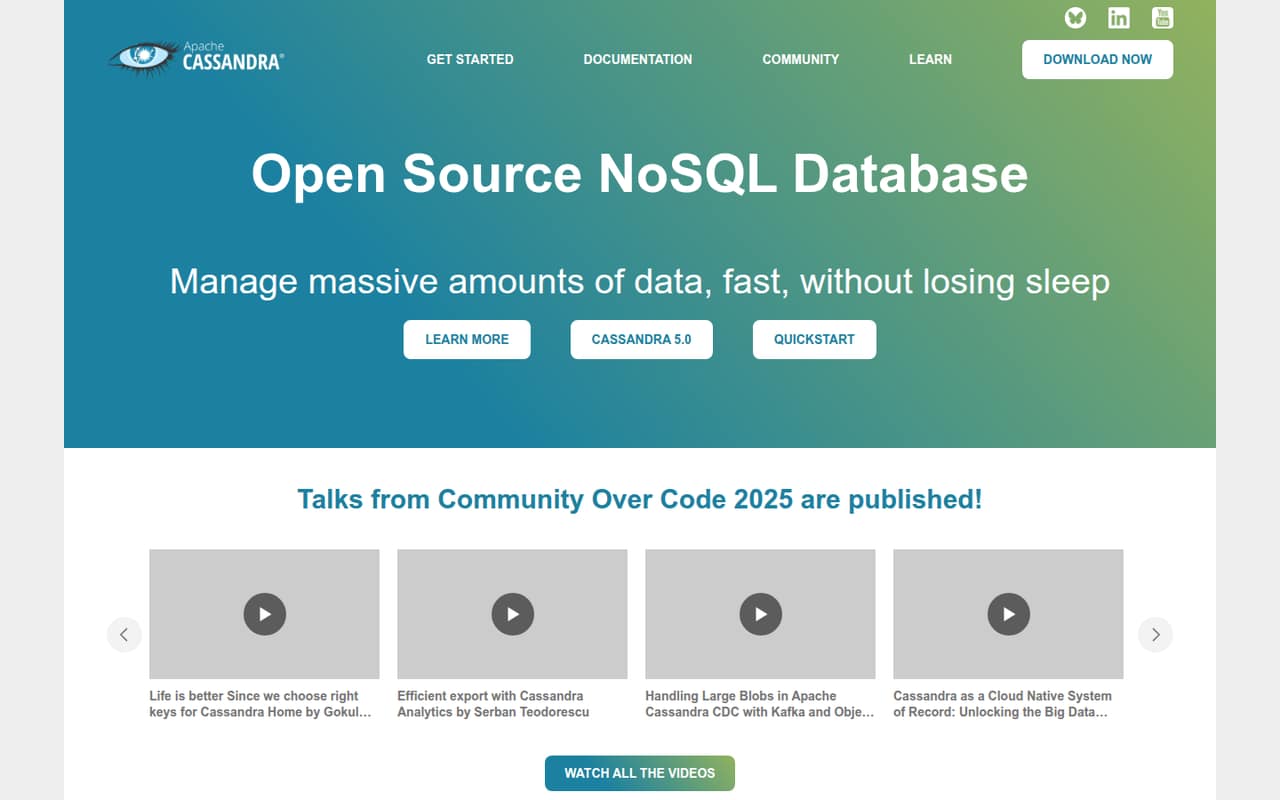
The homepage links to a Quickstart and community talks, including sessions on analytics, Kafka and object storage integration, Kubernetes operations, backups and CQL. These are useful starting points for evaluating the surrounding ecosystem, but they are not a substitute for confirming the integration details your application needs. The homepage does not name programming languages or SDKs; confirm supported language drivers, versions and connection options in Cassandra’s documentation before choosing a stack.
Operators should also check the CLI and administration workflow in the docs. The homepage identifies fqltool for capturing and replaying production workloads, and audit logging for tracking DML, DDL and DCL activity.
03Apache Cassandra pricing for developers
The self-hosted open-source option is free to download under Apache License 2.0. The pricing information lists no monthly or annual charge, free trial, add-ons or usage-based billing for the software. It also publishes no hosted plan price or included service limits.
Free software does not make a production cluster free to run. Your team pays for the compute, storage, networking and operational work needed for its deployment; those costs depend on your infrastructure and workload, and Cassandra’s pricing information does not quote them. There is no published Cassandra software bill that grows with requests, seats or usage, and no listed overage schedule. That is different from a managed database, where a provider may price service or capacity.
For a budget, estimate the cluster and data-center footprint you need, plus monitoring, backup, upgrades and on-call coverage. The project describes scaling by adding nodes, but does not publish a standard production configuration or infrastructure cost. Ask any prospective managed-service provider for its pricing, limits and support terms separately.
04Apache Cassandra: open source, self-hosting and lock-in
Cassandra is open source and available to self-host under the Apache License 2.0. Teams can run it on commodity hardware, cloud infrastructure or on-premises deployments. The Apache Software Foundation owns the project; a Reddit commenter describes it as deliberately vendor-neutral, with contributions from multiple organizations.
The homepage includes a community talk about efficient export with Cassandra Analytics, but does not define a general export format or a complete migration procedure. Before adoption, confirm how you will extract data, preserve schemas and move query-dependent application logic. Leaving Cassandra is not just a server switch: applications use its data model and query patterns, so migration planning should include both data conversion and application changes. Self-hosting gives teams control of their deployment, but it also leaves operations and upgrade work with them.
05Apache Cassandra in production
Cassandra’s published production story centers on replication, node replacement and scaling without application downtime. The project says clusters can replicate across data centers and describes withstanding a data-center outage; treat the replication behavior and recovery guarantees as configuration choices to validate against your own failure requirements. Its audit logging tracks DML, DDL and DCL activity, while fqltool can capture and replay workloads for analysis.
Plan operational testing for outages, capacity changes, backups, upgrades and data recovery. A commenter in a Reddit storage discussion said a replicated deployment needs at least three servers and that long-term retention still needs ongoing maintenance or a separate disaster-recovery plan. In another thread, a Cassandra operator called managing clusters “Annoying work even with all the tooling I've built up.” Those are individual reports, but they underline the operations burden.
The homepage does not publish service-level guarantees, compliance certifications or a universal cluster limit. Verify these requirements, plus driver compatibility and recovery procedures, before production.
From the threadsWhat users say
Reddit sentiment is broadly favorable to Cassandra’s maturity and user base, with operators also emphasizing the work of running clusters. Some comments compare it with alternatives, but they do not establish a universal winner.
The testing and quality story is remarkably better, so feature velocity is ramping up again
Datastax is not in control of Cassandra, the IP is owned by the Apache Software Foundation deliberately setup to be vendor neutral
Annoying work even with all the tooling I've built up
If you need this data around for 10 years, you either need to be constantly maintaining it or have another DR solution attached to it
Questions people ask
Why do teams use Apache Cassandra?
Teams use Cassandra for large active datasets that need high availability, scale-out capacity and replication across data centers. Its masterless design avoids a single point of failure. It is most suitable when the application and operations teams can accommodate a distributed database’s design and management requirements.
Does Apache Cassandra support multi-data-center deployments?
Yes. Cassandra supports replication across multiple data centers. The project says this can help an application withstand regional outages, but the outcome depends on the deployment and replication configuration. Validate consistency, failover and recovery behavior against your own availability requirements.
How much does Apache Cassandra cost?
The self-hosted open-source software is free to download under Apache License 2.0. Cassandra publishes no monthly or annual software charge in the listed pricing. You still pay for infrastructure and operations, and those costs vary by deployment. The project does not list managed-service pricing.
Can I run Apache Cassandra on my own infrastructure?
Yes. Cassandra is open source and can be self-hosted on commodity hardware, cloud infrastructure or on-premises deployments. Self-hosting means your team is responsible for operating the cluster, including capacity planning, upgrades, monitoring and recovery.
What should I check before using Cassandra in production?
Confirm language-driver support and versions in the documentation, then test your data model, replication settings, outage recovery, backups and scaling procedure. Also budget for the infrastructure and operator time your deployment requires. The project does not publish a universal production configuration or service-level guarantee.