
We may earn a commission if you buy through links on this page. It never changes a score or a ranking. How we make money
The bottom line
A persistent-agent development environment with flexible runners and pricing to check before scaling.
Amp is a development environment built around agents that run in orbs. Agents can continue working after you close your laptop, and you can share threads with teammates, monitor production and start previews in Portals.
Hobby is free and includes unlimited self-hosted orbs; Individual costs $20 per month and includes 45,000 minutes of Amp-hosted orb time. Before relying on Amp in production, confirm hosted usage costs, quotas and the data-export path with the vendor.
Good fit if
- Developers who want persistent agents
- Teams sharing agent threads and workflows
- Projects using their own runners
Skip it if
- Teams requiring a published API contract
- Organizations needing documented export terms
- Projects needing predictable hosted compute rates
ScoresHow it rates
What works
- Agents can keep working after you close your laptop
- Run agents in Amp-hosted or self-hosted orbs
- Hobby includes all product features
- Individual includes 45,000 hosted orb minutes
- Teams includes shared workflows and SAML/OIDC SSO
What doesn't
- Rate for pay-as-you-go hosted orb time is not published
- No published annual price for Individual
- Source licence and data-export terms are unclear
- Enterprise pricing is custom
- API, SDK and language support need confirmation
01What Amp is, technically
Amp is a development environment in which AI agents run in orbs. Its main architectural distinction is that agents can continue working after you close your laptop, with Amp-hosted orbs or self-hosted orbs as execution environments. The product sits alongside your codebase as an agent workspace, rather than being described as a library or a self-hosted Amp server.
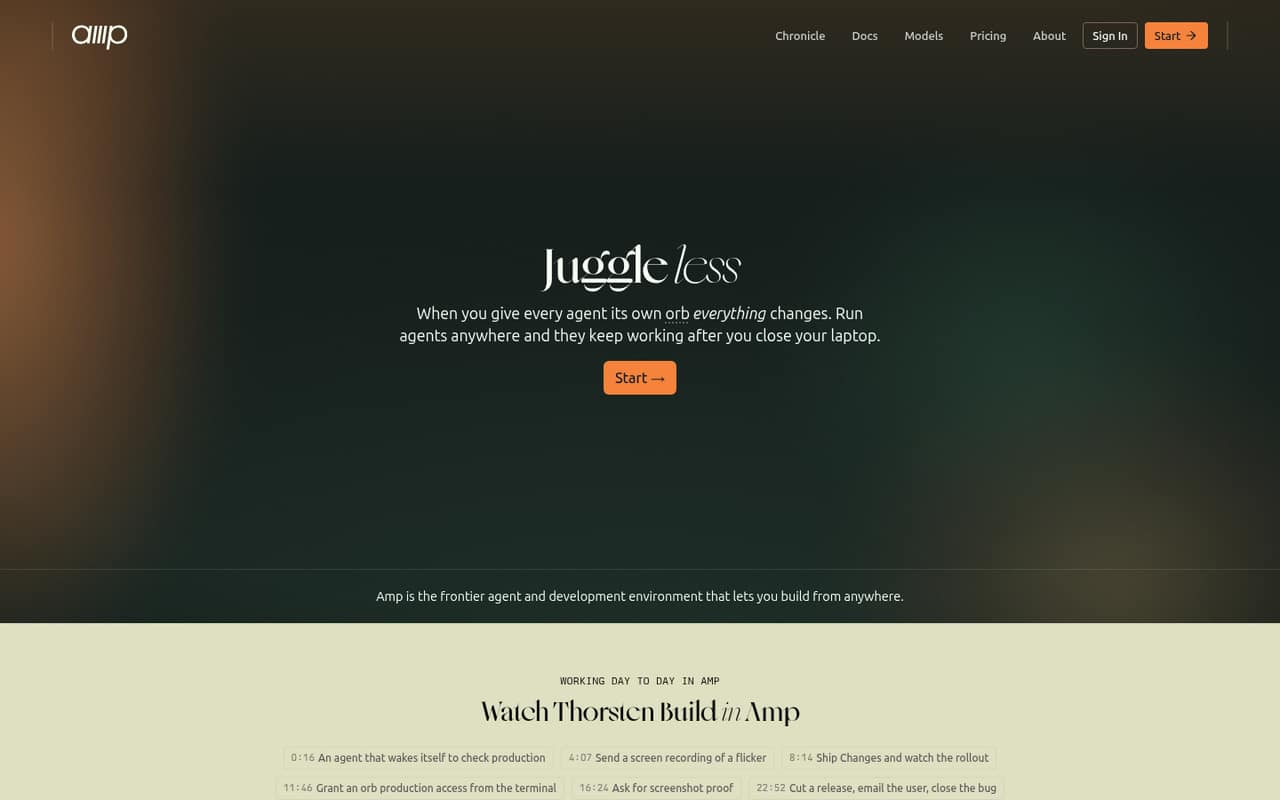
The problem it targets is coordinating coding work that outlasts a local interactive session. Agents can work on changes, run tests, start a development preview in a Portal, and check rollouts. You can share agents and threads with teammates; Amp also describes agents that wake up to check production. A video on the homepage shows a workflow involving terminal access, production monitoring and Slack through MCP, but those examples do not establish a general API contract. The practical fit depends on whether your team wants persistent agent execution and can work with Amp’s orb model.
02Amp API, SDKs and docs
Amp’s integration surface is its development environment, orbs, terminal workflows and Portals. The homepage shows amp clone for cloning an Amp-hosted project, and its workflow video shows granting an orb production access from a terminal. It also demonstrates Slack interaction through MCP. That is useful context for agent-driven work, but it is not a documented REST API, webhook interface or SDK contract.
The vendor’s homepage does not name supported programming languages, SDKs or a public API. Check Amp’s docs for current language support and integration options before planning an implementation around them. The homepage links to Chronicle, Docs and Models, and shows agents handling code changes, tests, rollout checks and production monitoring. These product workflows may fit an existing development process, but teams should confirm how they connect their own repositories, tools and credentials. Do not treat the amp clone command or the MCP example as evidence of a broader CLI or integration surface than the vendor documents.
03Amp pricing for developers
Hobby costs $0 per month and includes all product features, unlimited self-hosted orbs, use of your own tokens and keys, and pay-as-you-go Amp-hosted orbs. The hosted-orb rate is not published, so the free plan does not make hosted compute free. Individual costs $20 per month and includes all features, unlimited self-hosted orbs, unlimited public and private repositories, and 45,000 minutes of Amp-hosted orb time. The pricing page lists no annual price or billing option.
Teams has no extra charge and adds thread sharing, multiplayer, permissions, shared portals, plugins and skills, shared billing with pooled credits, and SAML/OIDC SSO. Enterprise uses custom terms, pooled credits only and no paid user seats; it adds SCIM, audit logs, network/MCP access controls, higher quotas and rate limits, and priority support. The pricing page does not state what happens when Individual’s included minutes run out or publish the hosted-orb pay-as-you-go rate. Ask about those costs, quota ceilings and rate limits before budgeting for production.
04Amp: open source, self-hosting and lock-in
Amp’s pricing includes unlimited self-hosted orbs on Hobby and Individual, and Hobby lets you use your own tokens and keys. That gives developers a way to run agent workloads on their own runners, but it is not the same as self-hosting the Amp development environment or service.
Amp does not publish its source licence or data-export terms. The homepage does not describe a full self-hosted server or a migration process for moving agent threads and workflows to another system. Before adopting Amp for long-running work, ask what data can be exported, in what format, and whether repository state, prompts and thread history can be transferred. You can reduce dependence on Amp-hosted compute by using self-hosted orbs, but that alone does not remove dependence on the Amp product or establish portability of its workflows.
05Amp in production
Amp describes agents that can wake up to check production, monitor rollouts, run tests and ship changes. The homepage also shows granting an orb production access and using OIDC in an example workflow. Enterprise adds audit logs, network/MCP access controls, SCIM user directory sync, higher resource quotas and rate limits, and priority support. These controls may matter when agents need access to production systems; confirm their exact scope and configuration with the vendor.
The pricing page does not publish specific quota or rate-limit values, nor does it give a hosted-orb rate for pay-as-you-go usage. Ask how included minutes are counted, what occurs at quota limits, and what reliability commitments apply to hosted orbs. For any agent that can change production, verify credential scope, revocation, audit coverage, approval steps and rollback procedures before granting access. Amp’s workflow examples show possible uses, not a guarantee of uptime or safe changes.
Questions people ask
What is Amp AI?
Amp is an AI development environment built around agents that run in orbs. Agents can continue working after you close your laptop, and can be shared with teammates. Amp also describes workflows for testing changes, previewing them in Portals and checking production rollouts.
How much does Amp cost?
Hobby is free. Individual costs $20 per month and includes 45,000 minutes of Amp-hosted orb time. Teams has no extra charge, while Enterprise uses custom terms. Hobby offers pay-as-you-go Amp-hosted orb time, but the rate is not published.
Can I use Amp without paying?
Yes. Hobby costs $0 per month and includes all product features, unlimited self-hosted orbs and use of your own tokens and keys. Amp-hosted orbs are pay-as-you-go on Hobby, so check the rate with the vendor before using them at scale.
Can I run Amp agents on my own infrastructure?
Amp’s Hobby and Individual plans include unlimited self-hosted orbs. That means you can use your own orb runners, but it does not establish that the Amp service itself can be self-hosted. Confirm runner requirements and supported deployment options in Amp’s docs.
Is Amp ready for production workflows?
Amp describes agents that can check production and monitor rollouts, and Enterprise includes audit logs and network/MCP access controls. Before granting production access, confirm the relevant security controls, quotas, rate limits and reliability commitments with the vendor.