
We may earn a commission if you buy through links on this page. It never changes a score or a ranking. How we make money
The bottom line
Aiven takes care of data-service operations, but production costs and migration details need careful review.
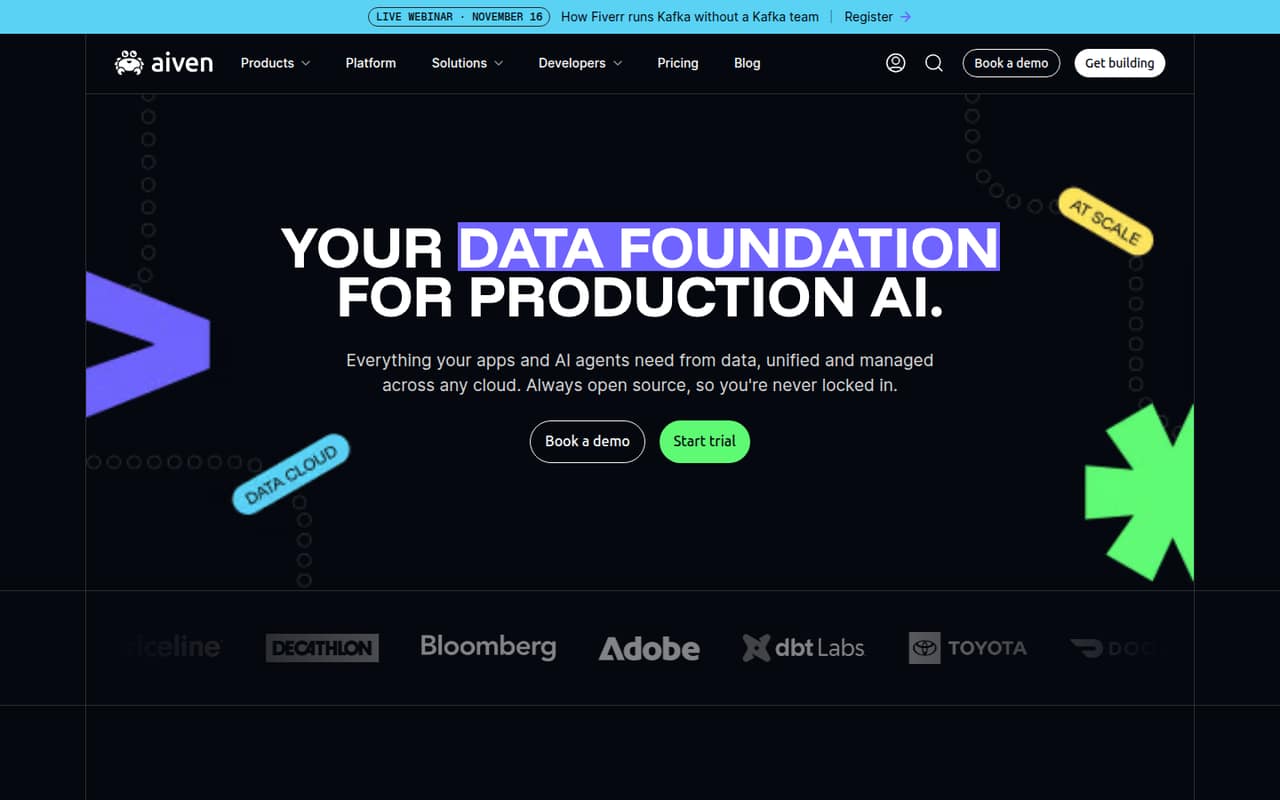
Aiven is a hosted control plane for managed open-source databases, streaming, analytics and search services across cloud providers. It handles operations such as backups, security patching, upgrades and scaling, while applications connect through standard APIs, drivers and clients.
Its portability story is useful, but it is not a blanket guarantee of a cheap or simple exit: confirm service-specific export and migration paths, and price the exact deployment. Reddit commenters report that Aiven was not cheaper than their existing Kafka options.
Good fit if
- Teams avoiding database operations
- Multi-cloud data-service deployments
- Prototypes using managed open-source tools
Skip it if
- Teams requiring self-hosted control planes
- Projects needing a fixed all-in price
- Buyers choosing solely on low cost
ScoresHow it rates
What works
- Manages backups, patching, upgrades and scaling
- Runs services across supported cloud providers
- Offers upstream open-source data technologies
- Free and low-cost development plans
- BYOC supports specific residency or cost needs
What doesn't
- Production plans start at $75 per month
- Additional services are billed independently by the hour
- Some add-on and support prices are unpublished
- Aiven control-plane licensing is not stated
- Reddit commenters report limited cost savings
01What Aiven is, technically
Aiven is a hosted management platform for running open-source data services. It sits between your application stack and the cloud infrastructure: you select services such as PostgreSQL, Apache Kafka, ClickHouse, OpenSearch, Valkey or MySQL, and Aiven manages the underlying service operations. The vendor says it handles backups, security patching, version upgrades and scaling.
Applications connect to those services using standard APIs, drivers and clients, rather than through a new data-access layer that replaces their database clients. Aiven's control plane spans AWS, Google Cloud, Azure and other supported providers; BYOC is available for teams that need to use their own cloud account. The product also includes Aiven for DataHub for data context and governance, and Aiven Runtime for deploying applications and agents alongside data services. This is infrastructure for teams building applications and data systems, not a database library or a self-hosted server you install in your codebase.
02Aiven API, SDKs and docs
The main integration surface is the data service itself: Aiven says its services use standard APIs, drivers and clients, and its homepage lists technologies including PostgreSQL, Apache Kafka, MySQL, ClickHouse, OpenSearch and Valkey. That lets application teams work with familiar service clients instead of adopting a single Aiven-specific data interface. The homepage also describes deploying services through a control plane and says popular technologies can be deployed in a few clicks.
The homepage does not name programming-language SDKs, a CLI, or specific API protocols for managing projects and services. Confirm SDK support, management API details and command-line options in Aiven's documentation before standardizing automation around them. The same check applies to service-specific integrations: the right driver and compatibility details depend on the database or streaming service you choose. For production, validate connection settings, supported versions and any pooling or integration requirements against the selected plan; the Free and Developer plans list no integrations or connection pooling.
03Aiven pricing for developers
Aiven has a Free plan at $0 per month: one dedicated VM with 1 CPU, 1 GB RAM and 1 GB total storage. It has no cloud or region selection, integrations or connection pooling. Developer costs $5 monthly and keeps the same VM size, with 8 GB total storage and the same listed restrictions. These tiers suit learning and development, not a production deployment with service integrations or pooling.
Production pricing starts at $75 monthly for Startup, which lists one VM, 2–32 CPUs, 4–192 GB RAM, 80 GB–11 TB of storage and a 99.99% uptime SLA. Business starts at $180 for two VMs and high availability; Premium starts at $270 for three VMs and a second standby node. Services are charged hourly and invoiced monthly, so adding services or selecting larger configurations raises the bill. Extra storage and dynamic disk sizing cost extra on Startup, Business and Premium. Additional support is separately charged, with prices not published; BYOC also adds a service fee, while cloud infrastructure is billed separately.
04Aiven: open source, self-hosting and lock-in
Aiven describes its data services as open source and says they use open standards and formats. That makes the database or streaming technology less tied to a proprietary client than a service built around a unique data interface. The homepage does not state the licences for each service or the licensing terms for Aiven's management control plane, so check both before making licence compliance part of an architecture decision.
Aiven offers BYOC, which lets customers use their own cloud environment, but that is not the same as self-hosting Aiven's control plane. The vendor says data, apps and teams stay portable and that customers could leave; it does not publish service-specific export procedures or migration guarantees on the homepage. Ask for the export format, network and egress costs, and a tested migration plan for each service. Standard APIs and clients can reduce application changes, but they do not by themselves move stored data or preserve every operational setting.
05Aiven in production
Aiven takes on routine service operations, and its plans distinguish between single-VM deployments, high availability and a Premium second standby node. Startup lists a 99.99% uptime SLA; Business lists high availability. The homepage says Aiven supports infrastructure compliant with SOC 2 Type II, ISO 27001, GDPR and HIPAA, and offers BYOC for data residency, compliance or cost requirements. Confirm which claims and service configurations apply to your chosen region and plan.
The pricing details do not publish rate limits, service-specific capacity ceilings or support response times. Ask Aiven how scaling works for the service you plan to run, what happens at capacity, and how maintenance and backups affect your recovery objectives. Reddit feedback is mixed on cost: one commenter said Aiven would cost the same or more than their existing Kafka provider, while another said they could not justify its price for Kafka, Elasticsearch and ClickHouse. Treat those as individual comparisons, not a general pricing result.
From the threadsWhat users say
The available Reddit comments raise price concerns, especially when comparing Aiven with established data-service providers. They offer little direct feedback on day-to-day reliability or support, so buyer sentiment is mixed rather than conclusive.
we would be paying the same amount if not more on Aiven
We just couldn't justify the price given that the companies behind these technologies offer a cloud solution
Confluent is apparently the biggest vendor, and also the most expensive one
Would appreciate their perspective on how big a pain the migration is + the cost savings by switching providers
Questions people ask
What is Aiven used for?
Aiven manages open-source data services such as PostgreSQL, Apache Kafka, ClickHouse, OpenSearch, Valkey and MySQL across cloud providers. It handles operations including backups, security patching, version upgrades and scaling, so engineering teams do not have to operate each service's underlying infrastructure themselves.
Can I use Aiven with my existing application?
Aiven says its services use standard APIs, drivers and clients, so an application can connect through the client surface for its selected database or streaming service. Check the service's supported versions, connection requirements and drivers in Aiven's documentation before changing a production stack.
Is Aiven suitable for production?
Aiven offers production-oriented plans, including Startup with a listed 99.99% uptime SLA, Business with high availability, and Premium with a second standby node. Confirm service-specific capacity, recovery objectives, support terms and applicable compliance coverage with Aiven before relying on it.
Can I run Aiven in my own cloud account?
Aiven offers BYOC for teams that need their own cloud environment. The pricing details list a separate Aiven service fee, with underlying infrastructure billed by the cloud provider. BYOC is not the same as self-hosting Aiven's control plane; confirm deployment and operational responsibilities with the vendor.
Can I leave Aiven without changing my application?
Aiven says its open-source services use open standards and formats, and standard APIs, drivers and clients can help keep application integrations portable. Moving data and operational settings still takes planning. Ask Aiven for export formats, migration procedures and any associated costs for the specific service you run.