
We may earn a commission if you buy through links on this page. It never changes a score or a ranking. How we make money
The bottom line
A flexible data replication platform with a strong connector catalog and production risks to investigate.
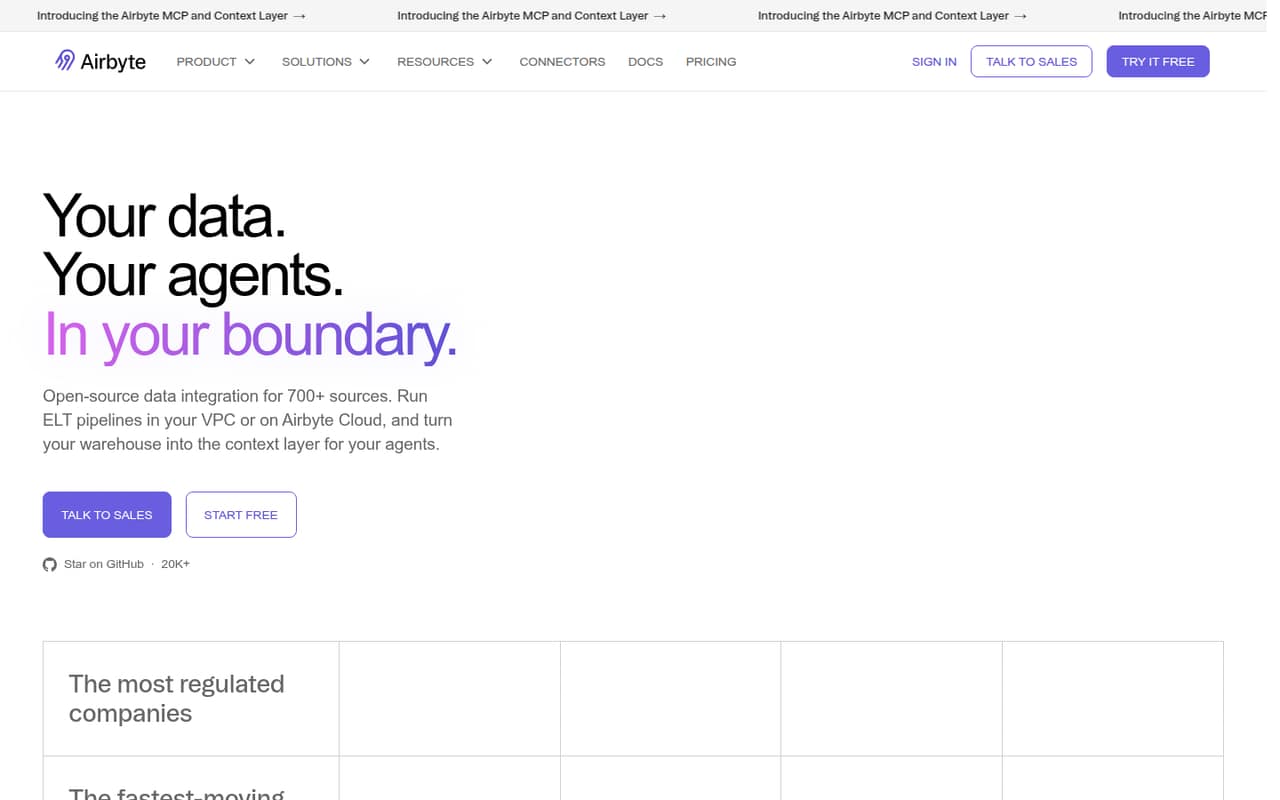
Airbyte is a data integration platform for replicating data between systems. Its 700+ connectors, self-hosted Core, managed Cloud and Hybrid deployment options give teams room to choose where pipelines run. The MCP and Context Layer also targets warehouse access for AI agents.
The trade-off is operational uncertainty: usage-based costs can climb, and Reddit users report bugs and poor support. We’d assess connector fit, API requirements, workload pricing and failure handling before putting critical pipelines on it.
Good fit if
- Teams connecting many data sources
- Organizations needing self-hosted pipelines
- Teams building warehouse-backed AI agents
Skip it if
- Teams requiring published API rate limits
- Projects needing guaranteed support response times
- Teams seeking fixed costs at any volume
ScoresHow it rates
What works
- 700+ connectors for sources and destinations
- Self-hosted, managed cloud and hybrid deployments
- Custom connectors can be built with Connector Builder
- Core pipelines can move to Cloud or Hybrid
- MCP Context Layer inherits access controls
What doesn't
- Standard and Plus costs rise with credit use
- Core usage limits are not published
- API and SDK details need verification
- Pro and Enterprise Flex require custom quotes
- Reddit users report bugs and poor support
01What Airbyte is, technically
Airbyte is a data integration platform that moves data from sources to destinations through a connector library. It sits between operational systems and destinations such as a data warehouse; it is a replication layer, not the warehouse itself. The homepage lists more than 700 connectors and a Connector Builder for custom connectors.
There are three deployment paths. Airbyte Core is an engine and connector set that teams run on their own infrastructure. Airbyte Cloud is managed, with MCP and the Context Layer built in. Hybrid keeps pipelines in your cloud, VPC or data center while Airbyte manages the control plane. The vendor says data does not leave your environment in Hybrid.
The MCP and Context Layer use a warehouse as context for agents, with inherited access controls. That makes Airbyte relevant to both conventional data loading and agent access to warehouse data. The right fit depends on connector coverage, deployment boundaries and the operational work your team can own.
02Airbyte API, SDKs and docs
The integration surface described by Airbyte is its connector library, the Connector Builder and the MCP and Context Layer. Connector Builder is for building and deploying custom connectors; the homepage does not name a programming language or SDK for that work. The docs should be the next stop for connector development requirements and supported source and destination behavior.
A Reddit user reports trying to connect through Airbyte’s API and encountering an OAuth-related server error. Before choosing an API-driven integration, confirm the API style, authentication flow, available SDKs and language support in Airbyte’s docs. The homepage promotes Docs and a connector catalog, but does not name a CLI or webhook integration surface.
For agent workflows, Airbyte presents MCP as the connection between warehouses and agents, with the Context Layer applying inherited access controls. For replication, start by checking whether the relevant connector supports the sync behavior and schema changes your pipeline needs. Treat connector availability as a starting point, not proof that a connector meets your production requirements.
03Airbyte pricing for developers
Airbyte Core is free to run on your own infrastructure under the Elastic License 2.0. Its usage limits are not published, and self-hosting means your team supplies and operates the infrastructure. For managed use, Standard starts at $20/month and includes 5 credits, about 1 GB, with a 1-hour minimum sync frequency. The 14-day trial includes 400 credits, about 100 GB.
Plus starts at $189/month with 40 credits, a 15-minute minimum sync frequency and two workspaces. Its listed credit packages range from 100 credits for $449/month to 2,000 for $4,999/month. Standard and Plus charge $5 per additional credit. API and custom-source usage is 6 credits per million rows; database and file usage is 4 credits per GB.
Pro uses custom capacity quotes priced through Data Workers, with a 5-minute minimum sync interval and flat pricing when volume spikes. Enterprise Flex also uses custom capacity pricing and supports deployment in a VPC, on-premises or across multiple regions. Seat limits are not published for Enterprise Flex. Standard and Plus annual prices are not published; confirm the bill model for your expected data volume before committing.
04Airbyte: open source, self-hosting and lock-in
Airbyte Core provides the engine and connectors for teams to run themselves. The pricing information identifies its license as Elastic License 2.0; read the license terms against your intended commercial use and deployment model. Airbyte also offers managed Cloud and Hybrid, so self-hosting is an option rather than a requirement.
The vendor says teams can move from Core to Cloud or Hybrid without rebuilding a pipeline. That can reduce lock-in between Airbyte deployment models, but it does not establish how easily connector configuration, sync state or custom connector code can move to another product. The vendor does not publish a data-export or migration-away workflow in the homepage information. Before adopting it, verify export formats for configuration and state, and test how your destination data and pipeline definitions would be preserved if you leave. Your source and destination systems remain separate parts of the stack; Airbyte is the integration layer between them.
05Airbyte in production
Production readiness depends on connector behavior, source API constraints, sync frequency and the failure modes your team can tolerate. Standard has a 1-hour minimum sync frequency, Plus 15 minutes and Pro 5 minutes. Airbyte does not publish API rate limits in the information available here; confirm limits and retry behavior for the specific connectors you plan to use. Also test schema changes, incremental loads, backfills and recovery from a failed sync before relying on a pipeline for an SLA.
The vendor says Hybrid keeps pipelines in your cloud, VPC or data center while Airbyte manages the control plane, and that data stays in your environment. Verify that boundary against your security and compliance requirements. The MCP and Context Layer inherits access controls, but that is not a substitute for reviewing your warehouse permissions and agent access paths.
Reddit reports are mixed. One user describes repeated self-hosted hangs that required a server reboot; another reports major Cloud bugs and poor support. These are individual accounts, not reliability measurements, but they make failure handling and support escalation worth checking before production rollout.
Questions people ask
What is Airbyte used for?
Airbyte replicates data from sources to destinations through its connector library. Teams use it to move data into systems such as warehouses, build custom connectors with Connector Builder, or provide warehouse context to AI agents through its MCP and Context Layer. It offers self-hosted, managed cloud and hybrid deployment options.
Is Airbyte similar to Airflow?
They serve different roles in a data stack. Airbyte moves data between sources and destinations through connectors. Airflow is a workflow orchestrator. Teams may use an orchestrator alongside a data integration tool, but Airbyte’s central job is replication rather than general workflow scheduling.
Does Airbyte use CDC?
CDC support depends on the connector and source. Airbyte’s general product information describes data replication and connectors, but does not establish CDC support for every source. Check the documentation for the specific connector, supported sync modes, database requirements and any limits before designing around change data capture.
Can I move from Airbyte Core to Cloud?
Airbyte says teams can move from Core to Cloud or Hybrid without rebuilding a pipeline. That describes movement between Airbyte deployment options, not migration to another platform. Check what happens to custom connector code, configuration and sync state during the transition.
Where does Airbyte Hybrid run my pipelines?
With Hybrid, pipelines run in your cloud, VPC or data center while Airbyte manages the control plane. Airbyte says data stays in your environment. Confirm the exact control-plane and data-plane boundaries with the vendor against your security, network and compliance requirements.
Sources
- Airbyte homepage
- Airbyte pricing, compiled via web search from airbyte.com, checkthat.ai, datastackindex.com, getorchestra.io, integrate.io
- Reddit: Any alternative to Airbyte?
- Reddit: Replace Airbyte with dlt
- Reddit: Airbyte vs Fivetran for our ELT stack? Any other alternatives?
- Reddit: Airbyte and similar EL tools