
We may earn a commission if you buy through links on this page. It never changes a score or a ranking. How we make money
The bottom line
A free, self-hosted agent framework; budget for the infrastructure and integration work you own.
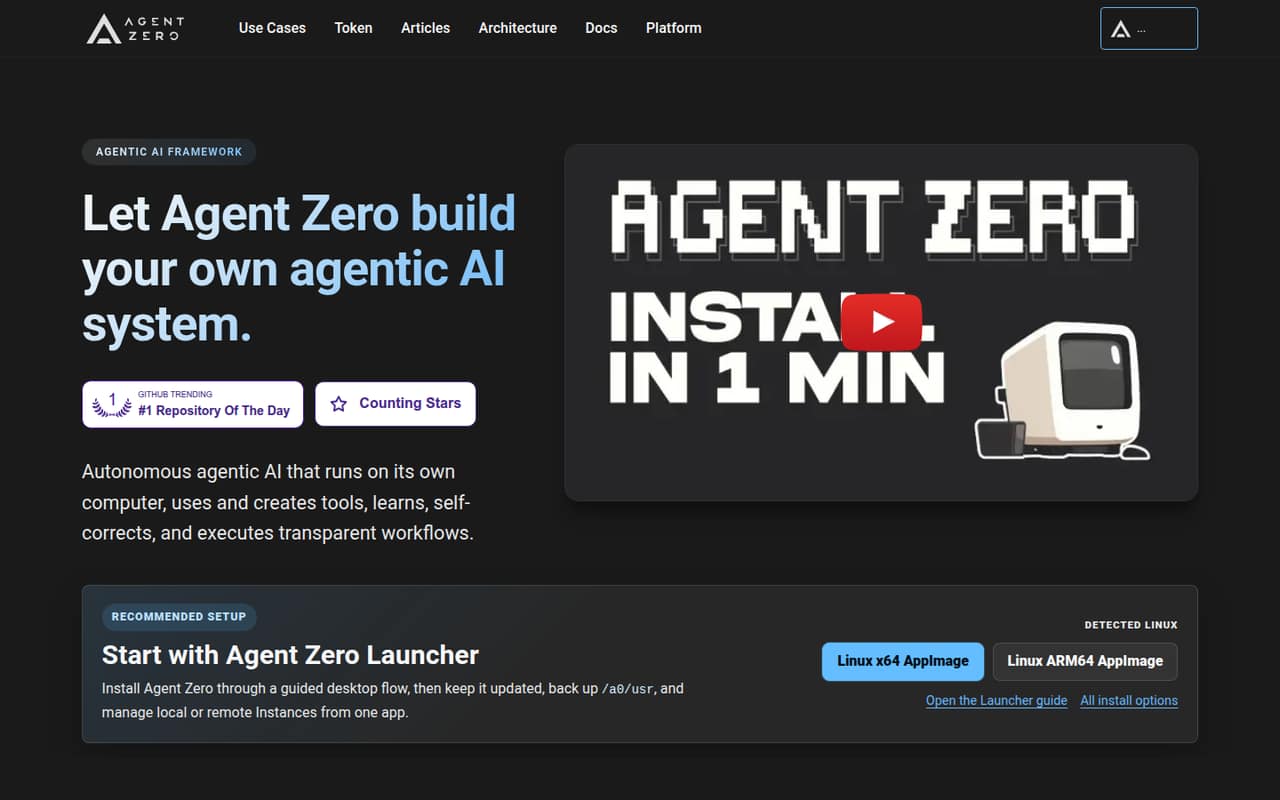
Agent Zero is an open-source framework for running autonomous agents on your own computer or managed infrastructure. Its Launcher manages local or remote instances, while the A0 CLI Connector links a Docker-sandboxed instance to local files, a terminal, and a browser.
The $0/month MIT option is strong value, but the vendor does not publish paid billing terms, usage limits, or detailed API and SDK information. We recommend it for teams comfortable operating the runtime and checking integration details before committing.
Good fit if
- Teams self-hosting agent runtimes
- Developers experimenting with local models
- Projects needing custom agent tools
Skip it if
- Teams expecting a managed SaaS
- Projects requiring documented SDKs upfront
- Operators needing published service guarantees
ScoresHow it rates
What works
- Open-source framework under the MIT license
- Free self-hosted option with no caps stated
- Launcher manages local and remote instances
- CLI Connector links Docker to local files
- Plugin Hub manages community plugins in the UI
What doesn't
- Vendor publishes no paid-plan or billing terms
- No language-specific SDK is named on the homepage
- API protocol and request details need verification
- Self-hosting leaves infrastructure operations to you
- Usage limits and service guarantees are not published
01What Agent Zero is, technically
Agent Zero is an open-source agent framework you run on your own computer or infrastructure you manage; it is not presented as a hosted SaaS agent API. It provides an environment where agents can execute workflows, use and create tools, and self-correct. In a stack, it sits between an AI model provider and the tools, files, browser, and workflows an agent needs to operate. The vendor says it can connect to AI providers and stay lightweight with local models.
The recommended path is Agent Zero Launcher: a desktop installer that manages local or remote instances, updates, and backups of /a0/usr. The A0 CLI Connector keeps Agent Zero sandboxed in Docker while connecting it to a local terminal, project files, and browser. That makes it a fit for teams that want to own the agent runtime and deployment boundary. It also means teams take responsibility for infrastructure and provider configuration.
02Agent Zero API, SDKs and docs
Agent Zero is integrated primarily as a running framework, not a documented language-specific library. The vendor lists an LLM API and API Dashboard, but the homepage gives no protocol or request details. No programming language or SDK is named; confirm SDK support in the vendor's docs before designing around a language binding.
The integration surfaces the vendor names are the A0 CLI Connector for local terminal, project files, and browser access; community plugins managed through Plugin Hub; and MCP-powered data pipelines. Installation docs, GitHub Docs, and DeepWiki are linked, and the Launcher guide is the recommended installation route. The vendor also says Agent Zero can connect to AI providers and run with local models. Check the docs for request examples, authentication, supported transports, versioning, and plugin compatibility before building a production integration.
03Agent Zero pricing for developers
The open-source self-hosted option costs $0 per month under the MIT license. The pricing information lists no usage caps, but that is not a published guarantee of unlimited compute, model capacity, or throughput. The vendor publishes no paid plans, billing terms, overage rates, seat prices, or compute allowances.
Agent Zero’s framework price is only one part of a deployment budget. You still need to plan for the infrastructure you operate and any model-provider costs associated with your chosen setup; the vendor’s published pricing does not provide rates for those expenses. With local models, you manage the machine running them. With a remote provider, check that provider’s pricing and limits separately. Before production, ask the vendor whether any usage, support, or hosted-instance charges apply, and set your own infrastructure and provider budgets.
04Agent Zero: open source, self-hosting and lock-in
Agent Zero is described as open source and free under the MIT license, with a self-hosted deployment option. Its Launcher manages local or remote instances and supports backups of /a0/usr. The A0 CLI Connector runs Agent Zero in Docker while connecting it to local files, a terminal, and a browser.
Self-hosting gives teams control over where they run the framework, but the vendor does not publish a data-export format or a migration guide. Ask how to back up and restore prompts, agent state, and plugin configuration before relying on them. The Launcher’s /a0/usr backup is a concrete starting point, not a documented guarantee that every part of an installation is portable. Migration effort will depend on how much of your workflow uses custom tools, plugins, and provider-specific features.
05Agent Zero in production
The vendor does not publish service-level guarantees, concurrency limits, or rate limits for the framework in the available pricing details. In production, test the limits of your chosen model provider, the compute available to your instance, and the behavior of browser and file access. Plan how you will monitor agent actions, handle failed workflows, and control access to tools and project data.
Plugin Hub says it can run AI-driven security scans on community plugins, and the vendor’s v2.12 release notes describe security fixes across messaging plugins. Treat those as reasons to review plugin permissions and keep deployments updated, not as a substitute for your own security review. Reddit posts include claims about using Agent Zero with Ollama locally and broad claims about what it can automate; those are user-post claims, not production evidence. Validate reliability and security with your own workloads before depending on it.
From the threadsWhat users say
The Reddit tone is positive, but the available posts lean promotional and offer little detail about deployment failures or operational limits. We treat that as a weak user signal, not a representative measure of production experience.
This AI Agent can do basically everything - Agent Zero
AgentZero: FREE AI Super Agent Automates ANYTHING! 🤯
Agent Zero with Ollama: Run a Powerful AI Agent for Free Locally
FREE Agent Zero AI Agent Does EVERYTHING (Crazy Results)
Questions people ask
Is Agent Zero a hosted service?
Agent Zero is presented as an open-source framework that runs on your own computer or infrastructure you manage, rather than a hosted SaaS agent service. Its Launcher can manage local or remote instances. The vendor also lists an LLM API, but check the docs to understand how that service relates to the self-hosted framework.
How much does Agent Zero cost?
The open-source self-hosted option is listed at $0 per month under the MIT license. The vendor lists no paid plans or billing terms. That price does not account for the infrastructure you operate or any model-provider costs; check those separately when estimating a deployment budget.
Can Agent Zero use local AI models?
Yes. The vendor says Agent Zero can connect to AI providers and describes its context engineering as designed to stay efficient with local models. The homepage does not name specific model requirements or performance limits, so check the installation and provider docs for compatibility with your chosen model and hardware.
How do I connect Agent Zero to local files and tools?
The vendor’s A0 CLI Connector keeps Agent Zero sandboxed in Docker and connects it to a local terminal, project files, and browser. Agent Zero also has a Plugin Hub for community plugins. Check the connector and plugin docs for setup steps, permissions, and compatibility with your workflow.
Is Agent Zero ready for production?
That depends on your deployment, model provider, and workload. The vendor does not publish service-level guarantees or framework rate limits in its pricing details. Before production, validate workflow failure handling, provider limits, compute needs, file and browser access, and plugin security with your own requirements.
Sources
- Agent Zero homepage
- Agent Zero pricing, compiled via web search from promptquorum.com
- Reddit: This AI Agent can do basically everything - Agent Zero
- Reddit: AgentZero: FREE AI Super Agent Automates ANYTHING! 🤯
- Reddit: Agent Zero with Ollama: Run a Powerful AI Agent for Free Locally
- Reddit: FREE Agent Zero AI Agent Does EVERYTHING (Crazy Results)