
We may earn a commission if you buy through links on this page. It never changes a score or a ranking. How we make money
The bottom line
A searchable React component catalog with agent, CLI and MCP install paths—not a runtime UI service.
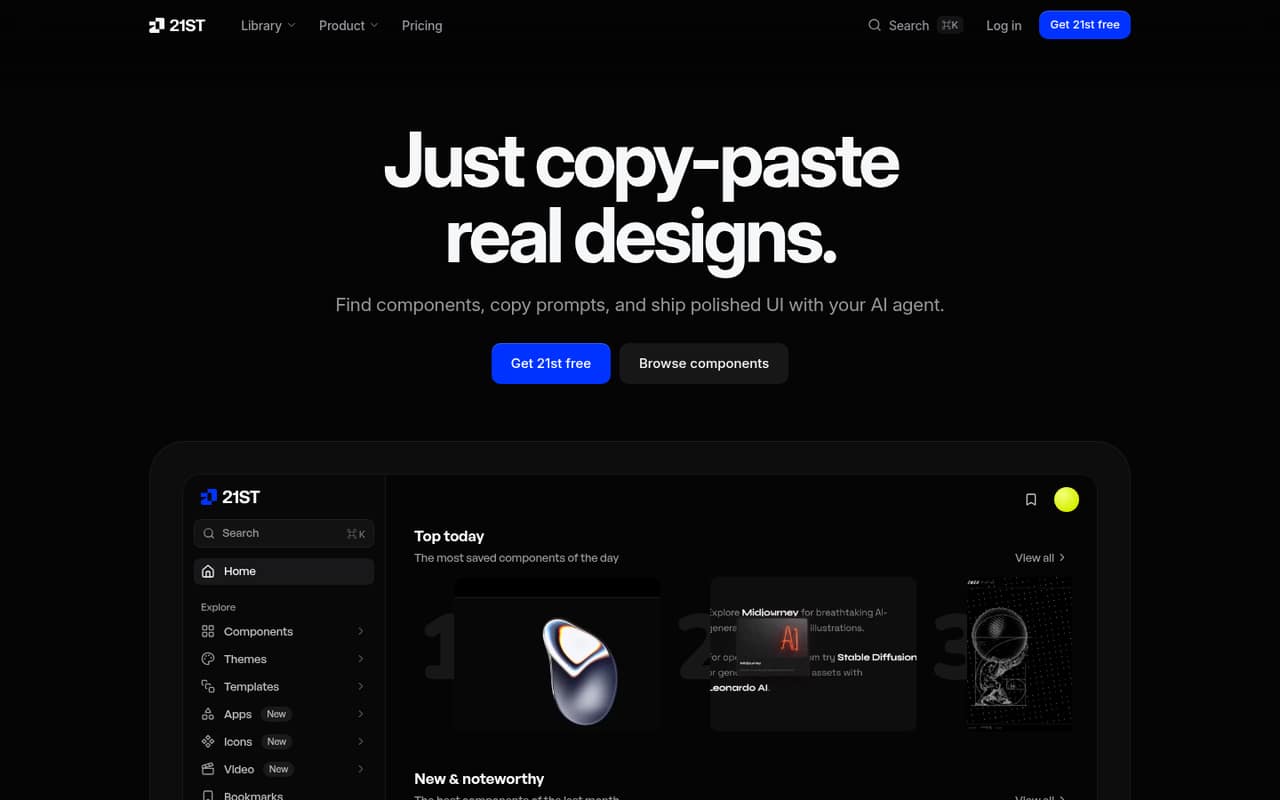
21st.dev is a hosted catalog of copy-ready UI components, prompts, themes, templates, icons and shaders. Components use React, TypeScript, Tailwind CSS and shadcn conventions; developers can paste prompts into coding agents or install source into a project with the CLI or shadcn command.
The free plan allows two component copies a day and five Design Bug Bot reviews. Builder starts at $6 per month billed yearly, or $8 month to month. The trade-off is straightforward: useful discovery and install tooling, but the vendor does not present it as a general-purpose API or self-hosted service.
Good fit if
- React teams using AI coding agents
- Developers collecting reusable UI patterns
- Teams that want source in their repo
Skip it if
- Non-React application stacks
- Teams requiring a self-hosted catalog
- Projects needing a documented runtime API
ScoresHow it rates
What works
- Components land in your repository as editable source
- Works with Claude Code, Cursor, Codex and Lovable
- CLI, MCP and shadcn command install paths
- Includes templates, themes, icons and shaders
- Free plan needs no card
What doesn't
- Free copies are capped at two per day
- Components target React, TypeScript and Tailwind CSS
- No public runtime API is described
- License and self-hosting terms are not identified
- Uptime, request limits and compliance details are not published
01What 21st.dev is, technically
21st.dev is a hosted catalog and workflow for discovering UI source, not a runtime component API or a server you deploy. Its library contains components from multiple authors, along with prompts, templates, themes, icons and shaders. The core use case is to find a design, then move its source or instructions into an existing project.
In a typical stack, the catalog sits outside the application. A developer browses the site, copies a prompt into an AI coding agent, or uses the CLI, MCP or a shadcn command to install component source. The resulting code lives in the project repository and can be edited with the rest of the UI. The homepage describes components as React and TypeScript with Tailwind CSS, following shadcn conventions, and says they run anywhere React runs, including Next.js, Vite, Remix and Astro. That makes 21st.dev a design and code-discovery layer for React teams, rather than a dependency that must serve every production page.
0221st.dev API, SDKs and docs
The homepage describes an integration surface built around a hosted library, prompts, MCP and a terminal CLI—not a general REST API or application SDK. It names React, TypeScript and Tailwind CSS for component code, and says components use the shadcn registry format. The site also gives a shadcn CLI command for each component and shows a terminal example: npx 21st add hero hero.tsx.
For agent workflows, the site says to copy a prompt into Claude Code, Cursor, Codex or Lovable. It also advertises access through supported MCP clients, but does not name a protocol version or client compatibility matrix in the homepage text. No SDK languages beyond the component stack are named. Confirm SDK support, MCP setup, CLI options and required versions in the vendor's documentation before standardizing the workflow. There is no API authentication model, endpoint reference or webhook integration described on the homepage, so teams looking for those surfaces should confirm availability with the vendor.
0321st.dev pricing for developers
The free plan costs $0, requires no card, and includes library search, two component copies or install commands a day, and five Design Bug Bot reviews. That daily copy limit is the point where regular use can require an upgrade. Builder costs $8 per month, or $6 per month billed yearly, for unlimited copies and installs, MCP and CLI access, and additional design assets.
Builder + AI costs $20 monthly or $15 per month billed yearly. It includes Builder features and 500, 1,000 or 2,000 AI credits a month; the selected credit amount affects the plan. Team costs $10 per user monthly or $7.50 per user billed yearly for 2–50 seats. Team + AI is listed at $18.75 per user per month billed yearly, with monthly pricing not listed. AI credit packs cost $5 per 100 credits and roll over month to month; automatic top-up is available with a customer-set monthly cap. The pricing page does not list request-based charges or compute fees. Model credit use and team seat count are the main bill variables.
0421st.dev: open source, self-hosting and lock-in
The homepage says component source lands in your repository and is yours to edit. That lowers lock-in at the application-code level: installed components can be maintained as project files rather than served from 21st.dev at runtime. The vendor does not identify an open-source license for the catalog or its service in the stated materials, so check the license attached to each component before redistributing or using it commercially.
21st.dev is presented as a hosted catalog, not a self-hosted server or package you can run in your own infrastructure. The vendor does not describe a data-export process for bookmarks, collections or other account data. If you leave, your installed source remains in your repo, but saved library organization and access to the hosted catalog may not. Ask the vendor about account-data export and component licensing if those affect a production workflow.
0521st.dev in production
The main production advantage is that the delivered component source is editable in your repository. That keeps the rendered UI under your application's build and deployment path, rather than adding a hosted runtime dependency. The main operational limit is on the service side: free users get two copies or install commands a day, while paid Builder plans remove that cap. AI plans meter generation and Design Bug Bot work through credits.
The vendor does not publish API request limits, uptime commitments or security and compliance details in the stated materials. Confirm those points, along with component licensing and MCP client support, before making the catalog a team dependency. Reddit sentiment reflects the free-tier change: one r/vibecoding thread complains that the allowance fell to two daily copies, while replies argue that creators should be paid. A separate r/webdev discussion values 21st.dev as a source of varied, copyable components. Treat those comments as individual reports, not reliability data.
From the threadsWhat users say
Reddit reactions are mixed: developers value the range of ready-made components, while some object to the free-tier cap. Replies also push back on the expectation that a useful library should remain free.
they are a good source to use when i am making projects but i love the freedom to have various sources to pick from
if you dont pay 8 bucks a month, you get stuck to just copying 2 prompts or 2 codes per day
Are you asking why people deserve to be paid for their work?
Thanks but im looking for websites with already built UI components and i can just copy and paste them like with 21st.dev
Questions people ask
What does 21st.dev do?
21st.dev is a hosted library for finding copy-ready UI components, prompts, templates, themes, icons and shaders. Developers can paste prompts into supported AI coding agents or use MCP, the CLI or a shadcn command to bring component source into a project. Components follow React, TypeScript, Tailwind CSS and shadcn conventions.
Is 21st.dev free?
Yes. The free plan includes browsing and searching the library, two component copies or install commands per day, and five Design Bug Bot reviews. No card is required. The Builder plan removes the copy limit and costs $8 monthly or $6 per month billed yearly.
Which frameworks and coding agents does 21st.dev support?
The component stack is React and TypeScript with Tailwind CSS and shadcn conventions. The vendor says components run in Next.js, Vite, Remix and Astro. Its homepage names Claude Code, Cursor, Codex and Lovable for prompt-based workflows, and advertises MCP and CLI access.
Does 21st.dev provide an API or SDK?
The homepage describes MCP, CLI and shadcn command workflows, but does not present a general REST API or name an SDK. It gives React, TypeScript and Tailwind CSS as the component technologies. Confirm available API endpoints, SDKs, authentication and client support in the vendor's documentation before planning an integration.
Can I use 21st.dev components in a commercial project?
The vendor says component source lands in your repository and is yours to edit. The homepage does not identify a license for the catalog or each component. Check the license attached to the specific component and confirm redistribution and commercial-use terms before shipping it in a paid product.